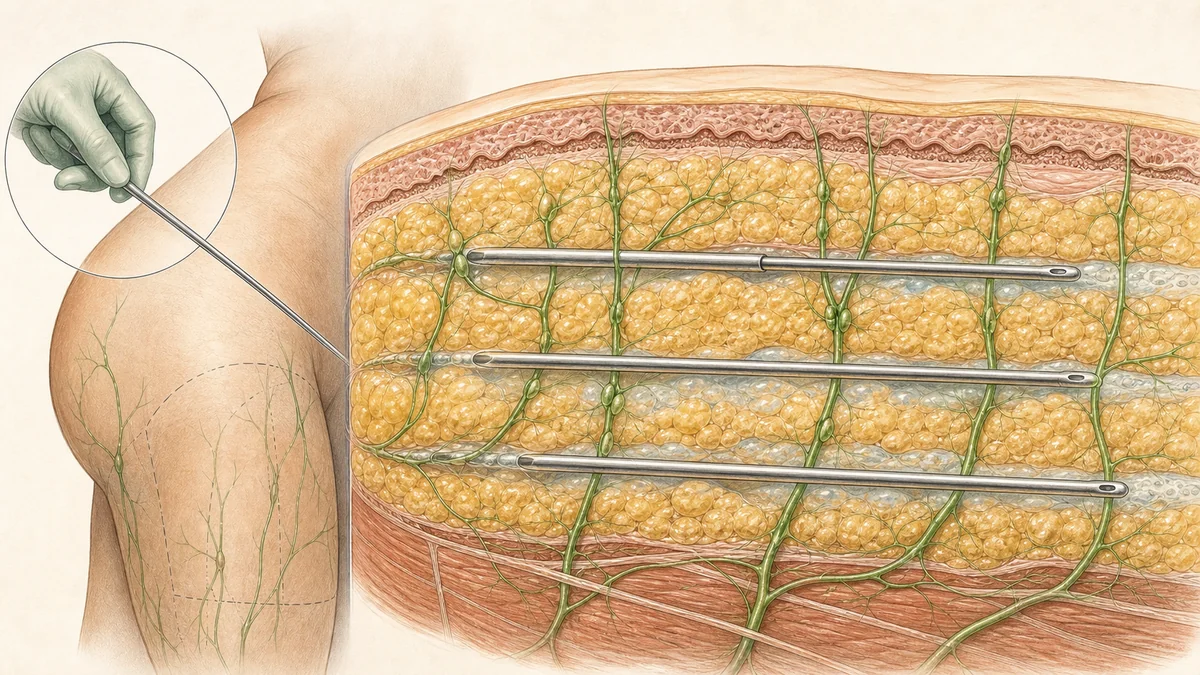
Lipedema surgery comes up a lot in patient communities — sometimes as a hoped-for endpoint, sometimes as something people are actively warned away from. Neither framing captures it accurately. This guide covers what the surgery actually does and doesn't do, why the specific technique used matters, how sessions and staging typically work, and what recovery and results realistically look like — grounded in the peer-reviewed literature available so far, not marketing claims.
For the wider picture of where surgery fits relative to conservative care, diet, and insurance, start with our lipedema treatment overview. If you haven't yet worked through conservative options, our conservative care guide is the logical starting point before this one.
What Lipedema Surgery Aims to Achieve — and What It Doesn't
Lipedema surgery removes diseased fat tissue from treated areas, most often the legs or arms, with the goal, outlined in the US standard-of-care guideline for lipedema, of reducing pain, heaviness, and the mobility limits that tissue volume can cause.4 That's a real, evidence-supported outcome for many patients — not a cosmetic side effect, but the actual clinical objective.
What it does not do is cure lipedema. The disorder is a systemic tissue condition, not a single localized deposit, so removing tissue from treated areas doesn't change the underlying disease process, and progression in areas not treated remains possible. Anyone considering surgery should go in expecting symptom relief in the treated region, not a resolution of the condition itself.
Conservative Care Comes First
The US standard-of-care guideline for lipedema places conservative management — compression, manual lymphatic drainage, movement, and pain management — ahead of surgery, and expects it to be tried consistently before surgery is seriously considered.4 This isn't just a formality: it's also frequently required for insurance documentation, and for some patients it resolves enough of the symptom burden that surgery is never needed.
If you haven't given conservative care a real, sustained trial yet, that's genuinely the place to start — our conservative treatment guide covers compression, MLD, movement, and pain management in full, including what a realistic trial period looks like.
Why Lymph-Sparing Technique Matters
The specific surgical approach used for lipedema differs from typical cosmetic liposuction in one crucial respect: it's designed, per the 2021 US standard-of-care guideline for lipedema, to preserve lymphatic vessels and structures while removing diseased tissue, since lipedema tissue sits close to lymphatic pathways that are easily damaged by more aggressive technique.4
Tumescent / Awake Technique
Most lipedema surgery uses the tumescent technique — large volumes of dilute local anesthetic fluid injected into tissue before suction — often performed with the patient awake or under light sedation rather than general anesthesia. This approach is widely used specifically because it supports gentler tissue handling and lower blood loss compared with some other methods. For what the awake technique itself involves, see our complete awake liposuction guide; for why it's often preferred for lipedema specifically — staged sessions, repositioning, recovery between procedures — see our guide on why awake technique is often preferred for lipedema.
Water-Assisted (WAL) and Power-Assisted Approaches
Beyond standard tumescent suction, some surgeons use water-assisted liposuction (WAL), which uses a thin, pressurized water jet to help separate fat cells before gentle suction, or power-assisted liposuction (PAL), which uses a vibrating cannula to loosen tissue with less manual force. A 2024 systematic review and meta-analysis suggests these modalities are generally comparable in safety and effectiveness when performed with lymph-sparing technique, though a single "best" method for every patient isn't established.3 Our dedicated lymph-sparing liposuction guide goes deeper into how these tools compare and what questions to ask a surgeon about technique choice.
What "Lymph-Sparing" Actually Means
In practice, lymph-sparing means the surgeon works with smaller cannulas, more conservative suction pressure, and an awareness of where major lymphatic channels run, rather than treating the area as uniform fat to be removed as efficiently as possible. It's a deliberate trade-off — potentially more sessions, more precision required — in exchange for protecting lymphatic function that lipedema patients often already have under some strain.
How Many Sessions? Staging by Area
Because lymph-sparing technique is more conservative by design, and because treating very large volumes of tissue in one session raises fluid-shift and safety concerns, lipedema surgery is typically staged across multiple sessions rather than done all at once, consistent with findings in a 2024 systematic review and meta-analysis.3 Legs and arms are commonly treated in separate sessions, and even a single limb may be split into more than one procedure depending on the amount of tissue involved.
Spacing between sessions generally allows for recovery and swelling to settle before the next area is addressed, which can mean the full treatment plan spans several months to over a year depending on how many areas need treatment. Our sessions and staging guide goes into more detail on how this planning typically works.
Who Is a Candidate
Candidacy isn't primarily about a specific weight or BMI cutoff. What tends to matter more is disease stage, how much symptom burden (pain, heaviness, mobility limitation) remains despite a genuine trial of conservative care, overall health for surgical safety, and realistic expectations about what surgery can and can't achieve. A person doesn't need to have "failed" conservative care entirely to be a candidate — the key question is whether conservative measures alone are adequately controlling symptoms.
General surgical fitness also matters, as it would for any procedure — factors like clotting risk, other health conditions, and the ability to comply with post-operative compression and activity guidance are part of a thorough evaluation. This is inherently an individualized decision made with a qualified surgeon, not something this guide can determine for any specific reader.
Risks & Complications
Risks specific to this population are worth naming directly: lymphatic injury (which lymph-sparing technique aims to minimize but can't eliminate entirely), seroma (fluid collection), contour irregularity, bruising, and the general risks associated with any liposuction procedure such as bleeding or infection. Despite these risks, a 2024 case series and narrative review of liposuction techniques for lipedema reports relatively low complication rates overall.1 Because lipedema tissue and surrounding lymphatics differ from typical cosmetic-liposuction anatomy, a surgeon's specific experience with lipedema — not just liposuction generally — is relevant context to ask about directly.
Recovery
Recovery after each session typically involves several days of significant swelling and discomfort, with compression garments worn essentially continuously during initial healing. Most people can return to light daily activity within one to two weeks, though full settling of swelling and final results can take longer, and this varies by how much tissue was treated and individual healing. Drainage from cannula entry points, bruising, and prolonged tenderness in treated areas over the first few weeks are all common and expected rather than complications.
Conservative Care Continues After Surgery
This point is easy to miss in surgical consultations, so it's worth stating plainly: surgery does not end the need for conservative care. Compression, manual lymphatic drainage, movement, and pain management remain part of ongoing lipedema management for most patients after surgery — often for life. The compression worn during initial recovery is not a temporary, surgery-specific measure that gets phased out once healing is complete; it's a continuation of the same conservative care most patients were already using before surgery.
Practically, this means most patients continue with some form of daily compression, periodic manual lymphatic drainage, and low-impact movement indefinitely after surgery. This isn't a sign that surgery "didn't work" — lipedema is a chronic condition, and treatment reduces symptoms and tissue load rather than eliminating the underlying disease. A surgeon who frames the operation as a one-time fix after which conservative care becomes unnecessary is not describing lipedema surgery as it is actually practiced or as the evidence supports.
Realistic Results & Long-Term
Available studies — including a 191-patient observational study of ultrasound-assisted liposuction for lower-limb lipedema — report meaningful improvement in pain and limb circumference at 12 months post-surgery for many patients.2 These are genuinely encouraging findings, but it's worth being honest about their limits: most available studies are observational rather than large randomized trials, follow-up periods are often a year or less, and results can vary based on stage, technique, and how much tissue was treated.
Longer-term, disease progression in untreated tissue remains possible, and some degree of recurrence or new swelling over years is realistic to expect for some patients rather than a guaranteed permanent result. Our guide to realistic surgical outcomes goes deeper into what the longer-term evidence does and doesn't currently show. If you've encountered "I cured my lipedema" stories online, our breakdown of what those claims actually mean explains how genuine improvement gets mislabeled as a cure.
Insurance in the US
US insurance coverage for lipedema surgery is inconsistent, and many plans still default to categorizing liposuction as cosmetic unless a patient's documentation proves otherwise. That documentation typically includes a formal lipedema diagnosis, records showing conservative care was tried and its results, and clear evidence of functional impact. Our insurance coverage guide covers this process, including what tends to strengthen an appeal when a claim is initially denied.
Questions to Ask a Surgeon
Because this is a specialized area within liposuction rather than routine cosmetic practice, it's reasonable to ask directly about a surgeon's specific experience with lipedema cases (not just general liposuction volume), which lymph-sparing technique they use and why, how they approach staging and session planning for your particular presentation, their complication rates, and what their follow-up process looks like. A surgeon confident in their lipedema-specific experience should be able to answer these plainly.
As with everything on this site, we don't recommend, rank, or name specific surgeons or clinics — this is information to bring into your own conversations, not a referral list.
Frequently Asked Questions
-
Does lipedema surgery cure lipedema?
No. Lipedema surgery removes diseased fat tissue in treated areas to reduce pain and improve mobility, but it doesn't cure the underlying disorder. The condition can still affect untreated areas, and conservative care generally continues afterward. Our lipedema treatment overview explains how surgery fits alongside the rest of the care pathway.
-
How many liposuction sessions are needed for lipedema?
It varies by how much tissue is affected and how many body areas need treatment, but multiple sessions spread over months are typical rather than a single procedure. Staging by area — legs, arms, or both, often split into separate sessions — is standard practice for lymph-sparing technique, partly to limit how much tissue and fluid shift is managed at once, as covered in our staging guide.
-
Is lipedema liposuction different from cosmetic liposuction?
Yes, in intent and technique. Lipedema surgery specifically aims to preserve lymphatic structures while removing diseased tissue tied to a medical condition, whereas cosmetic liposuction targets body contouring in people without lipedema. The lymph-sparing approach and staged, conservative-care-first pathway described in this guide are specific to lipedema, not standard cosmetic practice.
-
Does insurance cover lipedema surgery?
Coverage varies significantly by plan and typically requires documentation — a formal diagnosis, records of conservative care already tried, and evidence of functional impact — since many insurers default to treating liposuction as cosmetic unless proven otherwise. Our insurance guide covers what documentation tends to matter and how the appeals process commonly works.
-
Will lipedema come back after surgery?
Lipedema itself isn't "cured" by surgery, so the disease process can continue in tissue that wasn't treated, and long-term outcome data is still limited compared with more established procedures. This is why conservative care continuing after surgery matters, and why realistic expectations — covered in our treatment overview — are part of an honest surgical conversation.