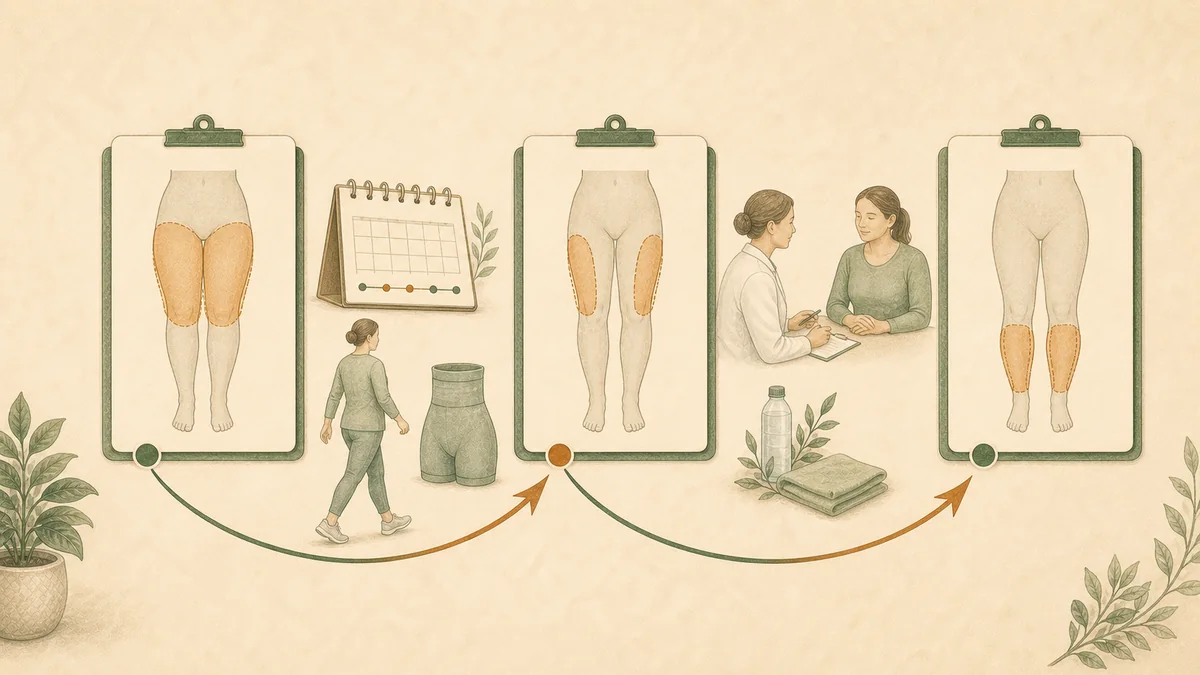
If you're researching lipedema surgery, one detail surprises a lot of people early on: it's rarely a single operation. Instead, lipedema liposuction is almost always staged — split into multiple separate sessions, sometimes spread across a year or more. The concept of lipedema surgery staging can feel discouraging if you were hoping for one procedure and done, but the staged approach exists for a specific, well-documented reason, and understanding it makes the whole process easier to plan for.
This page is a focused look at staging itself — why it happens, what shapes how many sessions a person needs, how much time typically goes between them, and what a realistic overall timeline looks like. For the fuller picture of the procedure itself, see our lipedema surgery guide; for background on the anesthesia technique that makes staged, awake sessions possible, see our awake liposuction overview.
Why Lipedema Surgery Staging Is Standard — Not Done at Once
Lipedema tissue is often widespread — commonly affecting both legs, sometimes both arms, and occasionally the trunk — which means the total volume of tissue involved can be substantial. Attempting to address all of it in a single operation would mean pushing well past what the 2021 US standard-of-care guideline for lipedema considers a safe amount of tumescent fluid, anesthetic, and tissue trauma for one surgical session.1 Staging isn't a shortcut or a way to stretch out billing — it's the safety framework that makes treating extensive lipedema tissue possible at all without exposing a patient to unnecessary risk.
It's also worth separating this from ordinary cosmetic liposuction, where a single area might reasonably be treated in one visit. Lipedema's disease burden is typically larger and more diffuse, and the tissue itself can behave differently under anesthesia and during healing, which is part of why lymph-sparing, staged protocols recommended in the 2021 US standard-of-care guideline for lipedema have become the norm in lipedema-specific surgical practice.1
The Safety Limit Behind Every Session
The most concrete driver of staging is anesthetic dosing. Tumescent technique relies on dilute local anesthetic — typically lidocaine — infused into the tissue before liposuction, and there is a well-established maximum safe dose per session based on body weight, as documented in Klein and Jeske's tumescent lidocaine dosing research.4 That ceiling directly limits how much tissue can be treated in one sitting: treating more tissue means using more fluid and more anesthetic, and once you approach the safety ceiling, the session has to stop regardless of how much affected tissue remains.
This is a genuine safety limit, not a soft guideline. Surgical teams plan each session's scope around it deliberately, which is why a surgeon may treat one thigh, one leg, or one arm in a given session rather than attempting several regions in a single visit.
How Many Sessions Are Typical?
There's no single universal number — a 2024 systematic review and meta-analysis of lipedema liposuction outcomes describes a fairly wide range across patients, generally reflecting how much tissue is affected and how it's distributed.3 Some patients with more limited, earlier-stage involvement complete treatment in two or three sessions; others with more extensive disease across legs, arms, and trunk may need six or more spread over an extended period, according to a 2024 case series and narrative review.2
| Area Pattern | Typical Session Approach | Typical Spacing |
|---|---|---|
| One leg or one arm | Often treated as a single session | 6–12 weeks before the next area |
| Both legs | Usually two separate sessions | Several weeks to a few months apart |
| Legs and arms | Multiple sessions across regions | Spread across many months |
| Extensive, multi-region disease | Four to six or more sessions | Often a year or longer, total |
What Determines the Number of Sessions
A few factors consistently shape how many sessions a surgeon recommends. The extent of affected tissue matters most — more body surface area involved generally means more sessions. Disease stage plays a role too, since the same standard-of-care guideline notes more advanced, fibrotic tissue can be more time- and effort-intensive to treat per unit area than earlier-stage tissue.1 A patient's overall health and how well they recover between sessions also factor in — healing speed isn't identical from person to person, and a surgeon will generally wait for adequate recovery rather than rush to a fixed schedule.
Practical considerations matter as well: how much time a patient can realistically take off work or caregiving duties, and — often significantly in the US — how insurance evaluates and approves each session. Our guide on insurance coverage for lipedema surgery goes into how that process typically works.
Why Spacing Between Sessions Matters
The gap between sessions isn't arbitrary downtime — it's when a lot of the real physiological work happens. Swelling from the previous session needs time to resolve, and the lymphatic system, which is already under strain in lipedema, needs a window to adapt before being asked to manage the aftermath of another round of tissue disruption.2 That spacing reflects both healing time and surgical planning norms described in a 2024 case series and narrative review of lipedema liposuction.2 Operating on tissue that's still swollen or hasn't finished healing can make the next session harder to plan accurately and may complicate recovery.
Most protocols space sessions roughly six to twelve weeks apart, though this is individualized based on how a patient is healing rather than a fixed calendar rule. A surgeon will typically want to see swelling substantially resolved and normal activity largely restored before scheduling the next area.
Realistic Timeline Expectations
Put together, staging means that comprehensive lipedema surgery is a months-to-years process, not a single event. For someone with extensive disease across multiple regions, it's common, according to a 2024 case series and narrative review, for total treatment — from the first session to the last — to span a year or more once all spacing and recovery time is accounted for.2 That's a meaningfully different timeline than cosmetic liposuction, and it's worth planning for accordingly: budgeting time off, arranging support during recovery windows, and pacing expectations about when the "whole picture" will be visible.
This extended timeline is also a reason conservative care doesn't pause during the surgical process — it's the throughline that keeps symptoms managed in between sessions and after the last one.
It also helps to think about the timeline in phases rather than as a single countdown. The first phase is typically the most demanding: an initial assessment, imaging or measurements where relevant, and the first one or two sessions that often address the areas causing the most pain or mobility limitation. A middle phase follows, where remaining regions are treated in a rhythm that fits the patient's healing pace, work schedule, and — in the US context — how each authorization moves through insurance.
A final phase focuses on smaller refinements, monitoring for any late swelling changes, and settling into a longer-term maintenance routine with compression and movement. Many patients describe the process as slower than they first expected but more manageable once broken into these stages, because each session has a defined scope and recovery window rather than one open-ended surgical event.
What Happens Between Sessions
Conservative care continues throughout the staged process. Compression garments are typically worn during recovery from each session and often beyond it, and manual lymphatic drainage may be recommended in the weeks following a session to support swelling reduction. This isn't a sign that surgery "isn't working" — it reflects that surgery reduces diseased tissue volume but doesn't replace the ongoing management lipedema requires, a point covered in more depth in our lipedema surgery overview.
Between-session visits are also when a surgical team reassesses how the previous area healed and confirms the plan for the next one, adjusting timing if recovery is slower than expected.
Frequently Asked Questions
-
How many liposuction sessions does lipedema surgery typically require?
It varies by how much tissue is affected, but many patients need somewhere between two and six or more sessions, often staged by body area (for example, one leg at a time). Our lipedema surgery guide covers the full range of factors a surgeon weighs before recommending a specific number.
-
Why can't lipedema liposuction be done in one surgery?
Each session has a safe upper limit on how much tumescent fluid and anesthetic can be used and how much tissue can be safely treated at once. Trying to treat widespread lipedema tissue in a single operation would exceed those safety margins, which is why the awake liposuction technique relies on a staged approach instead.
-
How long do I need to wait between sessions?
Spacing is individualized, but many patients wait roughly six to twelve weeks between sessions to allow swelling to resolve and the lymphatic system to adapt. Your surgical team will confirm timing based on how you're healing, not a fixed calendar — see our surgery guide for the recovery process in more detail.
-
Does insurance affect how many sessions I can have?
It can. Coverage decisions vary by policy and insurer, and some plans evaluate each session's medical necessity separately. Our guide to insurance coverage for lipedema surgery explains what documentation typically factors into these decisions.
-
What happens if I skip conservative care between sessions?
Compression and other conservative measures are generally expected to continue between and after sessions, not just before surgery begins. Skipping them can make swelling harder to control and may affect how well each session's results hold up — our surgery overview explains why conservative care doesn't stop once operating begins.
-
Is a staged approach less effective than one large surgery?
No — staging is the standard, safety-driven approach for extensive lipedema tissue, not a compromise on results. It allows each area to be treated thoroughly within safe limits, which research on lipedema liposuction outcomes associates with meaningful, lasting symptom improvement.