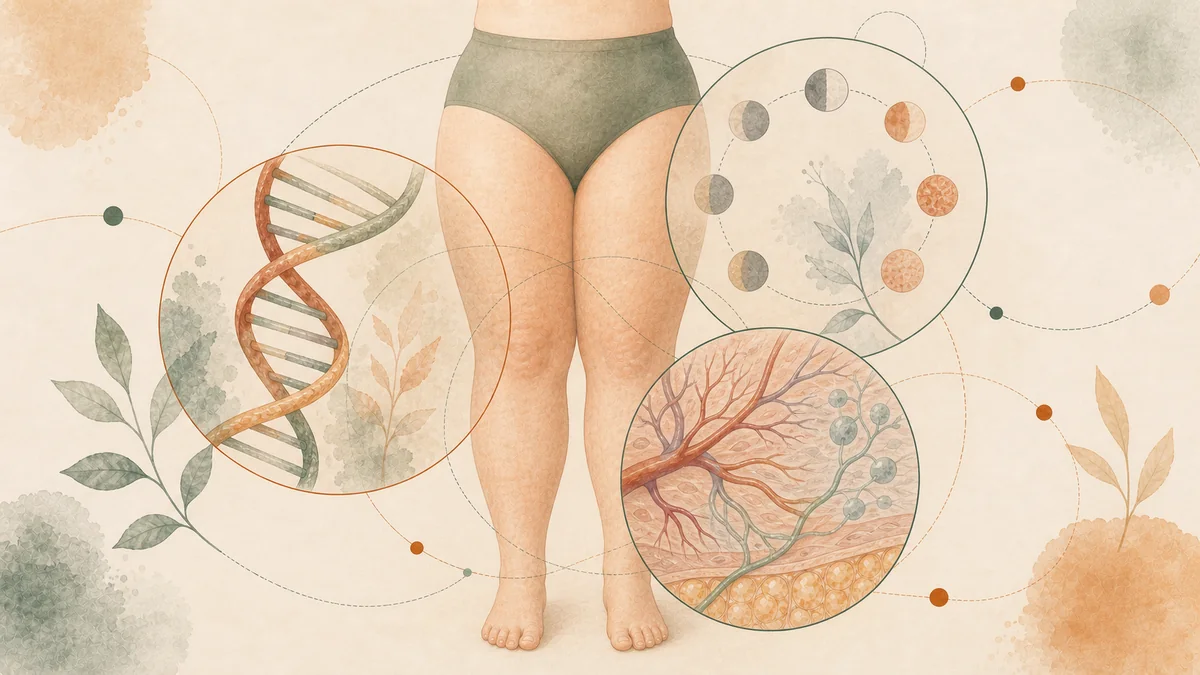
"Did I cause this?" is one of the most common — and most painful — questions people ask after suspecting they have lipedema. Years of being told to simply lose weight, often by well-meaning doctors and family members, leave many people believing their body shape is somehow their own fault. It isn't. The short version of what causes lipedema is that researchers point to an interaction of genetic predisposition, hormonal signaling, and vascular or inflammatory changes in fat tissue — not diet or activity level — and the honest, evidence-based answer is worth understanding in full.
This guide walks through what current research does and doesn't know about lipedema's causes, the factors most strongly implicated, and — just as importantly — what has been ruled out. For the full clinical picture, see our understanding lipedema overview.
What Causes Lipedema? The Honest Answer
Despite decades of clinical observation, researchers have not identified a single definitive cause of lipedema. What's understood instead is that it appears to result from an interaction between genetic predisposition, hormonal signaling, and changes in the blood vessels and connective tissue that support fat cells, according to a 2025 PMC clinical review.1 This is a genuinely honest gap in the science, not a sign that the condition isn't real or well documented — lipedema's clinical features are consistently described across decades of medical literature even though the precise trigger mechanism remains under investigation.
Being upfront about this uncertainty matters. Overstating how well the cause is understood would misrepresent the state of the research; understating it — or implying the cause is simply unknown behavior — would misrepresent the patient experience. Both are avoided here.
Hormonal Triggers
The clearest pattern in lipedema's onset is its timing: symptoms very commonly begin or noticeably worsen around puberty, pregnancy, or menopause — three of the biggest hormonal transitions in a woman's life, notes StatPearls' overview of lipedema on NCBI Bookshelf.3 This timing has led researchers to focus heavily on estrogen and its effect on fat tissue distribution and blood vessel function as a likely central piece of the puzzle.
It's worth noting that hormonal involvement doesn't mean lipedema is simply "hormonal weight gain" in the way that phrase gets used casually. The tissue changes involved — increased fat cell size, altered blood vessel permeability, and a tendency toward inflammation — go well beyond ordinary hormone-related weight fluctuation, which is part of why lipedema doesn't resolve the way typical hormonal weight changes eventually do.
Continue: Lipedema symptoms — the full picture →Genetic Predisposition & Family History
A hereditary pattern shows up frequently in clinical histories: many people with lipedema have a mother, sister, or aunt with a similar body shape, even if that relative was never formally diagnosed. Researchers believe lipedema genes may follow an inheritance pattern that's more common in women, though the specific gene or genes responsible haven't been definitively pinpointed, per Herbst and colleagues' 2021 consensus guideline.2
A family history isn't required for a lipedema evaluation to make sense, though — plenty of people are the first in their family to be recognized simply because awareness of the condition has improved over time. If a family history is present, it's a useful detail to mention at an appointment, alongside a description of your own symptoms and timeline.
Why It Affects Almost Exclusively Women
Lipedema is overwhelmingly diagnosed in women, and reported cases in men are rare and typically tied to conditions that significantly disrupt normal hormone balance. This strong sex-specific pattern is one of the more compelling pieces of evidence for a hormonal cause, since it's difficult to explain through genetics or lifestyle factors alone — both of which would be expected to affect men and women more similarly.
This doesn't mean every woman is at equal risk, or that hormones alone fully explain who develops lipedema and who doesn't. It does mean that any credible explanation for lipedema's cause has to account for why it tracks so closely with female hormonal biology specifically.
What Does Not Cause Lipedema
It bears repeating plainly: lipedema is not caused by overeating, a lack of exercise, or insufficient willpower, according to Herbst et al.'s 2021 consensus guideline.2 These explanations get applied to lipedema constantly, in large part because the visible result — disproportionate lower-body fat — superficially resembles ordinary weight gain. But the underlying tissue is fundamentally different, which is exactly why it doesn't respond to the calorie deficits and exercise routines that do change ordinary fat.
If you've spent years being told to "just lose weight" and found that the affected areas barely changed no matter what you did, that experience is consistent with how lipedema actually behaves — not a sign you didn't try hard enough. Our guide on lipedema legs covers this diet-resistance pattern in more detail specifically for the most commonly affected area.
Why Understanding the Cause Matters for Patients
Understanding what does and doesn't cause lipedema isn't an academic exercise — it has practical consequences for how patients are treated in clinic and how they treat themselves at home. When the cause is misattributed to overeating or inactivity, care too often stops at "lose weight and come back," which delays recognition by years and leaves people cycling through diets that were never going to change lipedema tissue in the first place. Knowing that the drivers are genetic, hormonal, and vascular reframes the conversation toward evaluation, staging, and evidence-based management rather than blame.
It also changes what patients ask for. Someone who understands that lipedema fat behaves differently from ordinary fat is better equipped to seek a proper clinical evaluation and to weigh conservative options against surgical ones on the basis of what each actually addresses. Our guide on how lipedema is diagnosed walks through what that evaluation involves, and the treatment options overview covers what current care can and cannot do.
Research Directions
Active research is underway into several possible mechanisms, including microvascular changes that make blood vessels more permeable, chronic low-grade inflammation within affected fat tissue, and the specific genetic variants that might predispose someone to the condition. Progress has been genuinely slower than for many other conditions, in part because lipedema has historically been under-recognized and under-funded relative to how common it is.
Greater clinical awareness in recent years has begun to translate into more research interest, which is a meaningful, if overdue, shift. A clearer picture of the precise cause could eventually support more targeted treatments beyond the conservative and surgical options available today — a subject covered in our treatment options overview.
It's reasonable to want a definitive answer, especially after years of confusion or dismissal, but the current state of the science doesn't yet provide one — and it's more useful, and more honest, to plan around what's actually known than to wait for a single explanation that may be years away. What's already well established — the pattern of symptoms, the response to conservative care, and the ineffectiveness of diet alone — is enough to guide meaningful management today, even while the underlying mechanism is still being worked out.
Frequently Asked Questions
-
Is lipedema genetic?
A genetic predisposition appears to play a meaningful role — many people with lipedema have a mother, sister, or aunt with a similar leg or arm shape, suggesting a hereditary pattern. That said, no single "lipedema gene" has been identified, and researchers currently believe multiple genes likely interact with hormonal factors. Our guide to lipedema symptoms covers the physical signs that tend to run in families alongside the condition.
-
Did I cause this by overeating or not exercising?
No. This is one of the most important things to understand about lipedema: it is not a consequence of overeating, inactivity, or a lack of willpower. It's a tissue disorder involving genetic, hormonal, and vascular factors that are outside a person's behavioral control, which is why lipedema fat doesn't respond to the diet and exercise changes described in our lipedema legs guide.
-
Why does lipedema affect almost exclusively women?
The strong link to female hormones — particularly estrogen — and the pattern of onset around puberty, pregnancy, and menopause both point toward a hormonal component that's specific to female physiology. This is one of the clearer pieces of evidence researchers point to when describing lipedema in our understanding lipedema overview as a hormonally influenced condition rather than simple weight gain.
-
Can men get lipedema?
It's extremely rare, and reported cases in men are typically associated with conditions that significantly disrupt normal hormone levels, such as liver disease or hormone therapy. Because lipedema is so strongly tied to female hormonal patterns, a similar-looking condition in a man is more likely to reflect a different or additional underlying issue that needs its own evaluation.
-
Is there a genetic test for lipedema?
Not currently. Lipedema remains a clinical diagnosis based on physical examination and history rather than a blood or genetic test, even though researchers suspect a hereditary component. Our guide on how lipedema is diagnosed explains what an evaluation actually involves in the absence of a definitive lab test.
-
Does lipedema always run in families?
Often, but not always — many people with lipedema can point to a relative with a similar body shape, while others have no known family history at all. A missing family history doesn't rule lipedema out; it may simply reflect that the condition went unrecognized in earlier generations, a pattern discussed further in our understanding lipedema overview.