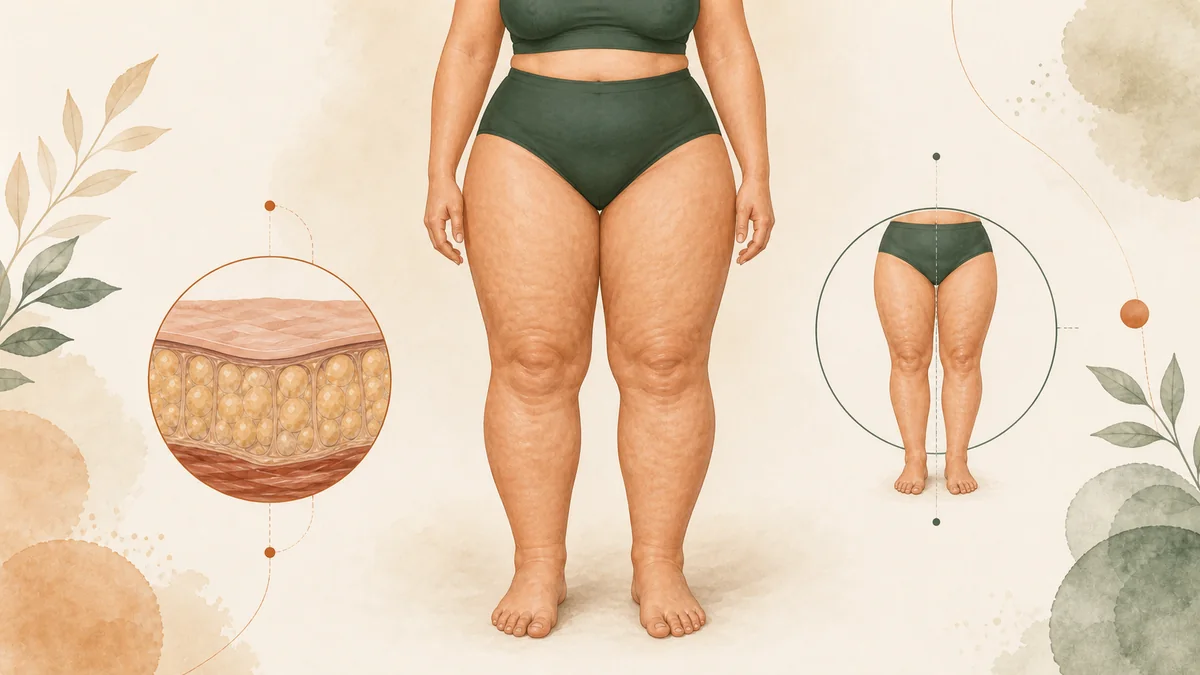
If you've spent years being told to "just lose weight," only to find that your legs never seem to change no matter what you do, you're not alone — and you may be dealing with something other than ordinary body fat. So what is lipedema, exactly? Lipedema is a real, documented medical condition, and understanding what it actually is can be the first step toward getting taken seriously by a clinician.
This guide covers what lipedema is, why it's so often confused with obesity, its common symptoms, what's currently known about its causes, and how it tends to progress. Nothing here is a diagnosis — only a clinician who examines you in person can confirm lipedema — but understanding the condition itself is essential background before that conversation. For help figuring out whether your symptoms even sound like lipedema in the first place, see our is it lipedema? guides.
What Is Lipedema? A Clear Definition
Lipedema is a chronic disorder of fat tissue that causes a disproportionate, symmetrical build-up of fat — most often in the hips, thighs, and lower legs, and sometimes the arms — while typically sparing the hands and feet, according to a 2023 StatPearls overview of lipedema.1 Unlike ordinary fat gain, lipedema tissue is tender or genuinely painful to the touch, bruises easily, and develops in a mirror-image pattern affecting both sides of the body equally.
The condition almost always affects women, and it frequently starts or noticeably worsens around a hormonal turning point — puberty, pregnancy, or menopause, as documented in Herbst et al.'s 2021 US consensus guideline.2 A separate 2024 German multi-society clinical guideline also recognizes lipedema as a distinct condition and provides consensus recommendations for its diagnosis and treatment.4 The reproductive-life pattern supports hormonal involvement, but the exact mechanism remains under investigation. Lipedema can change over time, with tissue becoming firmer or more nodular in some people, but that course is not inevitable or uniform; our guide to lipedema stages explains that uncertainty in detail.
It Is Not Obesity
This is one of the most important things to understand about lipedema, and the misunderstanding that causes the most harm. Lipedema is not a consequence of overeating, inactivity, or "not trying hard enough" — it is a distinct medical condition with its own tissue characteristics, and it can occur in people at any body weight, including those who are otherwise slim, per Herbst and colleagues' 2021 consensus guideline.2 A person can be at a stable, healthy weight everywhere else in their body and still have lipedema legs or arms that are significantly disproportionate to the rest of them.
The clearest evidence that lipedema is not ordinary fat is how it behaves: lipedema tissue is well documented to resist diet and exercise, meaning a person can lose weight elsewhere in the body while lipedema-affected areas stay largely the same size. This is not a sign of insufficient effort, and it is not something willpower can change. Being told to simply lose weight — often for years, by multiple clinicians — is one of the most consistently reported experiences among people later diagnosed with lipedema, and it's a pattern this site takes seriously rather than dismissing.
Continue: The full picture of lipedema symptoms →Common Symptoms
Lipedema presents with a recognizable cluster of physical and sensory signs, even though the severity and exact combination varies from person to person. The most commonly reported symptoms include:
- Disproportionate, symmetrical swelling — usually in both legs or both arms equally, out of proportion to the rest of the body
- Pain and tenderness to pressure, often described as a constant ache that worsens with standing or by the end of the day
- Easy bruising, frequently without a clear cause or memorable injury
- A feeling of heaviness or fatigue in the affected limbs
- Soft, nodular tissue under the skin, sometimes described as feeling like small peas or grains of rice
- A visible "cuff" where normal-sized hands or feet meet noticeably larger limbs
Pain is one of the most clinically useful and most frequently overlooked symptoms — ordinary fat is not painful, and tenderness to pressure is a real physical finding, not something to be minimized. For a complete breakdown of every symptom category, including which ones fluctuate with hormones or heat, see our dedicated lipedema symptoms guide.
What Causes It
The honest answer is that the exact cause of lipedema isn't fully understood. What research does point to is a combination of factors working together rather than a single trigger. Hormonal shifts appear to play a major role: onset or a noticeable worsening of lipedema very often coincides with puberty, pregnancy, or menopause, which strongly suggests estrogen and other reproductive hormones are involved in some way, a link noted in Herbst et al.'s 2021 consensus guideline.2
Genetics also appear important — lipedema frequently runs in families, with many patients reporting that a mother, sister, or aunt has a similar body shape or set of symptoms, even if that relative was never formally diagnosed. What lipedema is not caused by is overeating, inactivity, or a lack of self-discipline; it is not a moral failing or a lifestyle choice, and framing it that way has historically delayed diagnosis for a great many patients.
How Common Is It & Why It's Underdiagnosed
Estimates suggest lipedema may affect up to 11% of adult women, which would make it far from rare — and yet it remains widely unrecognized, both by the general public and, at times, by clinicians who were never specifically trained to identify it, according to StatPearls' overview of lipedema on NCBI Bookshelf.1 Several factors combine to keep diagnosis rates low: lipedema's resemblance to ordinary weight gain, inconsistent medical coding and awareness across specialties, and a long-standing tendency to attribute leg or arm swelling to diet and exercise habits rather than investigating further, a gap highlighted in a 2025 Obesity Reviews analysis.3
The practical result is a diagnostic delay that, for many patients, stretches into years — sometimes a decade or more from first noticing symptoms to getting an accurate name for what's happening in their body. Increasing awareness of lipedema as a distinct, legitimate medical condition is one of the central reasons resources like this one exist.
How It Progresses
Lipedema is typically described using a staging system that tracks differences in tissue and skin findings — from relatively smooth skin with underlying nodular tissue in the earliest stage, through more pronounced skin changes and tissue lobules in later stages. Progression is not automatic or identical for every person: some people remain stable for years, while others notice change. Conservative care can help manage symptoms and function, but current evidence does not show that it reliably prevents stage progression.
Because staging and its practical implications deserve a full explanation on their own — including the important nuance that a person's stage is not the same as their pain severity — we cover this in complete detail in our lipedema stages guide, including an honest answer to whether progression is truly inevitable.
Related Conditions
Lipedema doesn't always occur in isolation, and it's frequently confused with — or coexists alongside — a handful of related conditions. Lymphedema, a build-up of lymphatic fluid rather than a fat-tissue disorder, is the most clinically important comparison, since advanced lipedema can eventually develop a secondary lymphatic component sometimes referred to as lipo-lymphedema. Joint hypermobility and connective-tissue conditions such as Ehlers-Danlos syndrome have also been observed at higher rates among people with lipedema, though the exact relationship is still being studied and shouldn't be assumed for every patient.
Cellulite and ordinary obesity are the two most common non-medical mix-ups, both covered in depth in our lipedema vs cellulite comparison. Because these overlaps genuinely affect how a person should be evaluated and treated, telling them apart accurately — rather than assuming any one explanation — is worth taking seriously with a clinician.
Getting Evaluated
If several of the symptoms above sound familiar, the most useful next step is preparing for a proper clinical evaluation rather than trying to self-diagnose. Lipedema is generally recognized through a physical exam and detailed history — including when symptoms started, whether close relatives share a similar pattern, and how the tissue responds to pressure — rather than a single blood test or scan.
Not every general practitioner is familiar with lipedema, so it can help to specifically mention the condition by name rather than only describing "leg swelling" or "stubborn fat." Our guide on how lipedema is diagnosed walks through exactly what that evaluation involves and which specialties are most likely to recognize it. And if symptoms are already affecting your daily life, our treatment options guide covers conservative care first, with surgery discussed as a later option rather than a starting point.
Frequently Asked Questions
-
Is lipedema the same thing as being overweight?
No. Lipedema is a distinct medical condition that causes a disproportionate build-up of fat, most often in the legs, independent of a person's overall body weight. A person of any size can have lipedema, and the disproportionate, symmetrical, painful pattern it causes is different from generalized weight gain. This is one of the most common and damaging misunderstandings people with lipedema symptoms face.
-
What causes lipedema?
The exact cause isn't fully known, but research points to a combination of hormonal triggers — onset or worsening often coincides with puberty, pregnancy, or menopause — and genetic predisposition, since lipedema frequently runs in families. See our full guide on lipedema causes and risk factors for more detail on what's currently understood.
-
Can men get lipedema?
Lipedema is overwhelmingly diagnosed in women, and the strong hormonal association — onset around puberty, pregnancy, or menopause — is a major reason why. Documented cases in men are rare and typically associated with conditions that significantly alter hormone levels, such as liver disease or testosterone-affecting therapy. It remains a condition almost exclusively seen in women, a pattern discussed further in our understanding lipedema hub.
-
Is there a cure for lipedema?
No, lipedema currently has no cure. Care focuses on managing symptoms, supporting function, and improving quality of life through conservative measures and, in some cases, surgery — not eliminating the underlying condition. Our treatment options guide walks through what conservative care and surgery can and cannot realistically achieve.
-
How is lipedema diagnosed?
Lipedema is typically diagnosed through a clinical evaluation — a physical exam and detailed history — rather than a single lab test or scan, ideally by a clinician familiar with the condition. This page can't diagnose you; if your symptoms sound familiar, our how lipedema is diagnosed guide explains what that evaluation actually involves.
-
Does lipedema always get worse over time?
Not necessarily. Lipedema can change over time, but progression isn't automatic or uniform for everyone. Early recognition and consistent conservative care can help manage pain, swelling, and function, but they have not been proven to prevent stage progression. Our lipedema stages guide explains what the evidence does and does not show.
-
What's the difference between lipedema and lymphedema?
Lipedema is a disorder of fat tissue, while lymphedema is a build-up of lymphatic fluid, and the two have different distribution patterns, foot involvement, and clinical signs — though advanced lipedema can eventually involve a lymphatic component. Our related conditions guide breaks down exactly how the two are distinguished.