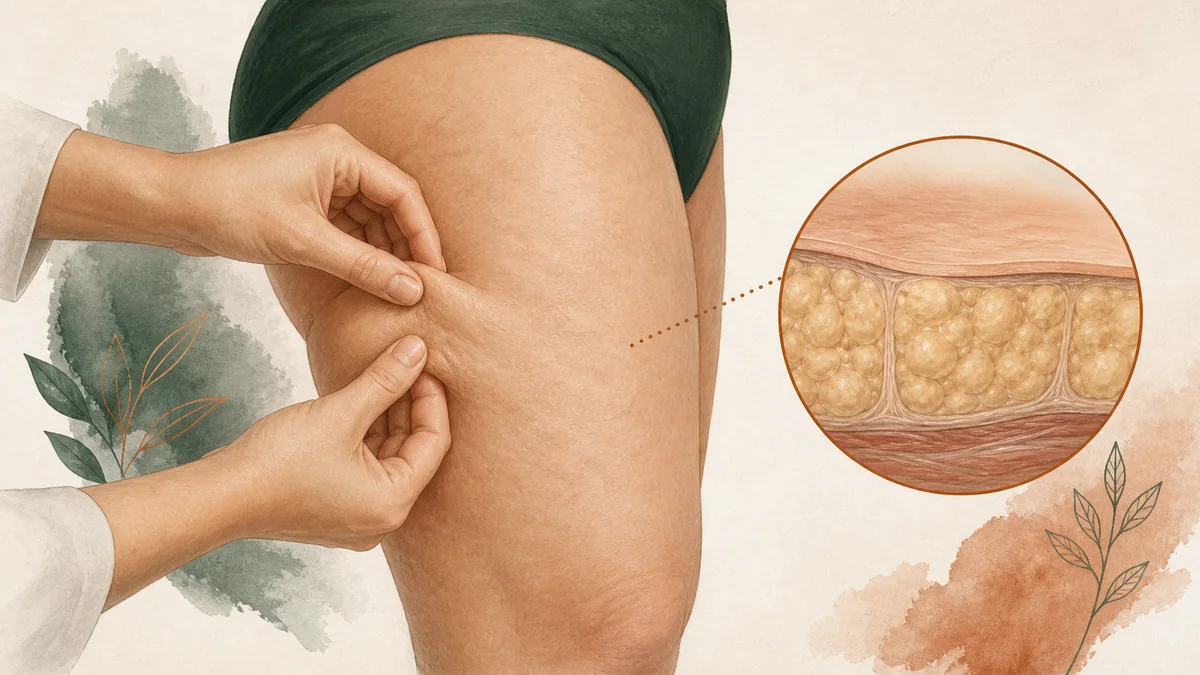
The lipedema pinch test appears frequently in forums and search results as a quick home check. In clinical literature, it is described more narrowly as a way to provoke and compare tissue tenderness during examination — not as a yes/no home diagnosis. This guide explains that distinction and the limits of interpreting a single pinch. For the wider picture, see our is it lipedema? overview.
What the Lipedema Pinch Test Is
Kruppa and colleagues' 2020 clinical review describes the pinch test as a way to check characteristic tissue tenderness: pressure may feel distinctly unpleasant in affected areas while causing no pain elsewhere.4 A 2025 clinical review and the 2021 US Standard of Care place tenderness and nodular tissue within a broader clinical history and physical examination.12
How It's Performed
During an in-person assessment, a clinician may gently compress a fold of tissue and compare tenderness in an affected area with an unaffected area. The amount of pressure and the meaning of the response depend on clinical context; there is no accepted home score or cutoff. The clinician also examines distribution and symmetry, asks about spontaneous pain and easy bruising, and may separately check pitting and Stemmer's sign when lymphedema is a concern. Those are different findings, covered in our lipedema vs lymphedema guide.
| Aspect | Lipedema pinch test | Stemmer's sign |
|---|---|---|
| What it checks | Tissue tenderness under gentle compression | Whether skin at the base of a toe (or finger) can be lifted into a fold |
| Which condition it relates to | Lipedema | Lymphedema |
| Where on the body | Affected limb tissue, compared with an unaffected area | Dorsum of the second toe or a finger |
| Where it's used | By a clinician during examination | By a clinician during examination |
| Validated home version? | No | No |
| Diagnostic on its own? | No — one feature among several | Suggestive of lymphedema when positive, not confirmatory alone |
What a "Positive" Result Might Suggest
Discomfort that is clearly greater in affected tissue can demonstrate tenderness, a recognized lipedema feature. It still is not a diagnostic “positive” on its own. A clinician interprets that response alongside disproportionate limb size, easy bruising, symmetry, an ankle cuff, symptom history, and competing explanations.4
Continue: Lipedema vs cellulite — the full comparison →What It Cannot Do
This is the most important section: a home pinch cannot confirm or exclude lipedema. There is no validated cutoff, scoring system, sensitivity, or specificity for interpreting it as positive or negative. It also cannot reliably distinguish lipedema from cellulite, ordinary fat, lymphedema, or another cause of pain or swelling.
Self-testing carries two risks — false reassurance from a "normal" pinch, or unnecessary alarm from tenderness that may mean something else entirely. A proper assessment always comes from a full clinical evaluation, which our how lipedema is diagnosed guide explains.
Other Signs Clinicians Look At
Clinicians use the complete pattern rather than a pinch result. Symmetry matters: lipedema commonly affects both limbs similarly, while markedly asymmetric swelling points toward another explanation. The ankle and wrist cuff sign — relatively spared hands or feet meeting larger limbs above — is another relevant feature.
Easy bruising, family history of similar limb shape, and onset around puberty, pregnancy, or menopause add context, according to a StatPearls overview of lipedema.3 No single sign is decisive — the overall pattern and exclusion of other causes guide evaluation.
What to Bring to Your Appointment
If several signs above sound familiar, a little preparation helps more than any home test:
- When symptoms started and whether they changed around puberty, pregnancy, or menopause.
- Notes on spontaneous pain, tenderness during ordinary touch or pressure, and unexplained bruising.
- Whether close relatives have a similar leg or arm shape.
Naming lipedema specifically — rather than only “heavy legs” or “bad cellulite” — points your clinician toward the right evaluation. If you tried a lipedema pinch test at home, do not label it positive or negative; simply describe what you noticed and let the clinician interpret it in context.
Common Mistakes When People Try the Pinch Test at Home
The central mistake is treating the lipedema pinch test as if it had a validated home protocol. It does not. Other common problems include:
- Pinching too hard. Enough pressure will make almost any tissue uncomfortable — that does not confirm lipedema.
- Calling the result positive or negative. No accepted threshold exists for either label.
- Treating a painless result as “all clear.” A home pinch has no rule-out value.
- Comparing your result to forum descriptions. Tissue texture and pressure are subjective; online language is not a substitute for a clinical examination.
The useful approach is to record symptoms without turning them into a diagnosis. A clinician can then consider tenderness together with distribution, symmetry, cuff signs, bruising, family history, and alternative explanations.
Frequently Asked Questions
-
Does a positive pinch test mean I have lipedema?
No. A clinical pinch maneuver can help demonstrate tissue tenderness, but it has no stand-alone positive result that diagnoses lipedema. Tenderness and nodular tissue are interpreted as part of a full history and physical examination. Our how lipedema is diagnosed guide explains that process.
-
How do I do the pinch test at home?
There is no standardized, medically validated home protocol with an accepted score or cutoff. Rather than trying to create a positive or negative result, note symptoms that occur naturally — such as tenderness, easy bruising, symmetry, or swelling — and discuss the overall pattern during an in-person examination.
-
Is the pinch test painful?
Deliberately pinching hard enough can make anyone uncomfortable, so pain produced by a self-check is not a diagnostic result. Spontaneous tenderness or pain with ordinary pressure is a recognized lipedema symptom worth describing to a clinician alongside distribution, symmetry, bruising, and swelling.
-
Can the pinch test be wrong?
A home pinch has no validated sensitivity, specificity, or accepted positive/negative threshold for lipedema. It therefore cannot reliably rule the condition in or out. Clinicians evaluate the complete pattern instead, as explained in our lipedema vs cellulite comparison.
-
What's the difference between the pinch test for lipedema and for cellulite?
There is no validated side-by-side home pinch test that distinguishes the two. Cellulite describes a surface dimpling pattern, while lipedema evaluation considers disproportionate distribution, tenderness, bruising, symmetry, and foot or hand sparing. See the vs cellulite guide for the broader comparison.
-
Should I see a doctor even if my pinch test feels normal?
Yes, if other signs concern you. A normal-feeling home pinch has no rule-out value. Symmetrical leg or arm enlargement, easy bruising, tenderness, or a visible ankle or wrist cuff are more useful details to bring to a clinician; our is it lipedema? overview lists the wider pattern.