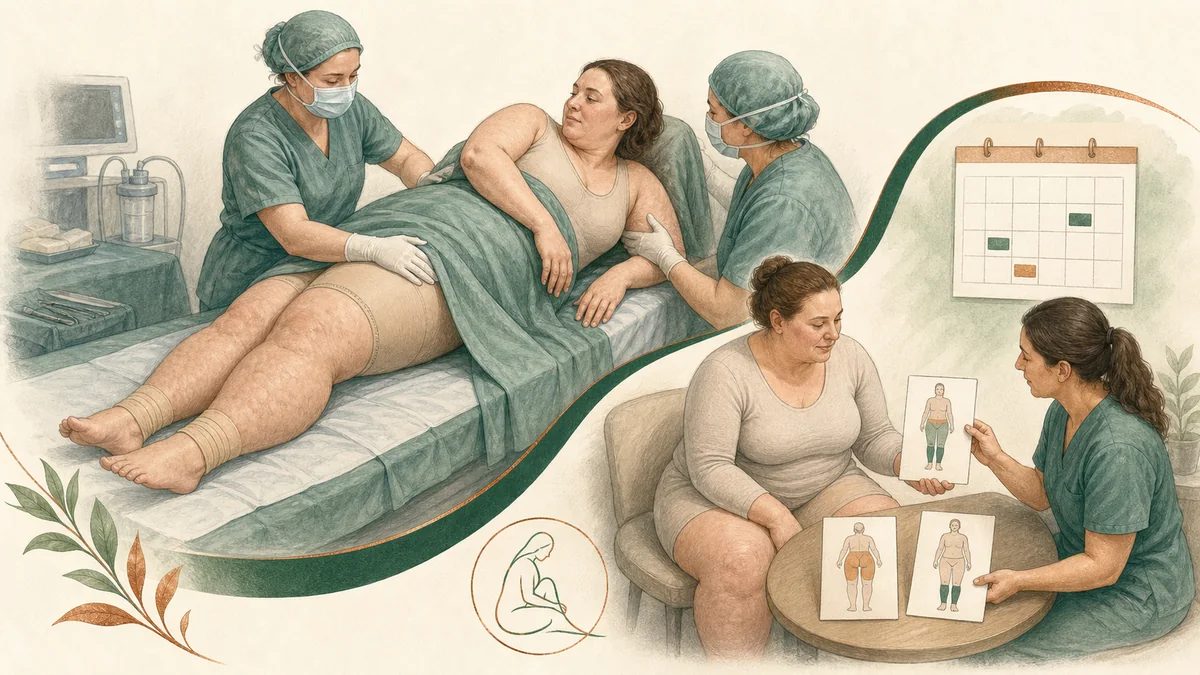
Awake liposuction for lipedema comes up constantly in surgical planning conversations — sometimes framed as if it were the only real option. It isn't the only option, but there are concrete, practical reasons it's so often the plan specifically for lipedema, distinct from why any particular mechanical tool might be chosen.
This guide covers the anesthesia-choice side of lipedema surgery: staging, repeated exposure, repositioning, and recovery between sessions. For the separate question of which specific liposuction tool best preserves lymphatic tissue, see our lymph-sparing liposuction guide. For the surgery itself — candidacy, staging, and recovery overall — see our full lipedema surgery guide.
Why Awake Liposuction for Lipedema Matters
Cosmetic liposuction is often a single, planned procedure. Lipedema surgery is usually not — because lipedema commonly affects large, symmetric areas (both legs, both arms, or more), and treating a very large tissue volume in one sitting raises fluid-shift and safety concerns, care is typically staged across multiple separate sessions spread over months, a pattern that a 2024 systematic review and meta-analysis of liposuction for lipedema describes as common and well tolerated.4 That single fact — repeat surgery, not one-time surgery — is what makes anesthesia choice a bigger conversation here than in most cosmetic liposuction planning.
There's also a practical scheduling angle: a same-day, outpatient anesthesia approach is generally easier to fit into a staged plan spanning a year or more than an approach requiring a longer surgical-facility stay each time. None of this means general anesthesia is off the table for lipedema — it means the calculus that favors awake technique in a single cosmetic case gets stronger, not weaker, once repeat sessions enter the picture.
Avoiding Repeated General Anesthesia
General anesthesia carries its own well-known risks — effects on breathing and circulation, nausea, longer recovery time — that are generally manageable for a single procedure but become a bigger cumulative consideration when a patient may need three, four, or more separate sessions over a year or more. Tumescent, awake-style local anesthesia has a long track record for large-volume liposuction specifically because it avoids that repeated systemic exposure, dating back to Klein's original tumescent technique research and refined in later dosing-safety studies.1
This isn't a claim that general anesthesia is unsafe — it's a specific trade-off calculation that shifts when surgery is planned as several separate events rather than one.
Repositioning During Treatment
Areas commonly affected by lipedema — thighs, upper arms, sometimes the abdomen — often need to be treated from more than one angle to address the full circumference of the limb. Rather than lying in a single fixed position for the whole session, a patient might shift from lying face-up to face-down, or roll partway, so the surgeon can access the front, back, and sides of the treatment area within one appointment. An awake or lightly sedated patient can often make that shift with simple verbal guidance from the surgical team, which tends to be more straightforward than repositioning someone who is fully unconscious, where every position change requires more coordination and care around airway management.
This isn't a minor convenience — for circumferential areas specifically, incomplete access to one side of a limb can mean uneven results, so the ability to reposition efficiently and safely partway through a session is a genuine part of why awake technique fits lipedema surgery's typical treatment areas well.
Continue: What awake liposuction actually feels like →Recovery Between Staged Sessions
Local and regional anesthesia approaches generally allow for a faster return to an alert, ambulatory state than general anesthesia, without the grogginess, nausea, or extended monitoring that often follow a general-anesthesia case, per a StatPearls overview of local and regional anesthesia.3 When a treatment plan involves multiple sessions spaced months apart, a technique that lets patients bounce back to their normal routine more quickly between procedures fits the overall plan more comfortably than repeated longer recoveries would.
Anesthesia Choice vs Technique Choice
It's worth being precise about what this page does and doesn't cover. Staying awake or lightly sedated is an anesthesia decision — it determines how you experience the procedure and how quickly you recover. It's a separate decision from which mechanical tool the surgeon uses to actually remove fat — water-assisted, power-assisted, or ultrasound-assisted devices, chosen specifically to reduce disruption to lymphatic tissue. Our dedicated lymph-sparing liposuction guide covers that technique-level comparison, including what "lymph-sparing" can and can't promise.
In practice, the two decisions are usually paired — tumescent fluid infusion (which enables the awake approach) also happens to separate fat gently from surrounding tissue before mechanical removal, which our tumescent technique guide explains in more depth — but they remain conceptually distinct questions worth understanding separately.
Communication During Surgery: A Real Clinical Advantage
One benefit of the awake approach that gets underestimated in written summaries is real-time communication. A conscious patient can flag pain, unusual sensations, positional discomfort, or early signs of feeling unwell the moment they notice them, rather than after emerging from general anesthesia hours later. In lipedema surgery — where tissue is already tender in ways that vary from area to area and where staged sessions mean the same patient may go through the same conversation multiple times over months — that feedback loop matters.
Practical examples: a patient who feels an unexpected sharp sensation during infiltration can say so before the surgeon moves to the next area; someone whose leg starts to feel numb in a way that reads more like nerve pressure than tumescent anesthesia can flag it and the team can adjust positioning; patients who have had lipedema surgery before can proactively describe which sensations were manageable and which weren't. None of this replaces surgeon judgment or monitoring equipment — it complements them. For a fuller picture of what patients actually notice during and after an awake procedure, see our what awake liposuction feels like guide.
When General Anesthesia Is Still Used
Awake technique isn't automatically the right call for every lipedema case. Very large single-session volumes, significant patient anxiety about being awake during surgery, or specific medical factors can make general anesthesia the more appropriate choice for a given session. Our guide on when awake liposuction isn't the right choice covers these situations directly — this is a decision made with your surgical and anesthesia team, not a default to insist on regardless of individual circumstances.
It's also worth naming a pattern we see often in patient forums: someone who had general anesthesia for a first session and awake technique for a later one, or vice versa, and ends up comparing the two directly. Both experiences can be entirely reasonable, and neither one being harder or easier for a specific patient says anything universal about which is "better" for lipedema surgery in general. The right question isn't which anesthesia approach wins in the abstract, but which fits the specific case, the specific session, and the specific patient in front of the team. That's a conversation to have session by session, not a permanent identity for how your care must proceed. Our full lipedema surgery guide covers how these session-by-session decisions typically get planned.
Frequently Asked Questions
-
Is awake liposuction safe for lipedema surgery specifically?
The tumescent, awake approach has a long safety track record when lidocaine dosing limits are followed and the patient is appropriately selected, and it's the anesthesia base used for most lipedema surgery. As with any surgical anesthesia, individual risk depends on the treatment area, session length, and each patient's health history, which is why this is discussed directly with your surgical and anesthesia team rather than assumed automatically.
-
Why does lipedema surgery often need multiple sessions, and how does that affect anesthesia choice?
Lipedema commonly affects large, symmetric areas, and treating very large volumes in one sitting raises fluid-shift and safety concerns, so care is typically staged across several sessions over months. An anesthesia approach with a quick, predictable recovery — allowing a return to baseline before the next session — fits that staged plan more naturally than repeated general anesthesia would. Our sessions and staging guide covers how this planning typically works.
-
Will I be repositioned during an awake lipedema procedure?
Often, yes, especially for circumferential areas like the thighs or upper arms that need to be treated from more than one angle. Being awake or lightly sedated means you can often help reposition yourself with guidance from the surgical team, which tends to be simpler than repositioning a patient under general anesthesia. Exact protocols vary by surgeon and facility.
-
Can I request general anesthesia instead for lipedema surgery?
That's a conversation to have directly with your surgeon — general anesthesia is sometimes used for lipedema cases, particularly for larger single-session volumes or based on patient preference and anxiety levels. It isn't automatically unsafe or wrong; it's a different set of trade-offs. Our guide on when awake liposuction isn't the right choice covers situations where general anesthesia may genuinely be the better fit.
-
Does staying awake mean I'll feel pain during lipedema surgery?
The tumescent fluid used in awake technique is specifically a large-volume local anesthetic, so the treatment area itself should be numb during the procedure. Some pressure, pulling sensation, or mild discomfort is commonly reported, and lipedema tissue that's already tender to the touch can make this sensation more noticeable than in people without the condition. Our what awake liposuction feels like guide covers this in detail.
-
Is this the same as "lymph-sparing" technique?
They're related but different decisions. This page is about the anesthesia choice — staying awake or lightly sedated instead of general anesthesia. The specific mechanical tool used to remove fat — water-assisted, power-assisted, or ultrasound-assisted — is a separate, lymphatic-preservation-focused technique decision covered in our dedicated lymph-sparing liposuction guide.