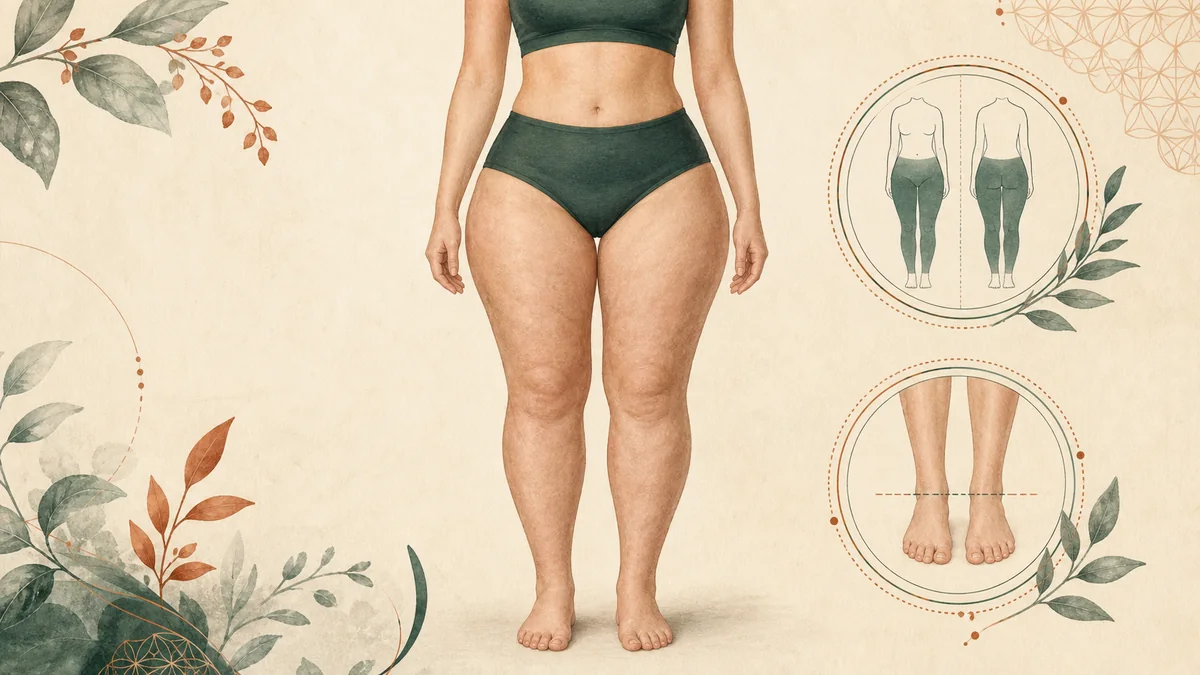
Lipedema in slim people cannot be confirmed or excluded by body weight alone. “You're not overweight, so it can't be that” is therefore a misleading way to assess the condition; clinicians instead consider disproportionate distribution, symptoms, tissue findings, and alternative explanations. See our is it lipedema? overview for broader context.
Why the "You're Not Overweight" Response Happens
A 2025 Obesity Reviews analysis describes lipedema as underrecognized and highlights persistent diagnostic challenges.1 The paper does not show that every delayed diagnosis results from a weight-based dismissal. The practical point is narrower: BMI does not measure fat distribution, tissue texture, or pain, so it cannot replace a condition-specific examination. Our lipedema or just fat legs guide covers the broader weight-related differential.
What Lipedema Looks Like in a Slim Body
In a slim person, lipedema's hallmark features are often easier to see: a narrow upper body paired with larger hips, thighs, or legs; a visible ankle "cuff" where the foot is spared; pain or tenderness that seems out of proportion to appearance; and easy bruising or nodular tissue on exam. These signs apply regardless of overall size.
Because the rest of the body may look conventionally "healthy," clinicians sometimes focus on BMI alone and miss disproportion at the hips or calves. Bringing photos that show the contrast between upper and lower body — and noting when swelling or pain worsens after standing — can make a pattern visible that a single glance in clinic might not capture.
Continue: Lipedema vs cellulite — how to tell the difference →Early-Stage Lipedema (Stage 1) Can Look "Normal"
In Stage 1, the skin can still look smooth and the shape change subtle enough to pass as ordinary variation — which, as a StatPearls overview of lipedema notes, makes early lipedema in slim people especially easy to overlook.3 See our guide to lipedema stages for how the condition progresses.
Why Athletes and Very Active People Get Missed
Regular training does not protect against lipedema, but fitness is often mistaken for evidence against it. Lipedema fat resists diet and exercise in ways ordinary fat does not — so a highly active person can stay fit overall while affected areas remain disproportionately large. That resistance is a clue worth naming at an appointment, not a personal failing.
A lean runner or cyclist may have strong quads and a narrow waist while thighs stay tender, heavy, or bruise-prone despite consistent training. Sports medicine visits that focus on performance metrics can overlook this pattern because weight and fitness scores look normal. Saying explicitly that exercise never shrank the affected areas — even during periods of high activity — often shifts the conversation from "you're fine because you're fit" to whether the tissue itself needs evaluation.
The Cost of Delayed Diagnosis
Diagnostic delay is documented across lipedema, and a 2025 clinical review emphasizes the need for better recognition and differential diagnosis.2 It does not quantify a slim-person-specific delay. Earlier recognition can open access to appropriate conservative care — see our treatment overview.
How to Advocate for an Evaluation
Keep a brief symptom log (onset, symmetry, hormonal triggers, family history), describe disproportion and tenderness specifically rather than "heavy legs," and ask about lipedema by name — including examination for the ankle cuff and tissue texture. If concerns are dismissed without a physical exam, ask for a referral. Our guide on being taken seriously covers how to frame that conversation.
Frequently Asked Questions
-
Can you have lipedema and be thin?
Yes. Lipedema is defined by a specific pattern of painful, disproportionate fat — not by overall body weight — so it can occur in people who are slim, athletic, or sit at a completely average BMI. A slim build can actually make the disproportion between the upper body and legs or arms more visually obvious once you know what to look for, as explained in our is it lipedema? overview.
-
Does BMI rule out lipedema?
No. BMI reflects overall body weight, not how fat is distributed or whether it's painful, and lipedema is diagnosed by physical pattern and symptoms rather than a weight calculation. A normal or low BMI does not rule lipedema in or out — see our guide on how lipedema is diagnosed for what a clinical evaluation actually involves.
-
Why do my legs hurt if I'm not overweight?
Leg pain in someone at a normal weight has several possible causes, and lipedema is one of them — its tissue is tender or painful independent of how much a person weighs. If the pain comes with symmetrical swelling, easy bruising, or a shape that looks different from the rest of the body, it's worth describing those specific details to a clinician rather than assuming pain requires being overweight.
-
Can lipedema affect athletes?
Yes. Regular training and a low body-fat percentage don't protect against lipedema, and physically active people are frequently told their symptoms can't be lipedema because they're clearly fit. This is one of the more common ways the condition gets missed — see our guide on lipedema vs cellulite for the tissue-level differences that fitness alone doesn't explain.
-
What should I ask my doctor?
Ask specifically whether your leg or arm pattern could be lipedema by name, rather than only describing "heavy legs" or general soreness. Bring notes on when it started, whether it's symmetrical, whether it's tender to pressure, and any family history of a similar shape — our guide on being taken seriously covers how to frame this conversation.
-
If I lose weight and my legs don't change, does that mean it's lipedema?
It's a meaningful clue, not a diagnosis. Lipedema fat is well documented to resist diet and exercise, so losing weight elsewhere while the legs or arms stay disproportionately large is a pattern clinicians take seriously. But other conditions can also behave this way, so the observation is worth bringing to an evaluation rather than concluding it on your own.