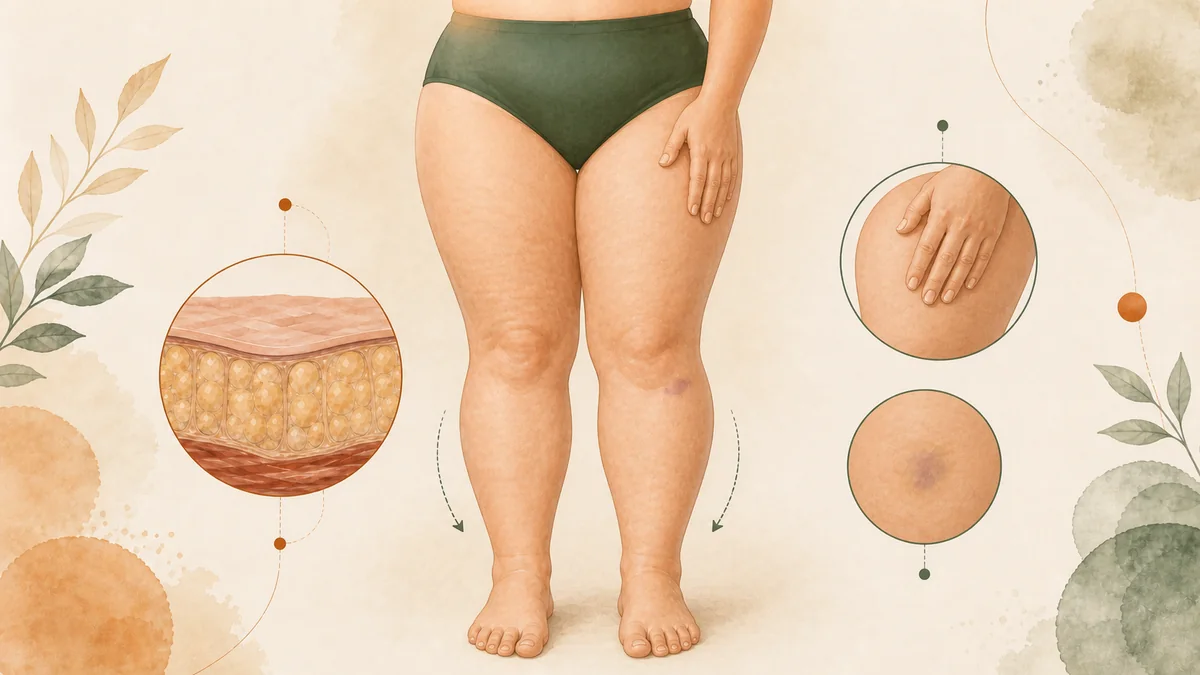
Lipedema symptoms are frequently reduced, in casual conversation, to "disproportionate legs" — but the visible shape is only part of the picture. Pain, tenderness, easy bruising, and a persistent sense of heaviness are just as characteristic of the condition, and they're often the symptoms patients remember most clearly, even when clinicians focus mainly on appearance.
This guide walks through the full symptom picture: what shows up physically, what you feel but can't always see, how symptoms shift over time, and what lipedema is not. For background on the condition itself, see our what is lipedema overview; this page goes deeper specifically into how it presents day to day.
Lipedema Symptoms: Physical Signs
The most recognizable physical sign of lipedema is disproportionate, symmetrical fat distribution — typically affecting the hips, thighs, and lower legs, and sometimes the upper arms, while the hands and feet stay a normal, comparatively smaller size. This creates a visible "cuff" at the ankles or wrists, where the normal-sized hand or foot meets a noticeably larger limb.
Underneath the skin, many people notice a soft, nodular texture, sometimes described as feeling like small peas, grains of rice, or marbles scattered through the tissue. As the condition progresses, skin surface changes and a more pronounced, sometimes lobulated tissue appearance can develop — a topic covered fully in our lipedema stages guide.
Distribution also matters: for many people, lipedema settles mainly around the hips and thighs, while for others it extends the full length of the leg or shows up in the arms as well. These patterns don't change the underlying symptom picture described in this guide, but they do shape which practical concerns — clothing fit, compression sizing, mobility — end up mattering most day to day. Our dedicated guides on lipedema legs and lipedema arms go into that distribution-specific detail.
Sensory Symptoms — Pain, Tenderness & Heaviness
Sensory symptoms are arguably the most clinically important — and most frequently overlooked — part of the lipedema picture. Ordinary fat, no matter how visually pronounced, is not painful. Lipedema tissue, by contrast, is commonly tender or genuinely painful to pressure, a symptom well documented in a 2025 PMC clinical review of the condition.1 Many patients describe it as a constant, dull ache that worsens by the end of the day, after standing for long periods, or with certain types of contact.
A related and equally common complaint is heaviness — a sense that the legs or arms are dragging or fatigued well beyond what's expected from normal daily activity. Because pain and heaviness aren't visible the way swelling is, they're easy for both patients and clinicians to underweight, but they carry real diagnostic value and shouldn't be left out of the conversation with a healthcare provider.
Some people also describe a distinct sensitivity to touch or pressure in affected areas — clothing seams, tight waistbands, or even a light bump feeling more uncomfortable than they would elsewhere on the body. This heightened tenderness is consistent with the tissue changes seen in lipedema and is worth mentioning specifically, rather than being described only in general terms like "sore legs." Our guide to why lipedema hurts goes deeper into what's actually happening in the tissue.
Continue: What causes lipedema, and why the mechanism isn't fully understood →Easy Bruising
People with lipedema frequently notice they bruise easily, sometimes without recalling any specific bump, knock, or injury that caused it. This is thought to relate to increased fragility of the small blood vessels within the affected tissue, though the exact mechanism isn't completely understood, according to a 2023 StatPearls overview of lipedema.2 Easy bruising on its own isn't unique to lipedema — plenty of unrelated conditions and medications can cause it — but combined with symmetrical swelling and pain to pressure, it becomes a meaningful part of the overall pattern.
Symptoms That Change With Hormones, Heat, or the Day
Lipedema symptoms are rarely perfectly static. Many people notice their legs or arms feel more swollen, heavier, or more tender at certain points in their menstrual cycle, during pregnancy, or around menopause — consistent with the condition's strong hormonal association documented in Herbst et al.'s 2021 consensus guideline.3 Hot weather and prolonged standing or sitting are also commonly reported triggers for a temporary worsening of swelling and discomfort, typically easing somewhat with rest, elevation, or cooler conditions.
This fluctuation is a normal feature of lipedema, not a sign that something new or dangerous is happening — but it can be genuinely confusing for people trying to track their own symptoms, which is exactly why keeping a simple symptom log ahead of a clinical appointment can be so useful. A short daily note capturing swelling, pain intensity, heaviness, and any obvious triggers over four to six weeks tends to reveal patterns that a single office visit could easily miss, and gives a clinician far more to work with than memory alone during a busy appointment window.
What Lipedema Is Not
Understanding lipedema also means understanding what it is not. It is not the same as ordinary edema — simple fluid retention that responds to elevation and typically pits under sustained finger pressure. It is not simply the result of eating too much or moving too little, and it does not indicate a lack of discipline or self-care, per Herbst et al.'s 2021 consensus guideline.3 It is also not identical to cellulite, even though both can appear on the thighs and lower legs; our lipedema vs cellulite comparison covers that distinction point by point.
Getting these distinctions right matters because each condition — or non-condition, in the case of cellulite — is managed completely differently, and lumping them together tends to delay people from getting the specific, useful care lipedema actually calls for.
Overlapping Conditions
Several other conditions share some symptoms with lipedema, which is part of why an accurate evaluation matters so much. Lymphedema — a build-up of lymphatic fluid rather than a fat-tissue disorder — can look similar at a glance but typically involves the feet, unlike lipedema, and can eventually coexist with lipedema in more advanced cases. Venous insufficiency can also cause leg swelling and heaviness, though it tends to respond differently to elevation and compression than lipedema does.
Joint hypermobility and connective-tissue conditions have additionally been observed at higher rates among people with lipedema, though this relationship is still being studied. Our lipedema and related conditions guide covers how each of these overlaps is currently understood and why the distinctions matter for treatment planning.
None of this means every symptom you experience needs an exotic explanation — ordinary aches, occasional swelling after a long flight, or garden-variety bruising happen to everyone regardless of lipedema. The pattern that's worth paying attention to is the combination described throughout this guide, sustained over time, rather than any single symptom in isolation.
When to Seek Evaluation
If you notice a combination of symmetrical leg or arm swelling, pain or tenderness to pressure, easy bruising, and a sense that the affected areas simply don't respond to diet and exercise the way the rest of your body does, it's a reasonable and worthwhile reason to bring lipedema up by name at your next medical appointment. This page can't diagnose you — only a clinical evaluation can do that — but recognizing the full symptom pattern is often what finally gets a conversation with a healthcare provider pointed in the right direction.
Our how lipedema is diagnosed guide explains exactly what that evaluation typically involves, and our treatment options overview covers what happens next — starting with conservative care, not surgery.
Frequently Asked Questions
-
Does lipedema always hurt?
Pain and tenderness are hallmark symptoms for most people with lipedema, but the intensity varies a great deal — some notice a mild, constant ache, while others describe sharper pain when the area is touched or pressed. Pain level also doesn't necessarily match the visible size of the affected tissue. Our lipedema stages guide explains why stage and pain severity aren't the same thing.
-
Why do I bruise so easily?
Easy bruising is a well-documented lipedema symptom, thought to relate to increased fragility of small blood vessels in the affected tissue. Many people notice bruises appearing without remembering any specific bump or injury. If this happens alongside symmetrical leg or arm swelling and tenderness, it's worth discussing lipedema specifically with a clinician — see our what is lipedema overview for the full picture.
-
Do lipedema symptoms fluctuate?
Yes. Many people notice their symptoms — particularly swelling, heaviness, and tenderness — shift with hormonal cycles, hot weather, prolonged standing, or time of day, often feeling worse by evening. This fluctuation is a normal part of the condition and doesn't mean anything has gone suddenly wrong; it's a pattern our lipedema causes guide explains in the context of hormonal triggers.
-
Is lipedema the same as swelling from being overweight?
No. Ordinary weight-related fat is generally not painful, is not strictly symmetrical, and does respond — at least partially — to diet and exercise. Lipedema's combination of pain, symmetry, diet-resistance, and a spared ankle or wrist "cuff" is a distinct pattern. Our what is lipedema guide covers exactly why lipedema is not obesity in more depth.
-
Can lipedema symptoms appear in only one leg?
Classic lipedema is symmetrical, affecting both legs or both arms to a similar degree, which is one of its more distinctive features. Symptoms that are clearly one-sided point away from lipedema and toward another cause, such as a vein problem or lymphedema, and should be evaluated separately — see our lipedema and related conditions guide for how these are told apart.
-
When should I see a clinician about these symptoms?
If you notice symmetrical leg or arm swelling combined with pain, tenderness, easy bruising, or a sense that the affected areas don't respond to diet and exercise, it's worth raising lipedema by name at your next appointment. Our how lipedema is diagnosed guide explains what a proper evaluation involves and how to prepare for it.