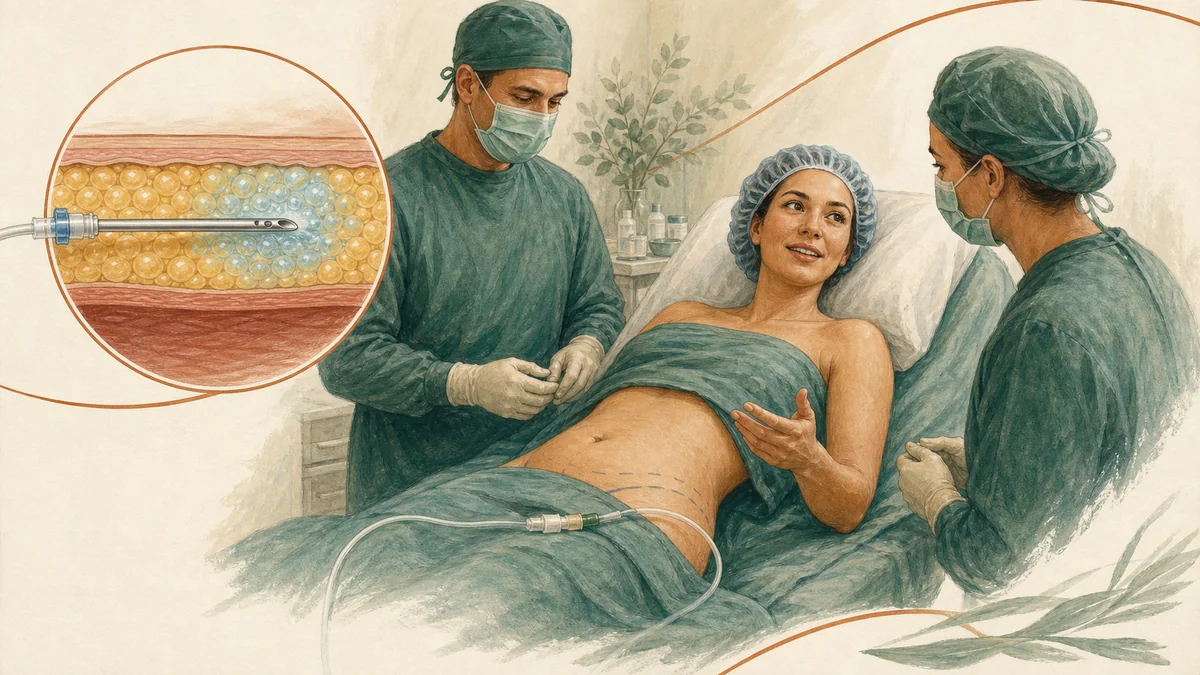
If you've been told you're a candidate for liposuction and heard the word "awake" attached to it, you probably have questions that go beyond a brochure answer. Awake liposuction means the procedure happens without general anesthesia — you're conscious, breathing on your own, and often able to talk with the surgical team while fat is removed from the treatment area. For many patients this sounds appealing on its face, but the honest picture is more nuanced than "awake equals better."
This guide walks through what "awake" actually involves, what it feels like in practice, where its real benefits and real limits are, and why it's frequently the technique of choice in lipedema surgery specifically. Nothing here replaces a conversation with the surgeon and anesthesia provider planning your case — every patient's anatomy, anxiety level, and treatment volume are different. For the mechanics that make staying awake possible in the first place, see our tumescent technique guide.
What "Awake Liposuction" Actually Means
"Awake liposuction" describes a procedure performed under local or tumescent anesthesia rather than general anesthesia. Instead of being put to sleep and having a breathing tube placed, the patient receives numbing medication injected directly into the treatment area, and stays conscious for the entire procedure. Some awake procedures add a mild oral or intravenous sedative on top of the local anesthesia — this is sometimes labeled monitored anesthesia care (MAC) — but the defining feature is that the patient never loses consciousness or the ability to breathe independently.
This is fundamentally different from twilight sedation slipping into unconsciousness, and it's different again from full general anesthesia, where an anesthesiologist manages the airway and the patient has no awareness of the procedure at all. Awake technique sits at the conscious end of that spectrum, which is precisely why the tumescent fluid used to numb the area has to do so much of the work — without it, staying awake through fat removal simply wouldn't be tolerable.
Are You Really Awake?
It's a fair question, and the honest answer is: it depends on how much sedation is layered on top of the local anesthesia. Some patients have no sedation at all and are fully alert, chatting with staff and watching monitors if they want to. Others receive a mild oral anti-anxiety medication that leaves them drowsy but still conscious and responsive. Still others receive light IV sedation that can blur or soften memory of parts of the procedure, even though they technically never lose consciousness or need airway support.
The table below lays out this spectrum honestly, because "awake" gets used loosely to describe anything short of general anesthesia — which can set unrealistic expectations in either direction.
| Approach | Consciousness | Airway support needed |
|---|---|---|
| Local/tumescent only | Fully alert, no drowsiness | No |
| Tumescent + mild oral sedative | Conscious, relaxed, may feel drowsy | No |
| Tumescent + IV sedation (MAC) | Conscious, responsive, memory may be patchy | Usually no — closely monitored |
| General anesthesia | Fully unconscious | Yes |
Every row above except the last one is generally grouped under the "awake liposuction" umbrella. If staying genuinely fully alert matters to you, ask specifically what sedation, if any, is planned — the terms "awake" and "conscious sedation" are not always used consistently between practices.
Continue: The tumescent technique explained →How the Tumescent Technique Makes It Possible
Awake liposuction only works because of a specific innovation: the tumescent technique, first described in the late 1980s in Klein's 1990 tumescent technique paper.1 Large volumes of a dilute anesthetic solution — far more fluid than a typical local injection — are infused into the fat layer before any suctioning begins. This swells and firms the tissue, numbs it thoroughly, and constricts small blood vessels, which is what allows a patient to stay conscious and comfortable while a meaningful volume of fat is removed.
Before this technique existed, liposuction generally required general anesthesia, because the discomfort of the procedure without deep, sustained local numbing was too much to tolerate while conscious. Our full tumescent technique guide covers exactly what's in the solution, how it's dosed safely, and how it changed liposuction practice.
What It Feels Like During Surgery
Most patients describe the numbing injection itself — a burning or stinging sensation as the tumescent fluid is infused — as the most noticeable part of the whole experience. Once the area is fully numb, patients typically report pressure, tugging, or a vibrating sensation as the cannula moves through the fat layer, rather than sharp pain. Some describe a dull ache toward the end of a longer session as the anesthetic effect in the deepest tissue starts to fade slightly.
Being conscious also means you can speak up in real time if an area feels more sensitive than expected, which some patients find reassuring compared to waking up from general anesthesia with no memory of the procedure. A detailed, step-by-step account of the sensations involved — from numbing to the final minutes — is covered in our dedicated what it feels like during awake liposuction guide.
Benefits
Awake liposuction offers several genuine advantages, though — as covered in the next section — none of them make it the automatically superior choice in every situation:
- No general-anesthesia risk — no breathing tube, no airway management, and none of the nausea or grogginess that can follow waking from general anesthesia.
- Faster initial recovery — many patients are able to walk out shortly after the procedure and resume light activity sooner than after general-anesthesia surgery.
- Position changes during surgery — because the patient is conscious and mobile, the surgeon can ask them to shift position to check symmetry, which is difficult under general anesthesia.
- Real-time patient feedback — the patient can report discomfort immediately rather than the surgeon relying solely on monitoring equipment.
- Lower facility requirements — awake procedures often don't require a full operating room or an anesthesiologist on staff, which can affect both access and cost.
Limits — When General Anesthesia Is the Better Choice
This is the part that gets oversimplified most often: awake is not automatically safer than general anesthesia, and treating it that way is a genuine myth this guide wants to correct directly. Every anesthesia approach carries trade-offs, and general anesthesia remains the better — and sometimes only appropriate — choice in several real situations.
Very large-volume procedures push tumescent lidocaine doses toward their established safety ceiling, which can make general anesthesia the safer route rather than pushing local anesthesia further, according to Klein & Jeske's 2016 dosing safety study.2 Patients with significant needle anxiety, difficulty tolerating prolonged procedures while conscious, or multiple large treatment areas planned in a single session are also frequently better served by general anesthesia. A thorough discussion of exactly where that line sits is covered in our limits and when general anesthesia is better guide.
Continue: When general anesthesia is the better choice →Why It's Often Preferred for Lipedema
Awake and tumescent technique come up constantly in the context of lipedema surgery specifically, and for a reason that goes beyond patient comfort. Lipedema fat tends to surround delicate lymphatic structures, and some surgeons and researchers believe tumescent, lower-pressure approaches may help preserve those structures better than more aggressive large-volume techniques performed entirely under general anesthesia, per a 2024 case series and narrative review.3 Because lipedema surgery is frequently staged across multiple sessions rather than done all at once, the awake/tumescent approach also fits naturally with that treatment pattern.
This is not the same as saying awake technique is a requirement for lipedema surgery, or that it eliminates all surgical risk to lymphatic tissue — it doesn't. Lipedema surgery is also typically staged across multiple sessions and paired with ongoing conservative care such as compression, which fits naturally with an outpatient, awake surgical approach, consistent with the 2021 Standard of Care for Lipedema in the United States guidelines.4 Our dedicated guide to why awake technique is preferred for lipedema goes into that staged-surgery reasoning in full, while our separate lymph-sparing liposuction guide covers the water-assisted and power-assisted tool comparison and the honest limits of what "lymph-sparing" can promise. For the surgery itself — candidacy, staging, and realistic outcomes — see our lipedema surgery guide.
Safety Profile
The tumescent solution used in awake liposuction contains dilute lidocaine, and lidocaine toxicity is the main safety concern that surgical teams actively manage. Tumescent lidocaine can be used at doses considerably higher than would be safe for a standard local injection, because the technique's slow absorption changes how the drug moves through the body — but that ceiling is still a real limit, not a suggestion, as established by Klein & Jeske's 2016 dosing safety study.2
This site does not provide dosing instructions, calculations, or guidance intended for self-administration — dosing decisions are made by the treating clinician based on the individual patient and procedure plan, and that responsibility should never shift to the patient. What matters for you as a patient is knowing that established, peer-reviewed dosing limits exist and that a qualified surgical team monitors against them throughout the procedure, including watching for early signs of lidocaine toxicity such as ringing in the ears, confusion, or an irregular heartbeat.
Cost
Awake liposuction cost varies with the number of areas treated, how many sessions are required, whether sedation is added, and geographic location — there is no single number that applies broadly. Because awake procedures often avoid operating-room and anesthesiologist fees, they can sometimes cost less per session than an equivalent general-anesthesia procedure, though multiple staged sessions can offset some of that savings over a full treatment course. Our awake liposuction cost guide breaks down the specific variables that drive pricing and what questions to ask when getting a quote.
Frequently Asked Questions
-
Will awake liposuction hurt?
Most patients feel pressure, tugging, or vibration rather than sharp pain, because the treatment area is numbed with tumescent anesthesia before any fat removal starts. The injection of the numbing fluid itself is usually the most noticeable sensation. Our guide on the tumescent technique explains exactly what makes this level of comfort possible during an awake procedure.
-
Is awake liposuction safer than liposuction under general anesthesia?
Not automatically. Awake liposuction avoids general-anesthesia-specific risks like airway management and post-anesthesia nausea, but it introduces its own considerations, including lidocaine dosing limits and how much a patient can tolerate while conscious. Which approach is safer depends on the case, not the technique alone — see our safety and limits section for specifics.
-
How long does awake liposuction take?
It varies with the number of areas treated and the volume of fat involved, but awake procedures are often broken into shorter sessions than a single large-volume general-anesthesia surgery would require. Some patients need multiple sessions over time rather than one long operation. Our cost guide covers how session count affects overall planning and price.
-
Can I be sedated and still be considered awake?
Yes. Many awake procedures include a mild oral or IV sedative on top of tumescent local anesthesia, so patients feel calmer without losing consciousness or the ability to respond to the surgical team. This is different from general anesthesia, where the patient is fully unconscious. Our guide on what it feels like during surgery explains this consciousness spectrum in more detail.
-
Is awake liposuction used for lipedema?
Yes, it's commonly used in lipedema surgery, partly because the tumescent approach may help preserve lymphatic structures better than large-volume procedures performed entirely under general anesthesia. It isn't the only technique used, and it isn't a cure for lipedema. Our lymph-sparing liposuction guide explains that tool-choice reasoning in full.
-
How much does awake liposuction cost?
Cost depends heavily on the number of areas treated, how many sessions are needed, and geographic location, so there is no single reliable figure. Awake procedures are sometimes less expensive per session than general-anesthesia surgery because they don't require an anesthesiologist or operating-room facility fees. Our dedicated cost guide breaks down the variables that actually drive the price.