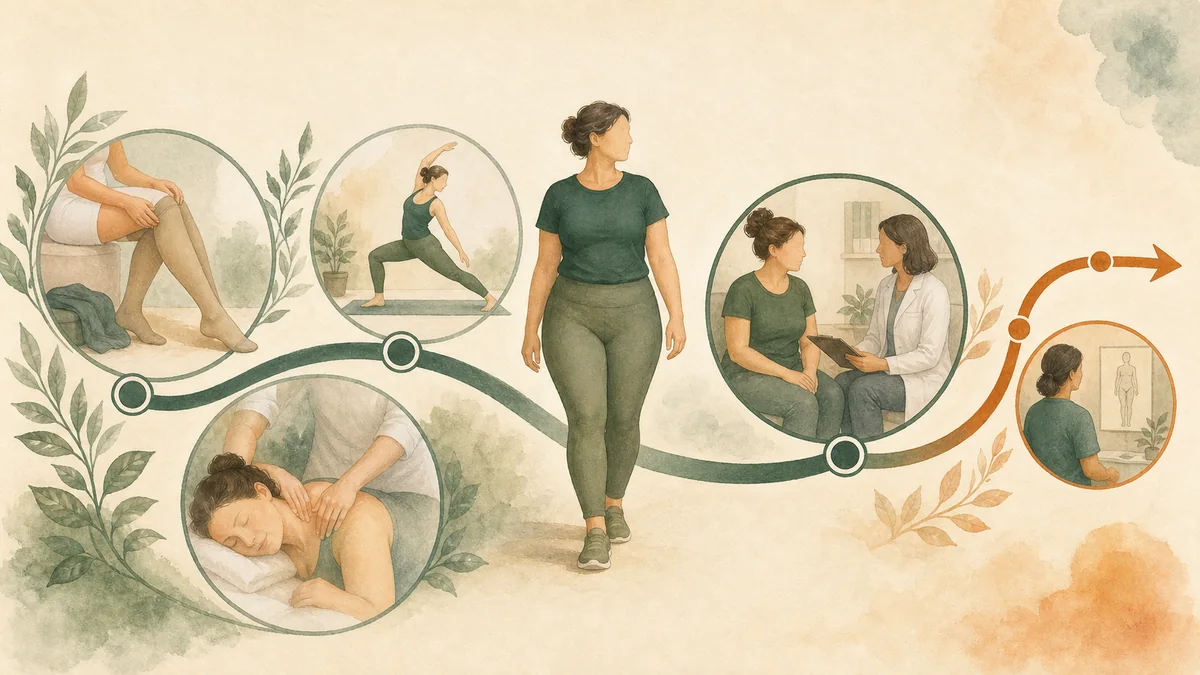
If you've been told there's no fix for lipedema, that's accurate — but it isn't the whole story. Lipedema treatment isn't about erasing the condition; it's about controlling pain, limiting how much affected tissue changes over time, and keeping you moving comfortably for as long as possible. Multiple approaches exist, and they aren't interchangeable or equally weighted: conservative care comes first, consistently, and surgery is a later option for people it doesn't fully help.
This guide walks through what actually works, in the order clinicians typically recommend it. For background on what lipedema is and how it's recognized in the first place, see our is it lipedema? overview or our guide to what lipedema is.
Lipedema Treatment: There Is No Cure — What It Aims For
It's worth saying plainly, because so much online content blurs this: lipedema has no known cure, a fact confirmed by the 2021 US standard-of-care guideline for lipedema, and no treatment — conservative or surgical — reverses the underlying disorder.1 That doesn't mean treatment is pointless. It means the goal is realistic and still meaningful: reduce pain, control swelling, and preserve the ability to move and function well.
Framing it this way matters for two reasons. First, it protects you from products or programs promising to eliminate lipedema entirely — a claim worth scrutinizing every time you see it (our guide to "cure" claims covers this directly). Second, it sets expectations correctly before any treatment begins, so genuine improvement in pain and mobility doesn't get dismissed just because the tissue itself hasn't disappeared.
Conservative Care: The Foundation
Conservative — meaning non-surgical — care is the standard starting point for lipedema management, and it's not a placeholder step on the way to surgery. It's the approach with the most consistent, longest-standing use documented in the US standard-of-care guideline for lipedema, and it continues even for people who eventually have surgery.1 Four pillars make up this foundation: compression garments, manual lymphatic drainage, regular movement, and structured pain management — each targeting a different part of how the condition affects the body.
Compression
Well-fitted compression garments help manage swelling and support affected tissue during daily activity. Getting the right garment type, fit, and wear schedule takes some trial and adjustment, and comfort issues are common early on.
Manual Lymphatic Drainage
MLD is a gentle, specialized massage technique intended to encourage fluid movement in affected tissue. It's typically performed by a certified lymphedema therapist, sometimes alongside broader complete decongestive therapy.
Movement & Exercise
Low-impact movement — walking, water-based exercise, gentle strength work — is generally encouraged within a comfortable pain range, rather than pushed as an aggressive weight-loss strategy.
Pain Management
Because lipedema tissue is often genuinely tender or painful, ongoing pain management — not just "toughing it out" — is considered a legitimate and necessary part of care, not a separate issue.
Each of these deserves more detail than an overview can give. Our conservative care guide covers all four in depth, including what realistic expectations look like and how to find a qualified lymphedema therapist.
Continue: Conservative treatment for lipedema in full →When Surgery Is Considered
Surgery isn't the default next step after conservative care — it's an option raised when symptoms persist despite a genuine, consistent trial of compression, MLD, movement, and pain management. Clinicians typically weigh disease stage, symptom burden, functional impact, and how much conservative measures have already helped before discussing surgery at all.
It's also worth noting that conservative care isn't just a prerequisite box to check — many patients find it meaningfully reduces symptoms on its own, and some never need surgery. For those who do move forward, our lipedema surgery guide covers candidacy, technique, sessions, and recovery in detail.
What Surgery Can and Cannot Do
When surgery is used for lipedema, it's almost always some form of lymph-sparing tumescent or awake liposuction, aimed at reducing the volume of diseased fat tissue in affected areas, as described in a 2024 case series and narrative review.2 A 2024 systematic review and meta-analysis of liposuction techniques for lipedema reports improvements in pain, heaviness, and mobility for many patients, with relatively low complication rates in the reviewed studies.3
What it cannot do is cure the condition. Lipedema is a systemic tissue disorder, not a localized fat deposit, so surgery addresses the tissue that's removed — it doesn't change the underlying disease process elsewhere in the body. Progression in untreated areas remains possible, and conservative care doesn't stop being necessary once surgery is done; if anything, it typically continues indefinitely afterward.
Diet & Nutrition
Diet is one of the most emotionally loaded topics for people with lipedema, many of whom have been told for years that losing weight would fix their legs. It's worth being direct: lipedema fat is resistant to diet and exercise in a way ordinary fat isn't, so no eating pattern removes it on its own. Nutrition can still play a supportive role — helping manage inflammation, comorbidities, and general health — which is a different thing from treating lipedema directly.
This site doesn't publish calorie targets, meal plans, or weight goals, for reasons our diet and nutrition guide explains in full. That guide also covers what the current evidence does and doesn't support, and why working with a registered dietitian tends to be more useful than a generic plan.
About "I Cured My Lipedema" Claims
Searches for stories about curing lipedema are common, and the motivation behind them — hope, frustration, years of being dismissed — is completely understandable. The honest answer is that no cure exists, and what usually explains a dramatic-sounding "cure" story is something else: coexisting weight loss unrelated to lipedema tissue, reduced swelling mistaken for fat loss, an original misdiagnosis, or early-stage fluctuation.
None of this means genuine improvement is impossible — real, meaningful improvement in pain and function absolutely happens with consistent care. It just isn't the same as a cure, and conflating the two can lead people toward unproven products or programs. Our full breakdown of cure claims walks through this distinction and some red flags worth watching for.
Insurance in the US
Insurance coverage for lipedema care in the US is inconsistent. Compression garments and therapist-provided MLD are more often covered, at least partially, than surgery is. Surgical coverage — when available at all — typically requires documentation: a formal diagnosis, records of conservative care already tried, and evidence of functional impact, since many insurers still default to treating liposuction as cosmetic unless proven otherwise.
Because requirements vary so widely by plan and by state, this overview can't stand in for checking your own policy. Our insurance coverage guide goes through the documentation that tends to matter and how appeals commonly work when a claim is denied.
Building Your Care Team
Lipedema management works best as a team effort rather than a single appointment. Depending on where you are in the process, that team might include a physician familiar with lipedema (often a phlebologist, vascular specialist, or lipedema-experienced plastic surgeon), a certified lymphedema therapist for compression and MLD, a registered dietitian, and — for some patients — a surgeon experienced in lymph-sparing technique.
Finding clinicians who genuinely recognize lipedema can take time, since awareness of the condition still varies a lot between providers. Our guide on finding a knowledgeable clinician covers what to look for and how to evaluate fit — without ranking or recommending specific names, which we don't do anywhere on this site.
Frequently Asked Questions
-
Can lipedema be cured?
No. Lipedema currently has no known cure. Treatment — whether conservative care or surgery — aims to control symptoms, support mobility, and improve quality of life, not eliminate the underlying condition. Our guide on "I cured my lipedema" claims explains why some recovery stories sound more dramatic than what the evidence actually supports.
-
What treatment do doctors recommend first for lipedema?
Conservative care is the standard starting point: compression garments, manual lymphatic drainage, movement, and pain management. It's typically tried consistently before surgery is discussed, and it continues afterward even if surgery is eventually pursued. Our conservative care guide covers each component in detail.
-
When is surgery considered for lipedema?
Surgery is generally considered when pain, swelling, or mobility problems persist despite a consistent trial of conservative care, or when disease stage and symptom burden are significant enough that conservative measures alone aren't enough. It is a decision made with a clinician, not a default next step — see our lipedema surgery guide for what that evaluation looks like.
-
Does insurance cover lipedema treatment in the US?
It depends on the plan and the specific treatment. Compression garments and MLD are more commonly covered than surgery, and many insurers require documented conservative care and medical necessity before considering surgical claims. Our insurance guide walks through what documentation tends to matter.
-
Can diet get rid of lipedema?
No. Lipedema fat resists diet and exercise in a way ordinary fat doesn't, so no eating pattern removes it directly. Nutrition can still support overall health and help manage related conditions, which is different from treating lipedema itself — our diet and nutrition guide covers what the evidence actually supports.
-
What happens if lipedema is left untreated?
Lipedema is generally considered a progressive condition, meaning affected tissue can gradually increase and become firmer over time without management, and mobility can become more difficult at later stages. It doesn't progress the same way in everyone, but conservative care early on, as described in our conservative care guide, is associated with better long-term function than leaving symptoms unaddressed.