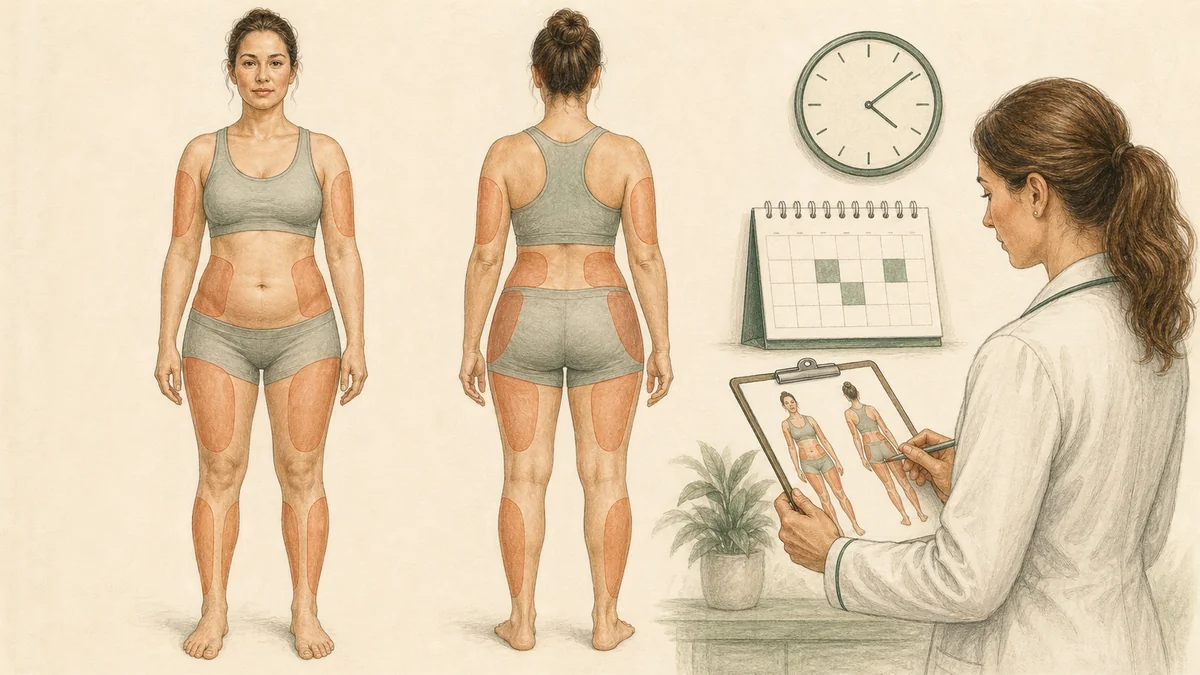
One of the most common questions about awake liposuction isn't about pain or recovery — it's simply "can this technique treat my area?" When people search for information on awake liposuction areas, the honest answer is that the awake/tumescent technique can reach most of the same general regions as liposuction performed under general anesthesia; what changes is how much can safely be done in a single visit and whether staging makes more sense than one long session.
This page focuses strictly on which general body regions the awake technique itself can treat and why — not on cosmetic outcome comparisons between different areas, which fall outside what this site covers. For the fuller picture of the technique, see our awake liposuction overview.
Commonly Treated Awake Liposuction Areas
The awake/tumescent technique is most often used on areas with accessible subcutaneous fat and enough surface area to infiltrate the tumescent solution evenly. In general practice, this commonly includes the thighs (inner and outer), the abdomen, the flanks, and the arms — regions frequently affected in both cosmetic contexts and in conditions like lipedema.
| Region | General technique considerations |
|---|---|
| Thighs (inner & outer) | Large surface area; often bilateral in lipedema, which raises total volume planning |
| Abdomen | Accessible superficial fat layer; frequently combined with flank treatment in one session |
| Flanks | Commonly paired with abdomen; contributes to total volume calculations |
| Arms | Smaller surface area than legs but often bilateral in lipedema |
| Back | Less commonly treated alone; access and positioning are more technique-dependent |
None of these regions is inherently off-limits to the awake technique. What matters more is discussed in the next section: how much tissue, combined across every area planned for a session, the anesthesia can safely cover at once.
Why the Technique — Not Just the Body Area — Determines Candidacy
Tumescent anesthesia relies on a diluted local anesthetic solution infiltrated into the tissue, and that solution has a well-established dosing ceiling based on body weight — a limit established in Klein's 1990 tumescent technique paper to prevent lidocaine toxicity.1 Klein & Jeske's 2016 dosing safety study refined those estimates further, distinguishing safe dosing thresholds for tumescent anesthesia alone versus tumescent anesthesia combined with liposuction.2 That ceiling, more than the specific body region, is what determines how much total area can realistically be treated while fully awake in one session.
In practice, this means two people with similar body areas but different overall treatment volumes — say, one small area versus several large ones — can have very different plans, even if every area involved is individually "commonly treated." The math is about total tissue volume and total anesthetic dose, not a simple checklist of which parts of the body qualify.
Continue: When general anesthesia is the better option →Larger or Multiple Areas Often Mean Staging
When a treatment plan involves a large single area, several areas, or both, staying within safe anesthesia limits often means splitting treatment into multiple sessions spaced weeks apart, rather than trying to complete everything in one long visit. This is a routine, planned part of care for larger cases — not a sign that something went wrong or that the awake technique "couldn't handle it."
A 2024 systematic review and meta-analysis of liposuction approaches used in lipedema management found that staged treatment across multiple sessions is a common and well-tolerated pattern, particularly when large or multiple regions are involved.3 Our guide on sessions and staging explains how surgeons typically sequence and space these visits.
When General Anesthesia Fits Better
There's a point at which the combined size of the areas involved, the number of regions planned, or a patient's anxiety and tolerance make general anesthesia a more appropriate choice than staying awake — even with staging available as an option. This isn't a failure of the awake approach; it's simply matching the anesthesia plan to the case in front of the surgical team.
Our dedicated guide on when awake isn't the right choice goes through these factors — volume limits, patient tolerance, and medical considerations — in full detail, including why "awake" is not automatically the safer or better option for every situation.
Lipedema and Large Treatment Areas
Large treatment areas are especially common in lipedema, because the condition typically affects both legs, or both arms, symmetrically and disproportionately rather than a single small region, per a 2025 PMC clinical review.4 That symmetric, large-volume pattern is one of the main reasons lipedema surgical plans frequently involve multiple staged sessions rather than a single visit.
This connects directly to why technique choice matters more in lipedema than in many cosmetic liposuction cases — the starting volume is often larger, the tissue itself may already be tender, and the total number of sessions needed tends to be higher. Our page on why the awake technique is often used for lipedema explains this connection in more depth, and our sessions and staging guide covers how a multi-session lipedema plan is typically structured.
Awake Liposuction Areas: What Body Position Allows
One thing rarely mentioned in awake-technique overviews is how much the patient's ability to reposition during a conscious procedure quietly expands which awake liposuction areas can be treated effectively in a single session. Under general anesthesia, moving a fully anesthetized patient safely from supine to lateral or prone position requires a coordinated team effort and is generally minimized to reduce airway and pressure-injury risk. A conscious patient can, with staff guidance, roll or shift positions between passes to allow the cannula to reach circumferential areas from multiple angles.
Practically, this makes a real difference for regions like the outer thighs, the posterior arms, and any area that benefits from being addressed from more than one direction — treatment planning can build repositioning into the session itself rather than deferring the "other side" to a later visit purely for positional reasons. That said, patient comfort and stamina still bound how long a repositioning-heavy session should run, which is why staging enters the conversation for larger cumulative areas even when access itself isn't the bottleneck. Our awake liposuction limits guide covers where those practical ceilings fall in more depth.
What to Discuss With Your Surgical Team
If you're weighing which areas can realistically be addressed in your case, a few questions are worth raising directly with a qualified surgeon: how many total areas are being considered, what the estimated combined treatment volume looks like, whether staging or general anesthesia makes more sense given that volume, and how session spacing would be planned if more than one visit is needed.
These are individualized clinical decisions, not something a general guide can answer for a specific case — but knowing the right questions to ask helps you have a more informed conversation with your own surgical team.
One more angle worth raising directly with the surgical team is how each planned area is sequenced relative to the others across the whole treatment arc. Areas addressed early in a multi-session plan can influence the swelling, sensation, and compression tolerance a patient carries into later sessions.
Ask which area comes first, why, and what recovery between sessions is expected to look like. If the plan is described only in single-area terms without a sequencing rationale, it is reasonable to ask for the fuller staged view before making a decision. Our sessions and staging guide covers how experienced teams typically approach sequencing across multiple visits.
Frequently Asked Questions
-
Can any body area be treated with awake liposuction?
Many common areas — including the thighs, abdomen, flanks, and arms — can be treated with the awake/tumescent technique, but suitability depends more on the total volume being treated and anesthesia dosing limits than on the specific body part alone. A surgeon evaluates each area individually as part of planning, which our awake liposuction overview explains further.
-
Why do some areas need multiple sessions?
Tumescent anesthesia has a dosing ceiling, so treating a very large area or several areas in one sitting can exceed what's safe to do in a single session. Splitting treatment into staged sessions keeps each visit within safe limits — our guide on sessions and staging covers how surgeons plan that timeline.
-
Does lipedema mean I'll need more sessions?
Often, yes. Lipedema commonly affects large, symmetric areas — both legs or both arms at once — which naturally increases the total treatment volume compared to a single, smaller area. Our page on why the awake technique is often used for lipedema explains how this factors into planning multiple sessions.
-
Is one body area safer than another for the awake technique?
Safety depends less on which specific area is treated and more on the total volume, anesthesia dose, session length, and the patient's individual health factors. Some areas do require more technical precision due to nearby structures, which is a conversation to have directly with a qualified surgical team during evaluation.
-
What determines whether I need general anesthesia instead?
Very large treatment areas, a high number of regions planned for a single visit, patient anxiety or tolerance, and certain medical factors can all push a case toward general anesthesia rather than staying fully awake. Our guide on when awake isn't the right choice walks through how that decision gets made.
-
How do surgeons decide which areas to treat first?
When multiple areas are planned, surgeons typically prioritize based on symptom impact, functional limitation, and how the areas relate to each other anatomically, then sequence sessions to stay within safe dosing at each visit. This is planned individually rather than following a fixed order — see our sessions and staging guide for more detail.