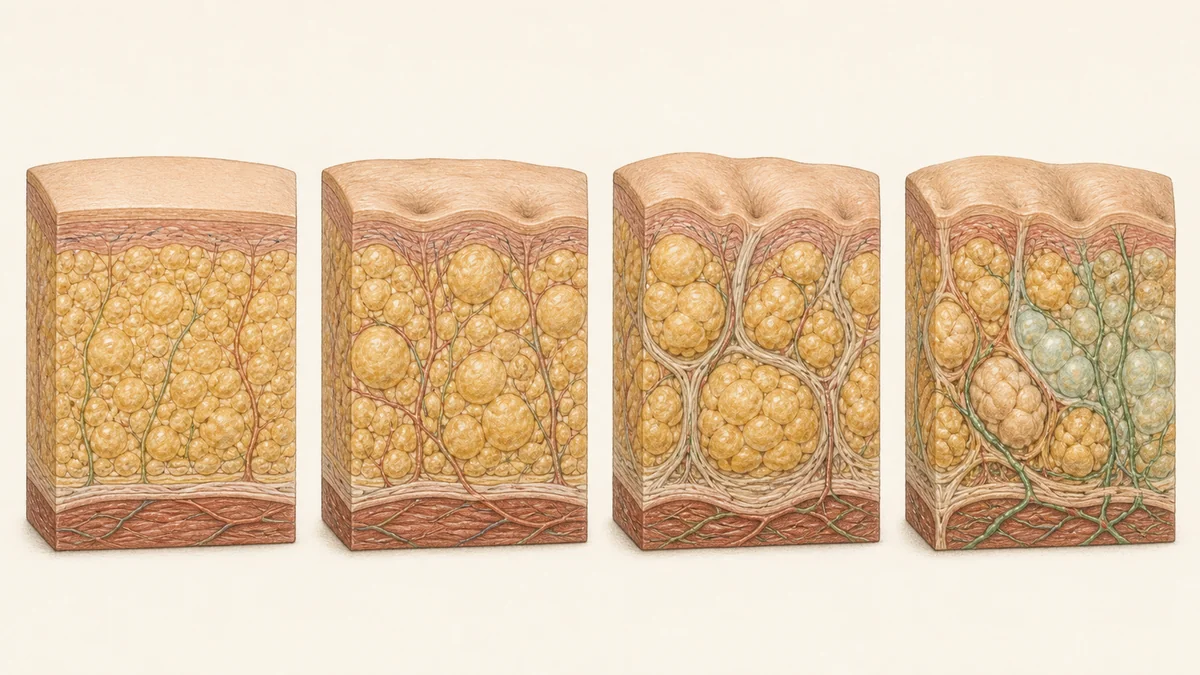
One of the most common questions people ask after learning about lipedema is some version of "how bad is mine?" The lipedema stages framework is the clinical shorthand used to answer that question — but it's often misunderstood, particularly the assumption that a higher stage automatically means more pain, or that everyone with lipedema is destined to progress through all four stages.
This guide explains how lipedema staging actually works, what each stage typically looks like, how distribution "types" differ from stages, and gives an honest answer to whether progression is something everyone should expect. For the full condition overview, start with our what is lipedema guide; this page focuses specifically on how the condition changes over time.
How Lipedema Stages Work — and Why Stage ≠ Pain Severity
Lipedema staging is based on physical tissue and skin characteristics observed during a clinical examination — things like skin surface texture, the size and firmness of underlying nodules, and how pronounced any tissue lobulation has become, per Herbst et al.'s 2021 consensus guideline.2 It is a way of describing how far the tissue changes have progressed, not a measure of how much pain or discomfort a person experiences.
This distinction matters a great deal in practice. Some people with relatively early-stage lipedema report significant pain and functional limitation, while others at a more advanced stage report comparatively manageable discomfort. Stage and pain severity are related to the same underlying condition, but they are not interchangeable, and a clinician evaluating lipedema should assess both separately rather than assuming one from the other.
It's also worth understanding what staging is not: it isn't a countdown, and it isn't a single number a person is permanently assigned the moment they're diagnosed. A clinical evaluation at one point in time reflects the tissue as it presents then — it's a snapshot used to guide care, not a fixed life sentence describing where someone is destined to end up.
Stage 1
In stage 1, the skin surface typically still looks smooth, but the tissue underneath already has the characteristic nodular, uneven texture associated with lipedema — sometimes described as feeling like small peas or grains of rice when gently palpated. Swelling and disproportion may be relatively mild at this stage, which is part of why stage 1 lipedema is so frequently overlooked or mistaken for ordinary weight distribution. Our early signs guide covers what to look for before the disproportion becomes obvious.
Stage 2
Stage 2 is generally marked by more noticeable changes to the skin surface itself — an uneven, sometimes dimpled appearance — along with larger and more prominent nodules beneath the skin. Disproportion between the affected limbs and the rest of the body tends to be more visually apparent than in stage 1, and symptoms like pain and heaviness often become more consistently present.
Stage 3
By stage 3, tissue changes are typically more pronounced, with larger deposits that can form distinct lobules or folds of tissue, sometimes affecting mobility and the ability to find well-fitting clothing or compression garments. The disproportion between affected areas and the rest of the body is usually clearly visible at this stage, and functional impact — difficulty walking long distances, joint strain, or skin fold irritation — becomes a more common concern.
Stage 4 (Lipo-Lymphedema)
Stage 4, often referred to as lipo-lymphedema, describes advanced lipedema in which a secondary lymphedema component has developed on top of the underlying fat-tissue disorder, as described in a 2023 StatPearls overview of lipedema.1 This happens because, over time, enlarged lipedema tissue can place enough pressure on the lymphatic system to impair its normal function, leading to additional fluid-related swelling layered on top of the original condition. Lipo-lymphedema typically requires coordinated care that addresses both the lipedema and the lymphatic involvement together, rather than treating either in isolation.
Continue: How lipedema and lymphedema interact →Types (Distribution Patterns)
Separate from staging, lipedema is also described by distribution "type" — which parts of the body are affected. Common patterns include involvement limited to the hips and thighs, involvement extending down through the lower legs while sparing the feet, and less commonly, involvement of the arms alongside or instead of the legs. A person's type generally describes where the condition shows up, while their stage describes how far it has progressed at that location — the two classifications work together but answer different questions.
Because distribution patterns deserve their own detailed treatment, we cover them fully in a dedicated types and distribution patterns guide, including how each pattern tends to affect symptoms and management differently.
Does Everyone Progress?
Here's the honest answer: no, progression through the stages is not inevitable for everyone with lipedema. In a prospective cohort of 100 patients followed for an average of 4.6 years, 62% remained stable, 28% progressed, and 10% improved, according to Forner-Cordero and Muñoz-Langa's 2025 study.4 That study measured lower-limb volume rather than every aspect of stage, but it directly challenges the idea that worsening is automatic.
Consistent conservative care — compression, movement, and manual lymphatic drainage where appropriate — can support symptom control and day-to-day function, according to Herbst and colleagues' 2021 consensus guideline.2 It should not be presented as proven prevention of stage progression: the prospective cohort found no association between maintenance therapies and progression.4
The most useful way to think about this is neither falsely reassuring nor fatalistic: lipedema is a real, chronic condition that can progress, but a stage 1 diagnosis today does not automatically mean a stage 4 outcome tomorrow. Accurate evaluation and conservative management are still worth prioritizing for symptom control and function. The natural history of lipedema across a lifetime has not been mapped in enough long-term prospective studies to predict how quickly or how far any one person's findings will change.
It also helps to separate two different anxieties that often get tangled together: worrying about whether lipedema will progress, and worrying that nothing can be done about it either way. Conservative measures have a documented role in symptom management, and treatment decisions are rarely limited to simply waiting and watching, per Herbst et al.'s 2021 consensus guideline.2
What Staging Means for Treatment
Stage can inform how a care team approaches treatment planning, though it is only one factor among several — symptom severity, functional impact, and a person's overall health also matter. Earlier-stage lipedema is often managed primarily through conservative measures, covered in full in our conservative care guide. More advanced presentations, or cases where conservative care alone isn't providing enough relief, may involve a conversation about surgical options — typically performed using lymph-sparing tumescent or awake liposuction techniques designed to minimize additional lymphatic disruption, per a 2024 Archives of Plastic Surgery systematic review.3
Regardless of stage, conservative care doesn't stop once surgery is considered — it typically continues afterward as part of ongoing management. Our treatment options overview covers the full sequence, from conservative care through surgical considerations, in more depth.
If surgery does become part of the conversation, staging and distribution type together help a surgical team estimate how many sessions realistic treatment might involve, since more extensive or advanced tissue involvement is generally addressed gradually rather than in a single operation. Our sessions and staging guide covers that planning process in more detail.
Frequently Asked Questions
-
What stage of lipedema do I have?
Staging is determined by a clinician during a physical examination, not by self-assessment — it depends on specific tissue and skin characteristics that are difficult to judge accurately on your own. This page can't diagnose you or assign a stage; our how lipedema is diagnosed guide explains what that clinical evaluation actually involves.
-
Does lipedema always get worse?
Not necessarily. Lipedema can change over time, but progression isn't automatic or identical for every person. A prospective cohort found most participants remained stable during follow-up, and maintenance therapies were not associated with progression. Conservative care remains useful for symptom and function management. Our lipedema treatment overview explains what it can realistically achieve.
-
What is stage 4 lipedema?
Stage 4, sometimes called lipo-lymphedema, describes advanced lipedema where a secondary lymphatic component has developed alongside the underlying fat-tissue disorder. It represents a more complex presentation that typically requires coordinated care addressing both the lipedema and the lymphatic involvement — see our lipedema and related conditions guide for how the two interact.
-
Does a higher stage mean more pain?
Not directly. Stage describes physical tissue and skin characteristics, while pain severity is a separate dimension that doesn't reliably track with stage — some people with earlier-stage lipedema report significant pain, while others at a later stage report comparatively little. Our lipedema symptoms guide covers pain and tenderness as their own distinct symptom category.
-
Can lipedema go back to an earlier stage?
Lipedema staging generally describes a progressive trajectory rather than one that reverses, though consistent conservative care can meaningfully reduce swelling, pain, and functional impact even without changing the underlying stage. Our treatment options guide explains what conservative care and, in some cases, surgery can realistically achieve at any stage.
-
Are lipedema types and lipedema stages the same thing?
No. Stages describe how far the tissue has progressed over time, while types describe which parts of the body are affected — for example, whole-leg involvement versus hips-and-thighs only. A person's type generally stays consistent while their stage can change; see the types section above or our full types and distribution patterns guide for more detail.