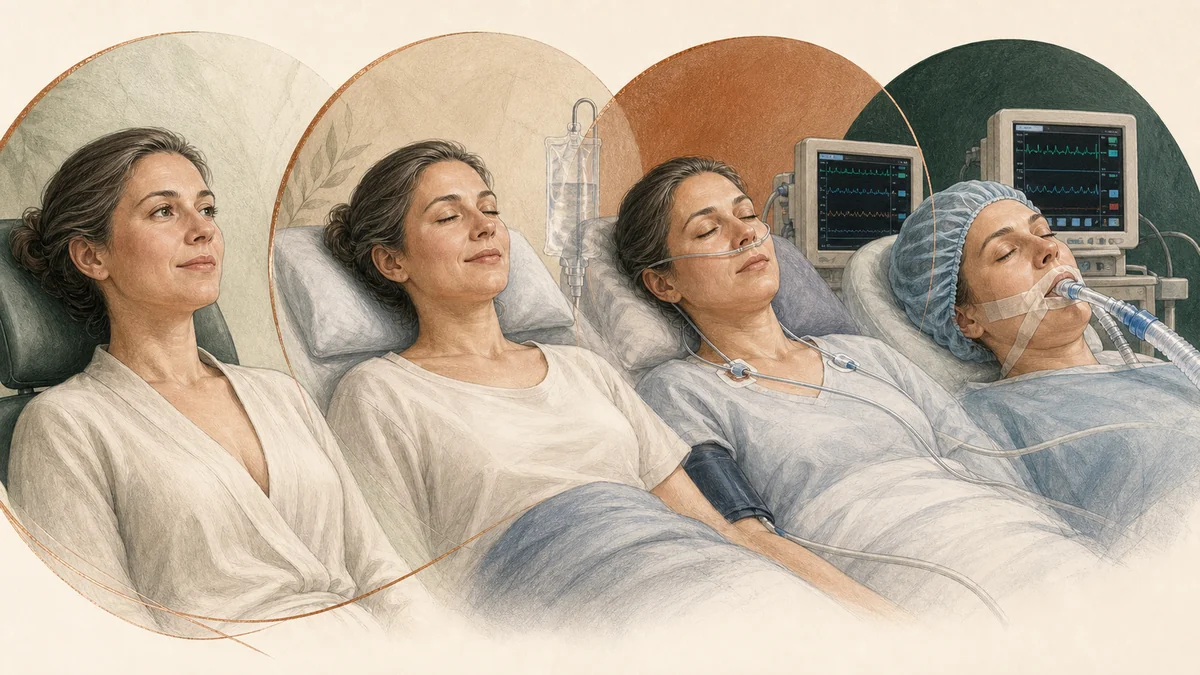
If you're preparing for a body procedure and keep running into terms like "MAC anesthesia," "twilight sedation," and "conscious sedation" used almost interchangeably, you're not imagining the confusion — these terms genuinely overlap, and even patient education materials often use them loosely. With the anesthesia options compared side by side, this guide lays out the full spectrum in one place, from the lightest option (local anesthesia) to the deepest (general anesthesia), so you can understand what's actually being offered before you're asked to consent to it.
None of this is meant to steer you toward a particular choice. The right anesthesia plan depends on the procedure being performed, your health history, and the judgment of the anesthesia provider and surgeon working together — and every option here has an appropriate use case. If you're specifically weighing an awake, tumescent-anesthesia liposuction procedure, our awake liposuction overview covers how that technique fits into this broader spectrum.
Anesthesia Options Compared: The Spectrum at a Glance
The table below lines up all five options against the same five dimensions: how conscious you are, who manages your airway, how you're monitored, what recovery typically looks like, and who administers the anesthesia. Treat this as an orientation map, not a decision tool — your own procedure and health details determine which column actually applies to you.
| Type | Consciousness Level | Airway | Monitoring | Recovery | Who Administers |
|---|---|---|---|---|---|
| Local anesthesia | Fully awake and alert | Self-managed | Basic vitals, spot-checked | Minutes to a couple of hours | Surgeon or proceduralist |
| Tumescent anesthesia | Fully awake, comfortable | Self-managed | Continuous vitals during infiltration | Same day, typically fast | Surgeon, often with anesthesia support |
| Twilight sedation / MAC | Drowsy to light sleep; can shift during the case | Usually self-managed, closely watched | Continuous, by a dedicated anesthesia provider | Grogginess for a few hours; need a companion | Anesthesiologist or CRNA |
| Conscious (moderate) sedation | Responsive to voice/touch, relaxed | Self-managed | Continuous, by a dedicated provider | Similar to twilight/MAC | Anesthesiologist, CRNA, or trained provider |
| General anesthesia | Fully unconscious | Managed by the provider (often a breathing tube) | Continuous, most intensive of the five | Hours to a full day; grogginess, possible nausea | Anesthesiologist or CRNA |
Local Anesthesia
Local anesthesia is the simplest option on the spectrum: a numbing medication is injected directly into a small, specific area, blocking pain signals there while you remain completely awake and aware throughout. It's typically used for minor procedures on a limited area, and because no sedative drugs are involved, recovery is usually immediate — you can often resume normal activity within a short time.
The trade-off is scope. Plain local anesthesia numbs only the area where it's injected, and the total dose is limited, which makes it unsuitable on its own for larger-volume or more extensive procedures. That limitation is exactly what led to the development of the tumescent technique, covered next.
Tumescent Anesthesia
Tumescent anesthesia solves the scope problem by infusing a large volume of dilute local anesthetic — typically lidocaine mixed with epinephrine and saline — directly into the tissue being treated. Because the anesthetic is so diluted, providers can safely use a much higher cumulative dose than a plain local injection would allow, extending numbing across a far larger area while a patient stays fully awake and comfortable, according to Klein's original tumescent technique research.3
This dose math was worked out specifically for procedures like liposuction, and Klein and Jeske's follow-up research on tumescent lidocaine dosing has since refined the estimated maximum safe amounts of tumescent lidocaine well beyond what was assumed possible with plain local injections.4 It's a core part of what makes awake, tumescent-anesthesia liposuction possible without general anesthesia, and it's frequently combined with light sedation for patients who want extra comfort without losing consciousness.
Continue: MAC anesthesia — what it actually means →Twilight Sedation / MAC
This is where the terminology gets genuinely confusing, and it's worth clarifying up front: "twilight sedation" is patient language, while the clinical term for the same underlying care model is Monitored Anesthesia Care (MAC). MAC isn't a specific drug or a fixed level of sleepiness — it's a model of care in which a dedicated anesthesia provider continuously monitors you and titrates sedation up or down as the procedure requires, sometimes moving between lighter and deeper states within the same case, as described in Das and Ghosh's overview of monitored anesthesia care.1
Under MAC, most patients drift somewhere between drowsy and lightly asleep, can usually still breathe on their own, and often have limited or partial memory of the procedure afterward — though there's no guarantee of complete amnesia. Our dedicated guides go much deeper on both angles of this: twilight sedation explained covers what it actually feels like, and MAC anesthesia explained covers the clinical model behind it in full, including who provides it and what's monitored.
Conscious Sedation — Same Thing?
Not exactly, even though the terms are frequently used as if they were interchangeable. Conscious sedation — also called moderate sedation — describes a specific point on the sedation-depth spectrum: you're relaxed and drowsy but can still respond to voice or light touch. MAC, by contrast, describes a model of care rather than one fixed depth, and a MAC case can move through the conscious-sedation range as part of a broader plan that the provider adjusts throughout the procedure, per a review of monitored anesthesia care in and outside the operating room.2
In practice, a patient described as receiving "twilight sedation" or "MAC" is very often, at some point during the case, experiencing something that would technically be classified as conscious sedation — which is exactly why the casual terms blur together. Our full conscious sedation guide untangles this distinction with a side-by-side look at where each term actually applies.
General Anesthesia
General anesthesia is the deepest point on the spectrum: you are fully unconscious, unable to respond to voice or touch, and your airway is actively managed by the anesthesia provider — often with a breathing tube — for the duration of the procedure. It requires more intensive monitoring and typically a longer recovery window than any lighter option, including grogginess and sometimes nausea in the hours afterward.
General anesthesia is generally reserved for procedures that are longer, involve a larger treatment area, or where a patient's anxiety or medical situation makes staying conscious impractical. It isn't inherently more dangerous than lighter sedation — it simply carries a different risk profile, discussed further below.
How Providers Choose
Anesthesia decisions are rarely arbitrary. Providers typically weigh the expected length and scope of the procedure, the patient's overall health and any relevant medical history, the patient's anxiety level and personal preference, and what a given facility is equipped and accredited to safely monitor. A short, small-area procedure might call for nothing beyond local or tumescent anesthesia, while a longer, larger-volume case may point toward twilight/MAC, conscious sedation, or general anesthesia instead.
Health history plays a bigger role than many patients expect. Conditions affecting the heart, lungs, or airway, current medications, and prior reactions to anesthesia can all shift a plan toward — or away from — a particular option, sometimes independent of what the procedure itself would otherwise call for. This is one reason a thorough pre-procedure medical history review matters as much as the procedure plan itself.
This is also a genuinely collaborative decision — a patient's stated comfort level matters, but it's balanced against what's medically appropriate for the specific procedure being planned. That's why the same procedure can reasonably be done under different anesthesia approaches for two different patients, and why a plan discussed at consultation can sometimes be adjusted again on the day of the procedure if circumstances change. Reviewing the anesthesia options compared here in advance is what makes that day-of conversation productive rather than confusing.
Safety Considerations by Type
It's tempting to assume that "lighter" anesthesia is automatically "safer" anesthesia, but that oversimplifies a more nuanced picture. Every option on this spectrum carries its own risk profile, and outcomes depend heavily on two things that have nothing to do with depth alone: the patient's individual health factors, and the quality and continuity of monitoring during the procedure, a point underscored by a review of monitored anesthesia care in and outside the operating room.2 A well-monitored deeper sedation can be safer in practice than a poorly monitored lighter one, and vice versa.
For tumescent anesthesia specifically, safety is closely tied to respecting established dose limits for the local anesthetic used — a boundary that Klein and Jeske's follow-up research on tumescent lidocaine dosing has studied and refined over decades of clinical use.4 For twilight/MAC and conscious sedation, safety depends heavily on having a dedicated, appropriately trained provider monitoring you continuously rather than intermittently. For general anesthesia, the risk profile shifts toward airway management and the physiological demands of full unconsciousness, which is exactly why it's paired with the most intensive monitoring of any option on this list. Our safety and risks by anesthesia type guide goes into this in more depth, including what accreditation and monitoring standards to look for regardless of which option applies to you.
Questions to Ask Before Your Procedure
Whatever anesthesia approach is proposed, a short list of direct questions can help you understand what to expect and confirm the plan is a good fit:
- What type of anesthesia or sedation is planned, and why is it the right fit for my specific procedure?
- Who will be monitoring me during the procedure, and what is their training and credential?
- What does the facility use to monitor vital signs, and is it accredited for this level of sedation?
- What will recovery look like immediately afterward, and do I need a companion to take me home?
- What are the specific risks for someone with my health history, and how are they managed?
Bringing a written list to your pre-procedure consultation is a simple, practical way to make sure these questions actually get answered before you consent.
Frequently Asked Questions
-
What's the difference between twilight sedation and MAC?
There isn't really a clinical difference — "twilight sedation" is the everyday term patients use, while Monitored Anesthesia Care (MAC) is the clinical name for the same care model: an anesthesia provider monitoring you and adjusting sedation depth as needed. Our full MAC anesthesia guide breaks down exactly how the terminology maps.
-
Is conscious sedation the same as twilight sedation?
They overlap but aren't identical. Conscious (moderate) sedation describes a specific depth on the sedation spectrum, while twilight sedation is patient language that often describes MAC — a care model that can move across several depths, including the conscious sedation range. See our conscious sedation guide for how the terms actually relate to each other.
-
Is local anesthesia enough for liposuction?
It depends on the treatment area and volume. Plain local anesthesia numbs a limited area, but the tumescent technique — a large volume of dilute local anesthetic infused into the tissue — extends what can be treated comfortably while a patient stays fully awake. Our tumescent anesthesia section above explains how this works and its safe dosing limits.
-
Which anesthesia type is safest?
There's no single "safest" option that applies to everyone — safety depends on the patient's health, the procedure's scope, and, just as importantly, the quality of monitoring during the procedure. A lighter sedation level isn't automatically safer than a deeper one; see our safety considerations by type section for how these factors actually interact.
-
Who decides which anesthesia I'll get?
It's typically a joint decision between the anesthesia provider and the surgeon, based on the planned procedure's length and scope, your overall health, any medications you take, and your own comfort or anxiety level. Our MAC anesthesia guide covers what a provider actually monitors and adjusts once that decision is made.
-
Can I ask to be more or less sedated?
You can and should raise your preference, but the final sedation plan also depends on medical factors like the procedure's scope and your health history — it isn't purely a menu choice. Bringing up anxiety or a strong preference for staying alert is a reasonable thing to discuss with your MAC anesthesia provider beforehand.