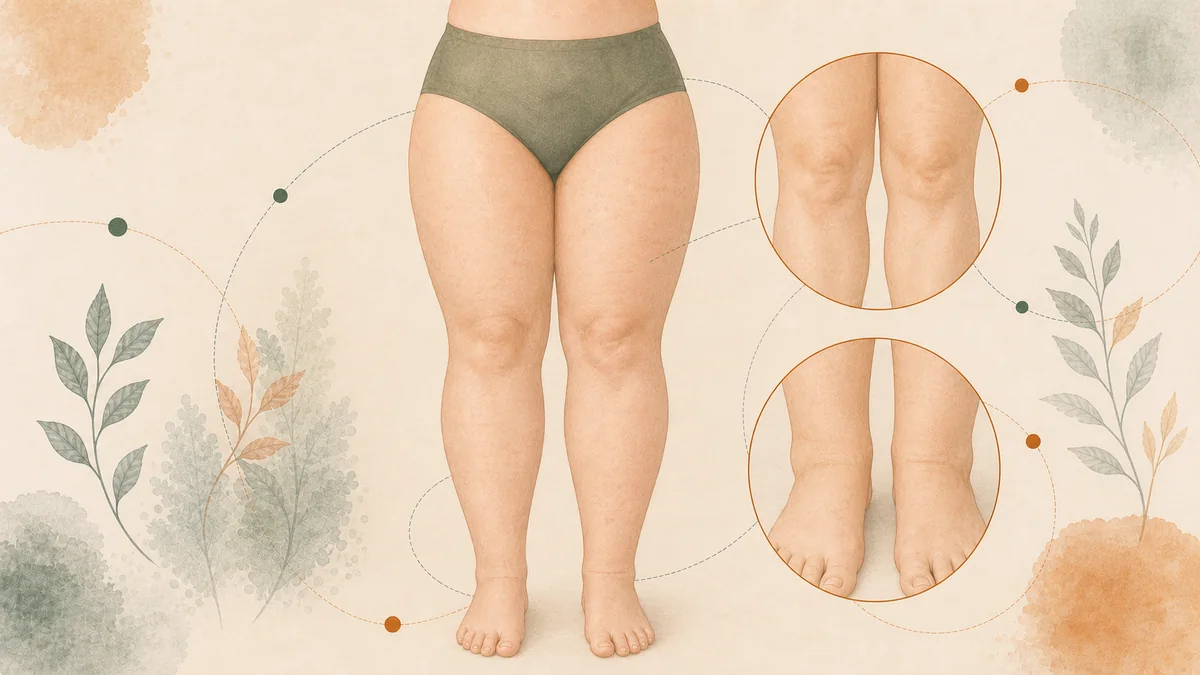
If your legs seem out of proportion with the rest of your body — heavier at the hips and thighs, tender to the touch, and stubbornly unaffected by diet changes — you may be describing lipedema legs, the single most common presentation of this condition. Because leg involvement is where most people first notice something is different, it's also where most confusion happens: with ordinary weight gain, with cellulite, and with swelling from other causes entirely. Our guide to reading the signs on your legs walks through that specific comparison in more depth.
This guide walks through exactly how lipedema typically presents in the legs, the specific pattern that separates it from other kinds of leg swelling, and what the practical impact looks like day to day. For the broader picture of the condition, see our overview of understanding lipedema; nothing here is a diagnosis, only a description of a well-documented clinical pattern.
Lipedema Legs: Typical Distribution
Lipedema in the legs classically follows a top-down pattern: it begins around the hips and thighs and extends down through the calves, often giving the lower body a column-like or "tree trunk" shape that's disproportionate to the upper body, per a 2025 PMC clinical review.1 The distribution is almost always symmetrical — both legs enlarge to a similar degree — which is one of the clearest differences between lipedema and ordinary fat gain, where one side can easily be more affected than the other.
The fat itself tends to feel different from typical fat tissue: many people describe a soft, uneven, sometimes nodular texture under the skin, occasionally compared to small peas or grains of rice. This texture, combined with the distribution pattern, is part of what a clinician evaluates during a physical exam — a subject covered in more depth in our guide on how lipedema is diagnosed.
Not everyone's legs are affected in exactly the same way — some people notice the enlargement concentrated more around the hips and thighs, while others see the calves affected more heavily. This variation in distribution is why clinicians sometimes describe different "types" of lipedema by which segments of the leg are most involved; our guide to lipedema types and distribution patterns covers those variations, along with how the condition can show up in other areas of the body.
The Cuff Sign at the Ankle
One of the most recognizable features of leg lipedema is that it usually stops abruptly at the ankle, leaving the feet a normal size even as the calves and thighs above them are noticeably enlarged. This creates a visible ring or "cuff" where the proportions suddenly change — a pattern that doesn't occur with ordinary weight gain, since typical fat distributes more gradually down the leg and does affect the feet.
The cuff sign is one of the more distinctive visual clues used alongside symmetry, tenderness, and texture when someone is being evaluated for lipedema. It's a helpful detail to point out by name at an appointment, since "my ankles look thin compared to my calves" communicates something more specific than "my legs are swollen."
Continue: Lipedema vs cellulite — how to tell them apart →Symptoms in the Legs
Beyond size and shape, leg lipedema comes with a distinct set of physical sensations. Pain or tenderness to pressure is a commonly reported symptom — many people notice their legs ache when touched, sat on, or pressed against furniture, in a way that ordinary fat simply doesn't, according to Herbst et al.'s 2021 consensus guideline.2 A sense of heaviness is also common, especially by the end of the day, after standing for long periods, or in warm weather.
Easy bruising is another frequent complaint — bruises that appear without a clear cause and take longer than expected to fade, thought to relate to increased fragility of small blood vessels in the affected tissue. None of these symptoms are simply "in your head": pain and tenderness are recognized clinical features of lipedema, not exaggeration, and they're worth describing clearly rather than downplaying at a medical appointment. Our guide on the full range of lipedema symptoms covers how these sensations show up across the whole body, not just the legs.
Symptoms can also fluctuate rather than staying constant. Heat, prolonged standing, hormonal shifts across the menstrual cycle, and long travel days are commonly reported triggers for legs feeling heavier, tighter, or more tender than usual. This variability is a normal feature of the condition, not a sign that something new or separate has gone wrong, though a sudden, one-sided change is always worth having checked.
How Leg Lipedema Differs From Venous Swelling and Lymphedema
Because so many things can make legs look or feel swollen, leg lipedema is frequently mistaken for other conditions — most often ordinary venous swelling or lymphedema, a related but distinct disorder of the lymphatic system. Lymphedema typically does involve the feet and toes and often produces pitting (an indentation that stays after you press the skin), whereas lipedema classically spares the feet and doesn't pit in its earlier stages. Our lipedema vs lymphedema guide covers this distinction — including cases where the two occur together — in much more detail.
Venous insufficiency can cause swelling in one or both legs and may improve with elevation, so laterality alone cannot distinguish it from lipedema. Skin changes, varicose veins, pitting, foot involvement, symptom pattern, and a vascular assessment may all matter. Because venous disease and lipedema can coexist, a clinician familiar with both is better positioned to identify which pattern — or combination of patterns — explains the symptoms.
Impact on Mobility and Daily Life
As leg lipedema progresses, the added tissue weight and volume can gradually affect mobility — walking longer distances, climbing stairs, or finding clothing and footwear that fit comfortably can all become more difficult over time, notes a 2023 StatPearls overview of lipedema.3 Joint strain, particularly at the knees and ankles, is also a common downstream effect of carrying disproportionate lower-body volume for years.
Progression isn't universal or inevitable, and many people with lipedema maintain good mobility for a long time. Conservative care can support comfort, movement, and symptom control, but it cannot guarantee a particular disease course. The practical, daily-life impact is real and worth acknowledging rather than minimizing, particularly since it's frequently dismissed by others as simply being "out of shape." Beyond the physical side, the shape of lipedema legs can also affect everyday choices — from finding trousers and boots that fit both the calf and the ankle to feeling comfortable in warm weather, at the beach, or during exercise classes. That emotional weight is a legitimate part of the picture and something a lipedema-aware clinician will usually acknowledge rather than brush aside.
Management Options for the Legs
Conservative care is the recommended starting point for leg lipedema, before anything more involved is considered. Properly fitted compression garments, gentle low-impact movement, and manual lymphatic drainage where appropriate aim to reduce heaviness, support the tissue, and improve day-to-day function; they are not a proven way to prevent stage progression. Our conservative care guide explains these goals and limitations.
For legs specifically, a knowledgeable fitter can make a significant difference in how comfortable and effective compression actually is, since off-the-shelf garments don't always accommodate the disproportionate shape lipedema creates. Our compression garments guide walks through fitting, fabric types, and realistic wear expectations specifically for legs. When conservative measures aren't enough to manage symptoms, surgical options exist and are covered separately in our lipedema surgery guide.
Frequently Asked Questions
-
Why do my legs hurt when I touch them?
Tenderness to pressure is one of the most consistent features of lipedema tissue, and it's a real physical symptom rather than sensitivity or imagination. The affected fat itself is thought to be inflamed and mechanically sensitive, which is different from ordinary fat that doesn't hurt when pressed. If your legs are painful to touch as well as disproportionately large, that combination is worth describing to a clinician using the word "lipedema" — see our overview of lipedema symptoms.
-
Why do my ankles look different from the rest of my legs?
This is the "cuff sign" — a visible ring where normal-sized feet meet enlarged calves and thighs. It happens because lipedema fat typically builds up from the hips down but stops abruptly above the ankle, sparing the feet almost entirely. This pattern is one of the more distinctive visual clues clinicians look for, and it's explained further in our guide to how lipedema is diagnosed.
-
Is leg swelling from lipedema the same as lymphedema?
No, though the two can look similar and can also occur together in later stages. Lipedema is a fat-tissue disorder, while lymphedema is caused by impaired lymphatic drainage and fluid buildup. Our lipedema vs lymphedema guide covers the specific signs — including foot involvement and pitting — that help tell them apart.
-
Can lipedema affect just one leg?
Lipedema is defined by symmetrical involvement, so it typically affects both legs to a similar degree rather than just one. Noticeably one-sided leg swelling points toward a different cause — such as a vein problem or lymphatic issue on that side — and is a reason to seek evaluation rather than assume it's lipedema.
-
Will losing weight change the shape of my legs?
Not reliably. Lipedema fat is well documented to resist diet and exercise, so a person can lose weight in the face, arms, or torso while the legs stay largely the same shape. This isn't a matter of effort — see our guide on what actually causes lipedema for why the fat itself behaves differently from ordinary weight gain.
-
What can help with heavy, painful legs day to day?
Conservative measures — properly fitted compression, gentle movement, and elevation — are the recommended starting point before anything more involved is considered, and they're covered in depth in our compression garments guide. Many people also find their legs feel heavier by the end of the day or in warm weather, which is a normal pattern rather than a sign something new is wrong.