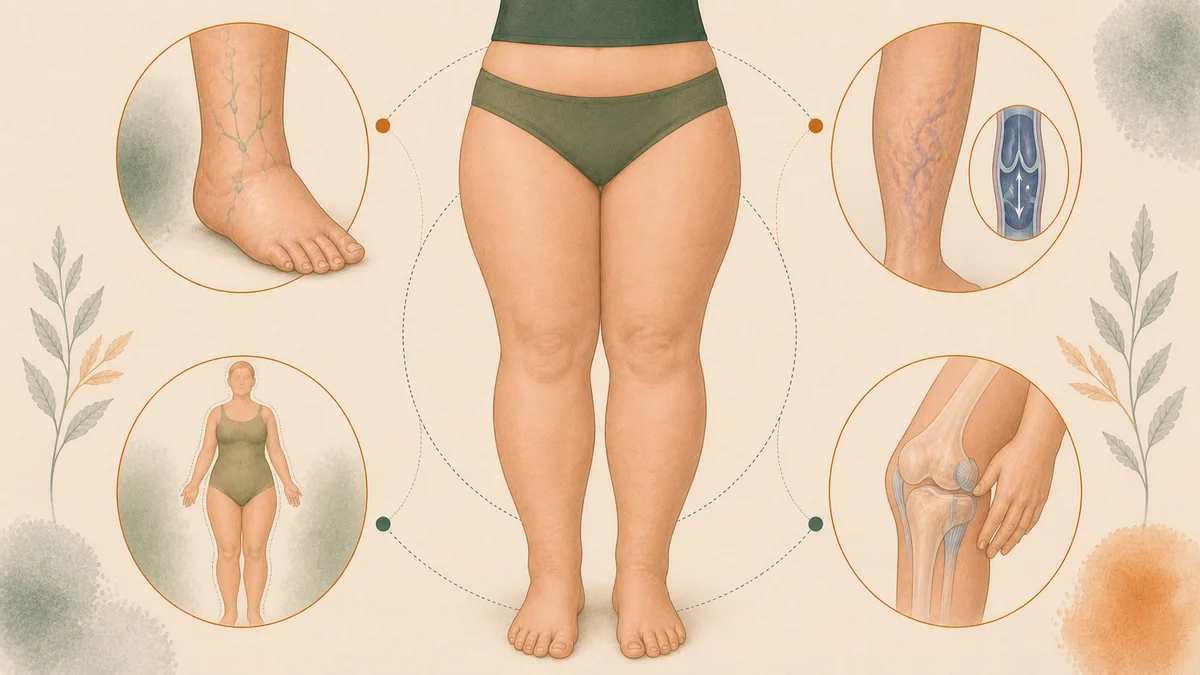
Lipedema and Related Conditions: An Overview
Lipedema rarely exists in complete isolation. Because it shares symptoms — swelling, heaviness, joint discomfort — with several other conditions, and because it can genuinely coexist with them, understanding how lipedema relates to lymphedema, venous insufficiency, obesity, and connective tissue conditions like Ehlers-Danlos syndrome can make a real difference in how well your overall picture is understood by a clinician.
This guide gives a brief overview of the more commonly discussed overlaps before spending more time on a connection that's gained increasing research attention: lipedema and joint hypermobility. For the broader condition overview, see our understanding lipedema hub.
Lipedema and Lymphedema
Lipedema and lymphedema are distinct conditions — one is a fat-tissue disorder, the other involves impaired lymphatic drainage — but they can occur together, particularly as lipedema advances. When lymphatic function becomes secondarily affected by long-standing lipedema, the combination is sometimes referred to as lipo-lymphedema, per a 2025 PMC clinical review.1 This guide won't repeat the full differentiation here; our dedicated lipedema vs lymphedema guide covers the specific signs — including foot involvement and pitting — that separate the two and explains what it means when both are present.
Lipedema and Venous Insufficiency
Chronic venous insufficiency — where leg veins struggle to return blood efficiently — frequently coexists with lipedema, and the two conditions can intensify each other's symptoms. Added tissue volume from lipedema can put pressure on veins and affect blood flow, while impaired venous return can, in turn, increase swelling and a sense of heaviness beyond what lipedema alone would cause.
Distinguishing between the two isn't always straightforward, since both cause leg heaviness and discomfort, but venous insufficiency tends to improve more with leg elevation and often shows visible varicose or spider veins, while lipedema's disproportionate, symmetrical, tender pattern typically persists regardless of position. A clinician evaluating leg symptoms often considers both possibilities together rather than assuming just one applies.
When both conditions are confirmed, management typically addresses each on its own track — compression is often useful for both, but venous-specific treatments like vein ablation don't resolve lipedema tissue, and lipedema-focused conservative care or surgery doesn't correct underlying vein dysfunction. Being clear with a treating clinician about which condition is being addressed by which intervention helps set realistic expectations for what each step of care can actually accomplish.
Lipedema and Obesity
Obesity and lipedema are separate conditions that can exist independently or together, and one does not cause the other. Lipedema can occur in people at any body weight, including those who are not overweight, while obesity involves excess fat distributed more generally throughout the body rather than in the disproportionate, symmetrical pattern lipedema follows, per Herbst et al.'s 2021 US consensus guideline.2
When both are present, each needs its own recognition and management rather than assuming that addressing weight alone will resolve the lipedema-affected areas. Our guide to lipedema or just fat legs covers this specific confusion — and how the two can coexist — in much more depth.
Continue: Is it lipedema or just fat legs? →Lipedema and Hypermobility / Ehlers-Danlos: What the Research Suggests
One of the more actively researched overlaps involves joint hypermobility and hypermobile Ehlers-Danlos syndrome (hEDS), a genetic connective tissue disorder. A cross-sectional study of lipedema patients found joint hypermobility reported in a substantial share of participants, alongside higher rates of related musculoskeletal and systemic symptoms compared with a lymphedema comparison group, according to Fiengo and Sbarbati's 2025 study.3 Because both lipedema and hypermobility conditions involve differences in connective tissue — the structural material that supports skin, blood vessels, and joints — researchers have proposed that shared connective tissue dysfunction may underlie both.
It's important to be precise about what this means: the overlap is an observed association, not a proven cause-and-effect relationship. Lipedema does not cause Ehlers-Danlos syndrome, and having EDS or hypermobility does not mean someone will develop lipedema. The 2025 cross-sectional study found more self-reported hypermobility-related features in its lipedema group than in its lymphedema comparison group, but its descriptive, questionnaire-based design cannot establish population prevalence, rule out selection bias, or show that the overlap exceeds chance.3
People with both conditions commonly report overlapping symptoms beyond joint hypermobility itself — chronic pain, easy bruising, fatigue, and digestive symptoms are frequently described by both groups, which can make it genuinely difficult to know which condition is driving a particular symptom on a given day.
Why It Matters for Care
Recognizing a possible hypermobility overlap can shape practical care decisions. Exercise recommendations may need to emphasize joint protection and controlled range of motion rather than high-impact movement, since hypermobile joints are more prone to strain and injury. Compression tolerance can also differ — some people with hypermobility find certain compression levels or garment styles more uncomfortable or less effective than others, which is worth discussing with a knowledgeable fitter.
If surgery is being considered for lipedema, connective tissue differences may also factor into planning and recovery expectations, since tissue healing and joint stability during recovery can be affected by underlying hypermobility. None of this means surgery is off the table — it means the full picture is relevant information for whoever is planning your care.
Awareness of a possible hypermobility overlap can also change how symptoms are interpreted day to day. Fatigue that feels disproportionate to activity level, joints that ache after ordinary movement, or dizziness on standing are sometimes dismissed as unrelated or unexplained when, in fact, they may reflect a broader connective tissue picture worth discussing as a whole rather than piece by piece.
What to Discuss With Your Clinician
If you have lipedema and also notice unusually flexible joints, frequent sprains, chronic joint pain, or a family history of "double-jointedness," it's worth mentioning these together rather than as separate, unrelated complaints. A simple physical assessment of joint range of motion — not a specialized test — is typically how hypermobility is screened for, and it can be done during a routine evaluation.
Bringing a written list of symptoms across different body systems — joints, skin, digestion, fatigue — tends to give a clinician a much clearer picture than describing each symptom in isolation over separate visits. Our guide on how lipedema is diagnosed covers how to prepare for this kind of comprehensive evaluation.
Frequently Asked Questions
-
Are lipedema and Ehlers-Danlos syndrome related?
Research has found a notable overlap between lipedema and hypermobility spectrum disorders, including hypermobile Ehlers-Danlos syndrome, but this is an observed association rather than a proven cause-and-effect relationship. Both involve connective tissue, which may explain why they co-occur, but having one does not mean a person has or will develop the other. Our lipedema causes guide covers what is and isn't understood about the condition's origins.
-
Should I be screened for hypermobility?
There's no requirement to be screened, but if you have lipedema alongside joint pain, frequent sprains, or a sense that your joints move more than most people's, it's a reasonable topic to raise with a clinician. Screening is typically a simple physical assessment of joint range of motion, not a specialized test, and it can help tailor exercise and compression recommendations.
-
Does having both change my treatment plan?
It can influence specifics — for example, exercise intensity and joint-protective strategies, or how compression is tolerated — but the core approach to lipedema itself, starting with conservative care, doesn't change. Our conservative care guide covers the general sequence of management that applies regardless of coexisting connective tissue findings.
-
Is lipedema the same as lymphedema?
No, though the two can occur together, especially in later stages, in a combination sometimes called lipo-lymphedema. Lipedema is a fat-tissue disorder, while lymphedema involves impaired lymphatic drainage. Our full lipedema vs lymphedema guide covers the specific signs that distinguish them and what it means when both are present.
-
Can lipedema cause venous insufficiency, or vice versa?
The two frequently coexist and can worsen each other's symptoms — added tissue volume can affect vein function, and impaired venous return can increase swelling and heaviness — but one doesn't straightforwardly cause the other in a simple sense. Both are evaluated and managed on their own terms, and a clinician familiar with both is best positioned to sort out which symptoms in the legs belong to which process.
-
Can someone have lipedema and obesity at the same time?
Yes, and it's common — lipedema can occur at any body weight, and having obesity alongside it doesn't mean the lipedema-affected areas are simply excess weight. Our guide to lipedema or just fat legs covers this distinction in detail, including why weight loss changes some areas of the body but not lipedema-affected tissue.