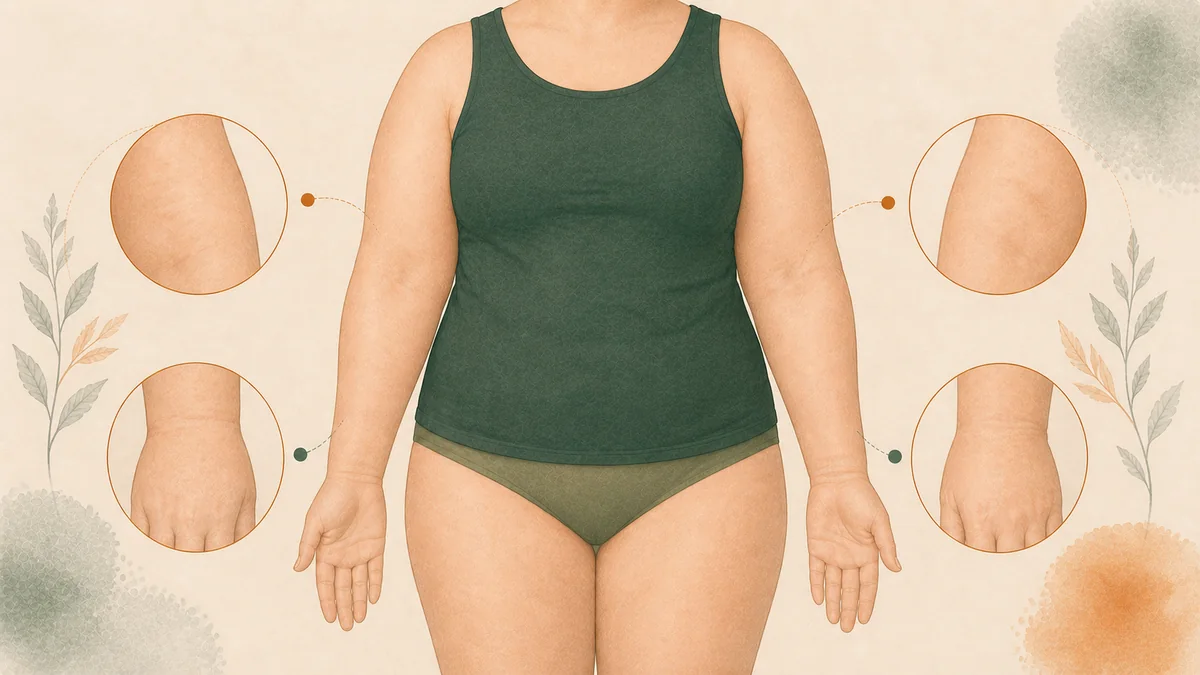
Legs get most of the attention when people talk about lipedema, but lipedema arms are commonly involved too — and the pattern there follows its own rules. If your upper arms feel disproportionately full, tender to the touch, and stubbornly resistant to toning exercises that seem to work everywhere else, lipedema arms may be part of what's going on.
This guide covers how often arms are affected, the specific signs that separate lipedema from ordinary arm fat, and what practical management looks like. For the full picture of the condition, see our understanding lipedema overview; as with all of our content, nothing here diagnoses you — only a clinician can do that.
How Often Lipedema Arms Are Involved
Arm involvement is common in lipedema, though it's reported somewhat less consistently than leg involvement, and it frequently develops alongside — or a few years after — the legs rather than appearing first, per a 2025 PMC clinical review.1 Isolated lipedema affecting only the arms, with no leg involvement at all, is the least common of the patterns clinicians describe.
As with the legs, arm involvement follows a symmetrical pattern: both arms enlarge to a similar degree, distinguishing it from asymmetric causes of arm swelling such as lymphedema following breast cancer treatment, which is typically one-sided. For a comparison of how the legs are affected, see our guide to lipedema legs.
Arm involvement tends to emerge around the same hormonal windows associated with lipedema more broadly — puberty, pregnancy, and menopause — since these shifts are thought to trigger or accelerate the underlying tissue changes. Someone who first noticed leg changes during pregnancy, for example, may then notice their arms following a similar pattern years later during perimenopause, which is a commonly reported sequence rather than a sign the condition is spreading unpredictably.
The Wrist "Cuff"
Much like the ankle in leg lipedema, the wrist is where arm lipedema classically stops — the hands are usually spared entirely, even as the forearm and upper arm above them are noticeably enlarged. This creates a visible ring at the wrist where a normal-sized hand meets a larger forearm, sometimes called the wrist "cuff," mirroring the ankle cuff seen in the legs.
Hand involvement isn't impossible, but it's uncommon, and when the hands do appear affected it's worth mentioning specifically to a clinician, since it can point toward a different or additional process. Our guide to lipedema types and distribution patterns covers hand involvement and other less typical presentations in more detail.
The wrist cuff is also a useful self-check when comparing arm changes to other possible causes of arm swelling. Fluid-related swelling — from heart, kidney, or thyroid conditions, for instance — tends to affect the hands and fingers as well, sometimes making rings feel tight. A clear boundary at the wrist, with hands that remain unaffected, points more specifically toward a fat-tissue pattern like lipedema rather than a fluid-retention process.
Continue: How lipedema is diagnosed →Symptoms & Functional Impact
The symptoms in the arms mirror those in the legs: tenderness or genuine pain when the tissue is pressed, a persistent feeling of heaviness, and bruises that appear without an obvious cause and take longer than usual to fade, consistent with Herbst et al.'s 2021 consensus guideline.2 Many people also notice the texture feels different from ordinary fat — soft but uneven, sometimes described as having small nodules underneath the skin.
Functionally, enlarged arms can make everyday tasks — reaching overhead, carrying bags, finding sleeves that fit without being tight at the wrist — more difficult over time, particularly as the condition progresses. This functional impact is frequently underestimated by people outside the patient's own experience, which is part of why documenting specific limitations, not just appearance, matters when discussing the condition with a clinician.
Clothing is one of the most common everyday frustrations reported: standard sleeve lengths and cuffs are cut for a more uniform taper from shoulder to wrist, which doesn't match the arm shape lipedema often creates. This is a practical, solvable problem rather than a reflection of anything being wrong with the body, and many people find that looking specifically for looser cuffs, stretch fabrics, or three-quarter sleeves reduces daily discomfort considerably.
Compression for Arms
Compression sleeves can help reduce heaviness and support arm tissue, but fitting arms presents different practical challenges than fitting legs. Sleeves can bunch uncomfortably at the elbow, dig in at the wrist if the cuff proportions don't match the arm's shape, or restrict the range of motion needed for everyday tasks if sized incorrectly.
A fitter experienced with lipedema — rather than generic compression sold for other purposes — makes a meaningful difference here. Our full compression garments guide covers fitting, fabric choice, and realistic wear expectations for both arms and legs, including how to tell when a garment is fitted correctly versus causing more harm than good.
Wearing time for arm sleeves is also worth approaching gradually rather than all at once, since new compression can feel unfamiliar or restrictive at first even when it's sized correctly. Many people find that building up wear time over one to two weeks, and pairing sleeves with gentle arm movement rather than complete stillness, makes long-term daily use far more manageable.
Surgical Considerations for Arms
When conservative measures aren't enough to manage arm symptoms, lymph-sparing liposuction techniques — the same general approach used for the legs — can be used on the arms as well, according to a 2024 case series.3 The extent, sequence, and technique should be individualized by a surgeon familiar with lipedema and upper-extremity lymphatic anatomy; the cited study does not establish that every arm procedure carries the same risk profile.
As with any lipedema surgery, this is generally approached as staged, multi-session care rather than a single procedure, and it follows — not replaces — a period of conservative management. Our lipedema surgery guide covers candidacy, technique, and realistic expectations in full, and our awake liposuction overview explains how the tumescent technique specifically applies to lipedema-affected tissue.
Because arm procedures are less commonly performed than leg procedures overall, it's worth specifically asking a prospective surgeon how many arm cases they've handled, not just how many lipedema cases in general — technique and outcomes can vary meaningfully between body areas even within the same practice.
Everyday Tasks Affected by Lipedema Arms
Beyond the visible size change, lipedema arms often quietly reshape day-to-day routines in ways that aren't always obvious from the outside. Reaching into overhead cabinets, fastening a bra behind the back, blow-drying hair, or holding a phone to the ear for a long call can each become more tiring than they used to be, since the extra tissue adds weight the shoulder and upper arm have to support through every motion.
Carrying is another area where the impact tends to show up. Grocery bags looped over the forearm, a heavy handbag on the shoulder, or a child on the hip can press directly on tender tissue and leave a lingering ache well after the load is set down. Some people notice bruising along the exact strap or handle line the next day, which reflects the tissue's vulnerability rather than the weight being unusually heavy.
Sleep and desk posture matter too: resting an arm on a firm armrest or lying on the affected side can become uncomfortable, and finding a supportive pillow arrangement often helps. For a fuller look at how discomfort in the tissue develops and what eases it day to day, see our guide to lipedema pain. Naming these specific limitations — rather than only describing appearance — gives clinicians a clearer sense of functional impact.
Frequently Asked Questions
-
Can lipedema affect only the arms?
Yes, though it's less common than leg involvement alone — arm lipedema most often appears alongside the legs, sometimes developing a few years later. When arms are affected without noticeable leg involvement, the same core features apply: symmetry, tenderness, and a texture that differs from ordinary fat. See our overview of lipedema legs for how the two presentations compare.
-
Do the hands get involved?
Usually not. Lipedema classically spares the hands, creating a visible size change at the wrist where a normal-sized hand meets an enlarged forearm — sometimes called the wrist "cuff." Hand involvement is uncommon but not impossible; our guide to lipedema types and distribution covers less typical patterns, including hand involvement, in more detail.
-
Does compression help with arm lipedema?
Properly fitted compression sleeves can reduce heaviness and support the tissue, though fitting arms comes with different practical challenges than fitting legs — sleeves can bunch at the elbow or restrict movement if sized incorrectly. Our compression garments guide covers fitting considerations for both arms and legs, along with realistic wear expectations.
-
Why do my upper arms feel heavy and tender?
Heaviness and tenderness to pressure are recognized features of lipedema tissue, not a sign of poor fitness or exaggeration. The affected fat is thought to involve inflammation and increased sensitivity, which is why pressing on it — or even a fitted sleeve — can feel uncomfortable in a way ordinary arm fat doesn't. Our guide to lipedema symptoms covers this sensation in more depth.
-
Is arm lipedema less common than leg lipedema?
Leg involvement is more consistently reported and is usually the first area people notice, but a meaningful share of people with lipedema also have arm involvement, frequently emerging after the legs are already affected. Isolated arm-only lipedema without any leg involvement is the least common of the three patterns described in our lipedema types guide.
-
Can surgery treat arm lipedema?
Lymph-sparing liposuction techniques can be used on the arms when conservative care isn't enough to manage symptoms, similar to how they are used on the legs. Candidacy and procedure planning should be individualized by a surgeon familiar with lipedema and lymphatic anatomy. Our lipedema surgery guide covers what the procedure involves and how candidacy is assessed.