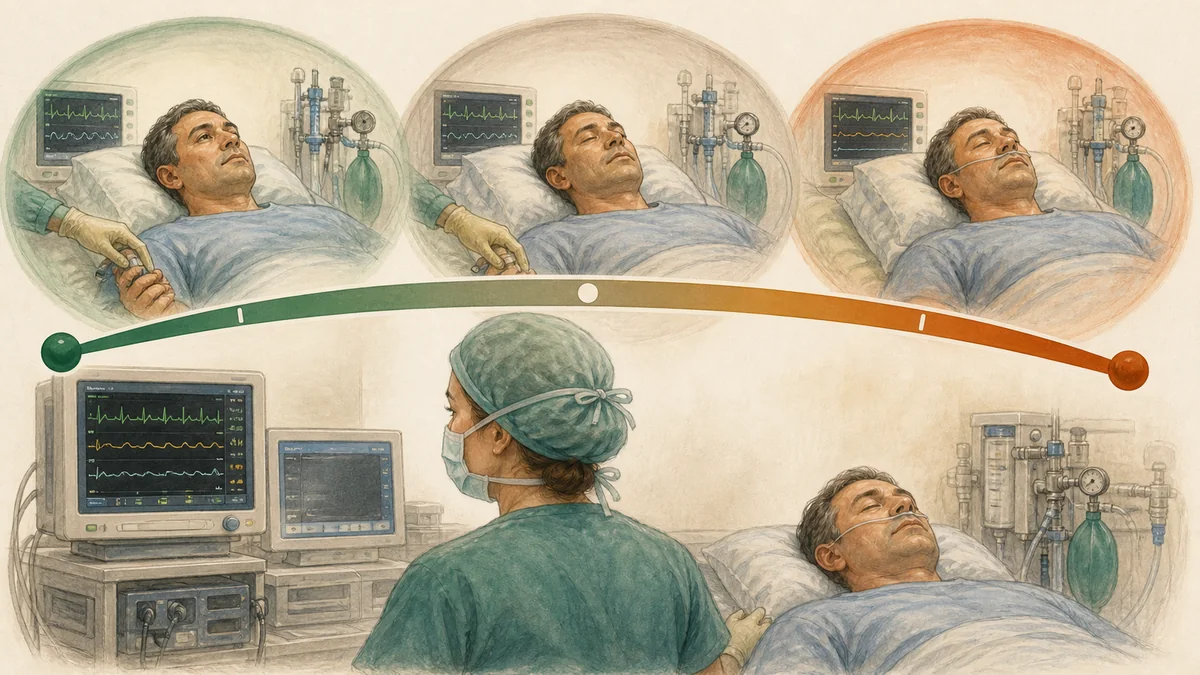
If you've been told your procedure will involve MAC anesthesia, you've likely also heard it called "twilight sedation," "conscious sedation," or just "IV sedation" — often in the same conversation, sometimes even by the same provider. That's not a sign anyone is being careless with terminology; it's a genuine reflection of how these terms overlap in everyday clinical use. This guide untangles what MAC actually means, how it differs from the terms it gets confused with, and what it's really like to experience it.
What MAC Actually Means
Monitored Anesthesia Care (MAC) is best understood as a model of care, not a specific drug, dose, or single fixed depth of sedation. Under MAC, a dedicated anesthesia provider is present for the entire procedure, continuously monitoring your vital signs and consciousness level, and adjusting the sedation as needed — sometimes lightening it, sometimes deepening it — in response to how the procedure is going and how you're responding, as Das and Ghosh's overview of monitored anesthesia care describes.1
This is the central nuance that gets lost in casual conversation: MAC isn't "a type of drug you're given" the way local anesthetic is a specific injectable agent. It's closer to a service — active, continuous clinical judgment applied throughout your procedure — which is why the exact experience of "being on MAC" can look different from one patient, or even one moment, to the next.
Terminology Untangled
The table below lines MAC up against the four terms it's most often confused with, so you can see where the real distinctions are — and where the differences are mostly about who's using the word.
| Term | What It Actually Describes | Relationship to MAC |
|---|---|---|
| MAC (Monitored Anesthesia Care) | A care model — continuous monitoring plus adjustable sedation, directed by an anesthesia provider | — |
| "Twilight sedation" | The everyday, patient-facing name for the drowsy, in-between state MAC typically produces | Same underlying care model as MAC — different audience for the term |
| Conscious / moderate sedation | A specific depth level on the sedation spectrum: relaxed, responsive to voice or touch | One depth a MAC case can pass through, not the whole of MAC |
| IV sedation | A description of the delivery route (medication given intravenously), not a depth or care model | Often the delivery method used during MAC, but not synonymous with it |
| General anesthesia | Full unconsciousness with an artificially managed airway | A separate, deeper category MAC does not include |
MAC vs "Twilight Sedation"
There's no real clinical daylight between these two — "twilight sedation" is patient language for MAC. The word "twilight" evokes the dim, in-between quality of the experience (neither fully awake nor fully asleep), while "MAC" describes the clinical structure behind it: who is providing the care and how they're monitoring and adjusting it.
MAC vs Conscious/Moderate Sedation
Conscious sedation (also called moderate sedation) is a specific point on the depth spectrum — you're drowsy and relaxed but can still respond to voice or a light touch. MAC is broader: a MAC case can include time spent at the conscious-sedation depth, but it can also move lighter or deeper than that as the provider adjusts throughout the procedure. Our full conscious sedation guide looks at this distinction from the other direction.
MAC vs IV Sedation
"IV sedation" simply describes how the sedating medication is delivered — through an intravenous line — rather than any particular depth or model of care. In practice, IV delivery is a common method used during MAC, but the term "IV sedation" says nothing about who's monitoring you or how closely, which is exactly what MAC is meant to convey.
MAC vs General Anesthesia
This is the clearest distinction of the group. General anesthesia means full unconsciousness, with the anesthesia provider actively managing your airway — often with a breathing tube — for the entire procedure. MAC, even at its deepest point, does not extend into that territory; if a procedure requires general anesthesia, it is planned and delivered as a separate, distinct category rather than as an extension of MAC.
Continue: Twilight sedation — what it actually feels like →The Sedation Depth Spectrum
Clinically, sedation is usually described across four points: minimal (relaxed, fully responsive), moderate (drowsy but responsive to voice or touch — this is conscious sedation), deep (difficult to rouse, may need help maintaining an airway), and general (fully unconscious), per a StatPearls overview of procedural sedation.3 MAC is unusual in that it isn't tied to one of these — a provider can move a patient between minimal, moderate, and deep sedation within a single procedure, titrating up or down as needed, while general anesthesia remains a separate category entirely, per a review of monitored anesthesia care in and outside the operating room.2
Who Provides It & What's Monitored
MAC is administered by a dedicated anesthesia provider — typically an anesthesiologist or a certified registered nurse anesthetist (CRNA) — whose sole job during the procedure is managing your sedation and monitoring your condition. This is distinct from the surgeon or proceduralist performing the procedure itself, who is focused on the procedure rather than your anesthesia status.
Standard monitoring during MAC includes continuous tracking of oxygen levels, heart rhythm, blood pressure, and breathing, along with ongoing assessment of your level of consciousness and responsiveness, per a review of monitored anesthesia care in and outside the operating room.2 This continuous oversight — not the specific depth of sedation reached — is what actually defines the "monitored" part of Monitored Anesthesia Care.
What It Feels Like
Most patients describe MAC as feeling drowsy, relaxed, and somewhat detached from time — many report that the procedure seemed to pass much faster than it actually did, or that they have only partial memory of it afterward. Because the depth can shift during the case, the experience isn't always uniform from start to finish. Our dedicated twilight sedation guide covers this experience in much more detail, including the honest answer to whether you'll talk or remember anything.
MAC Anesthesia Safety Profile & Risks
It's tempting to assume that because MAC is "lighter" than general anesthesia, it must also be inherently safer — but that's an oversimplification worth correcting directly. Safety with MAC, as with any anesthesia option, depends heavily on the patient's individual health factors and the quality and continuity of monitoring, not on sedation depth by itself — a point Das and Ghosh's overview of monitored anesthesia care makes directly.1 A well-monitored, appropriately selected MAC case can be very safe; a poorly monitored one carries real risk, regardless of how "light" the sedation is intended to be.
Real, if uncommon, risks with MAC include over-sedation affecting breathing, allergic or adverse reactions to sedating medications, and — rarely — the need to convert to a deeper level of care mid-procedure if the plan changes. These risks are managed through the continuous monitoring that defines MAC in the first place, which is why choosing a provider and facility with appropriate monitoring capability matters as much as the sedation plan itself.
It's also worth being direct about what MAC does not remove: any sedation-based technique still carries some baseline risk, and no reputable provider should describe MAC — or any other option on the spectrum — as risk-free. What differs meaningfully between options is how those risks are managed in practice, and that management depends far more on preparation, monitoring, and provider training than on the label attached to the sedation type.
When MAC Anesthesia Is Used for Liposuction
MAC is commonly paired with tumescent, awake liposuction, where the large-volume local anesthetic already provides substantial numbing and pain control, and light-to-moderate MAC sedation is added purely for comfort and anxiety relief rather than pain control itself. This combination lets many patients avoid general anesthesia altogether for procedures that would otherwise require it. Our awake liposuction overview explains how this pairing works in practice and why it's often preferred for larger-volume or multi-area cases.
Questions to Ask Your Anesthesia Provider
If MAC has been proposed for your procedure, these questions can help you understand exactly what to expect:
- What depth of sedation do you expect to target, and how much might that shift during the procedure?
- What is your training and credential, and will you be present continuously throughout?
- What monitoring equipment will be used, and how does the facility handle an unexpected change in my condition?
- Should I expect to remember any part of the procedure, and is that normal?
- What should I arrange in advance for recovery — for example, a companion to drive me home?
Frequently Asked Questions
-
What is MAC anesthesia?
MAC stands for Monitored Anesthesia Care — a model of care in which a dedicated anesthesia provider continuously monitors you and adjusts your sedation level throughout a procedure, rather than a single fixed drug or depth. It's the clinical term behind what most patients call "twilight sedation." Our anesthesia options compared guide places MAC alongside the rest of the sedation spectrum.
-
Is MAC the same as twilight sedation?
Functionally, yes — "twilight sedation" is the everyday term patients use for the same care model clinicians call MAC. The difference is really just vocabulary: MAC is the clinical name that describes who provides the care and how it's monitored, while "twilight" describes the drowsy, in-between feeling patients experience. Our twilight sedation guide covers that experience in detail.
-
Are you unconscious with MAC?
Not necessarily, and this is one of the most common misunderstandings. MAC can range from minimally sedated (relaxed but fully aware) to deeply sedated (difficult to rouse), and the provider adjusts within that range as the procedure requires — but it stops short of the full unconsciousness of general anesthesia, where an artificial airway is typically needed.
-
Is MAC safer than general anesthesia?
Not automatically. MAC and general anesthesia carry different risk profiles rather than one being universally safer than the other — outcomes depend on the patient's health, the procedure being performed, and the quality of monitoring in either case. Our safety profile section above explains why "lighter sedation" and "safer" aren't the same thing, and our anesthesia options compared guide covers the full spectrum.
-
Will I remember anything?
It varies by how deeply you're sedated at any given point and by individual response — some patients recall parts of the procedure clearly, others have only fragments, and some have none at all. There's no guaranteed amnesia with MAC the way there typically is with general anesthesia; our twilight sedation guide covers this honestly in more depth.