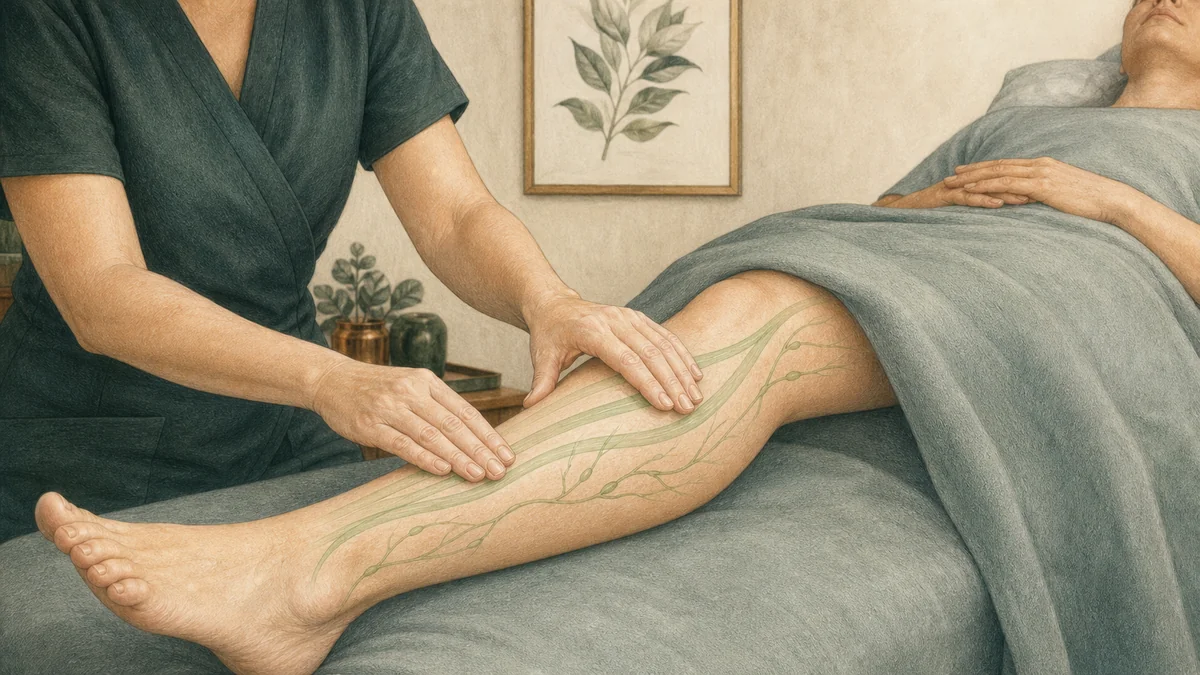
Manual lymphatic drainage for lipedema comes up constantly in patient conversations, but it's also one of the more misunderstood parts of conservative care. Some people picture a spa treatment; others expect it to shrink their legs. Neither is accurate. This guide explains what MLD actually is, what it can realistically help with, who's qualified to perform it, and why the version sold at many spas isn't the same thing as the clinical technique used for lipedema.
For how MLD fits alongside other day-to-day management, see our living with lipedema overview, or our compression garments guide for the therapy MLD is most often paired with.
What Manual Lymphatic Drainage for Lipedema Is
Manual lymphatic drainage is a specific, trained hands-on technique that uses light, rhythmic, directional pressure to encourage fluid movement through the lymphatic system toward areas where it can drain normally. The pressure involved is much lighter than most people expect — closer to the pressure you'd use to gently stretch skin than to knead muscle. The technique follows the body's lymphatic pathways in a deliberate sequence, which is very different from the broad, pressure-focused strokes used in a typical relaxation or deep-tissue massage.
What the Evidence Supports
Manual therapy, including MLD, is recommended as part of individualized lipedema management in the US standard-of-care consensus guideline, aimed at reducing pain and musculoskeletal restriction and stimulating lymphatic flow.1 A small trial comparing Complete Decongestive Therapy (which includes MLD) plus exercise, intermittent pneumatic compression plus exercise, and exercise alone in people with severe lipedema found that the group receiving decongestive therapy in addition to exercise had significantly greater improvements in limb volume, pain, and physical function than exercise alone, according to a randomized controlled trial in Lymphatic Research and Biology.2
It's worth being direct about the limits of this evidence. The lipedema-specific research base for CDT with MLD is still small — a registered randomized trial in severe lipedema enrolled only 33 women, and its authors noted at the outset that clinical effects of conservative treatments remain not clearly established across the condition more broadly, per the Bilgin randomized controlled trial in Lymphatic Research and Biology.2 That doesn't mean MLD is ineffective — many patients and clinicians report genuine symptom relief — but it does mean MLD is best framed as a supportive comfort and fluid-management tool, not a rigorously proven fat-reduction treatment. It never reduces lipedema fat tissue itself.
Continue: Compression garments for lipedema →MLD Within Complete Decongestive Therapy
MLD is rarely used entirely on its own. It's most often delivered as one component of Complete Decongestive Therapy (CDT), a broader program that combines manual lymphatic drainage, compression, exercise, skin care, and self-management education. CDT typically runs in two phases: an initial, more intensive reduction phase — sometimes several sessions a week for a period of weeks — followed by an ongoing maintenance phase that relies more on compression and self-care, with MLD sessions spaced further apart or replaced by taught self-MLD.
This phased structure matters because it sets realistic expectations: the frequency of MLD you might have during an intensive phase isn't meant to continue indefinitely, and tapering to maintenance isn't a sign that treatment "stopped working."
Who Should Perform It
MLD should be performed by someone specifically trained in the technique, not simply a massage therapist with general experience. The relevant credential to look for is Certified Lymphedema Therapist (CLT), which typically requires completing an accredited training program of at least 135 hours in Complete Decongestive Therapy, covering both technique and the medical background needed to recognize contraindications.
Some therapists go further and hold board certification through the Lymphology Association of North America, known as the CLT-LANA credential, which requires passing a national examination in addition to the training hours. If you're evaluating a potential provider, it's reasonable to directly ask whether they hold a CLT or CLT-LANA credential and how many hours of lipedema- or lymphedema-specific training they've completed — a legitimate provider will be able to answer this clearly. Our guide on finding a knowledgeable clinician covers how to vet credentials more broadly, without recommending any specific individual or practice.
What a Session Involves
A typical MLD session runs somewhere between 30 and 60 minutes, depending on how much of the body is being treated. You generally stay clothed in light, comfortable clothing or use a drape similar to a standard massage setup. The therapist works in a specific sequence, often starting near the neck and trunk to "clear" central lymphatic pathways before working outward toward the affected limbs — a counterintuitive order to most people, but a deliberate part of the technique's logic. The pressure used throughout is light; if a session feels like a deep-tissue massage, that's worth mentioning to the therapist or reconsidering as authentic MLD.
Before the first session, expect a brief intake — a discussion of your medical history, current symptoms, any diagnosed lymphatic or vascular conditions, and areas of tenderness. A good therapist will screen for contraindications such as active infection, acute deep vein thrombosis, or uncontrolled cardiac issues before laying hands on you, and will explain what they're doing as they go. Sensations during a session are usually minimal: a light skin stretch, a slow rhythmic pattern, occasionally a warm or tingling feeling as fluid moves. Sharp pain, bruising, or a feeling of being "worked over" are not expected outcomes of clinical MLD and should be flagged immediately.
MLD vs "Lymphatic Drainage Massage" Sold at Spas
This is one of the most important distinctions in this entire guide. Many spas and wellness businesses advertise a "lymphatic drainage massage" as a general wellness or de-puffing service. These services can vary enormously in technique, training, and pressure — some may loosely resemble true MLD, while others are closer to a standard relaxation massage marketed with lymphatic-sounding language.
The safety and efficacy gap matters here. Clinical MLD is built around specific contraindications and precautions relevant to lymphatic and vascular conditions, which a general spa therapist may not be trained to recognize. If you have lipedema, it's worth asking directly whether a provider has clinical CLT training in manual lymphatic drainage specifically — rather than assuming a spa service labeled "lymphatic drainage" is delivering the same technique referenced in lipedema clinical guidance.
Home Techniques and Their Limits
A trained therapist can teach a simplified self-MLD routine to practice at home between professional sessions, and many people with lipedema incorporate this into their daily routine. Self-MLD has real value as a maintenance tool, but it also has clear limits: it's a simplified version of the full technique, it can't substitute for an initial professional assessment of your specific fluid and tissue pattern, and it isn't designed to address more complex presentations the way hands-on clinical evaluation can. If self-MLD doesn't seem to be helping, or your symptoms are changing, that's a reason to check back in with a trained therapist rather than adjusting the technique on your own.
Frequently Asked Questions
-
Does lymphatic drainage help lipedema?
Manual lymphatic drainage can help reduce the sensation of heaviness, support fluid movement, and improve comfort for some people with lipedema, particularly when there's an overlapping lymphedema component. It does not reduce lipedema fat tissue itself. Evidence for MLD specifically is still fairly limited, so it's best understood as one supportive part of a broader plan alongside compression and movement, not a stand-alone fix.
-
Is spa lymphatic drainage massage the same as clinical MLD?
No, and this distinction matters. Clinical manual lymphatic drainage follows a specific, gentle, directional technique developed for lymphatic and fluid conditions, performed by someone trained in that exact protocol. A spa "lymphatic drainage massage" may use different pressure, techniques, or training entirely, and typically isn't designed around lipedema-specific tissue sensitivity or safety considerations. If you have lipedema, ask specifically about clinical MLD training, not general spa massage experience.
-
How often should I get manual lymphatic drainage?
Frequency varies by individual, symptom severity, and whether MLD is part of an intensive Complete Decongestive Therapy phase or ongoing maintenance. Some people have sessions multiple times a week during an initial intensive period and then taper to occasional maintenance sessions or self-MLD at home. A Certified Lymphedema Therapist can help build a realistic schedule based on your specific presentation — see our guide on compression garments for how MLD fits alongside other conservative care.
-
Can I do manual lymphatic drainage on myself at home?
A trained therapist can teach you a simplified self-MLD routine for daily maintenance between professional sessions, and many people with lipedema do use these techniques at home. Self-MLD has real limits, though — it's a simplified version of the full technique, it can't replace an initial professional assessment, and it won't address more complex fluid patterns the way a trained therapist's hands-on evaluation can.
-
What credential should a lymphatic drainage therapist have?
Look for a Certified Lymphedema Therapist (CLT) credential, which typically requires completing an accredited training program of at least 135 hours in Complete Decongestive Therapy. Some therapists also hold board certification through the Lymphology Association of North America (CLT-LANA), which maintains a public directory you can use to confirm someone's status. Our guide to finding a knowledgeable clinician covers how to vet credentials more broadly.
-
Does MLD reduce lipedema fat or just swelling?
MLD works on fluid movement, not fat tissue. Any improvement people notice — less heaviness, reduced swelling, better comfort — reflects changes in fluid and tissue congestion, not a reduction in the underlying lipedema fat itself. That distinction is honest but important, since it explains why MLD is paired with, not a replacement for, treatments that address the fat tissue directly, covered in our treatment options overview.