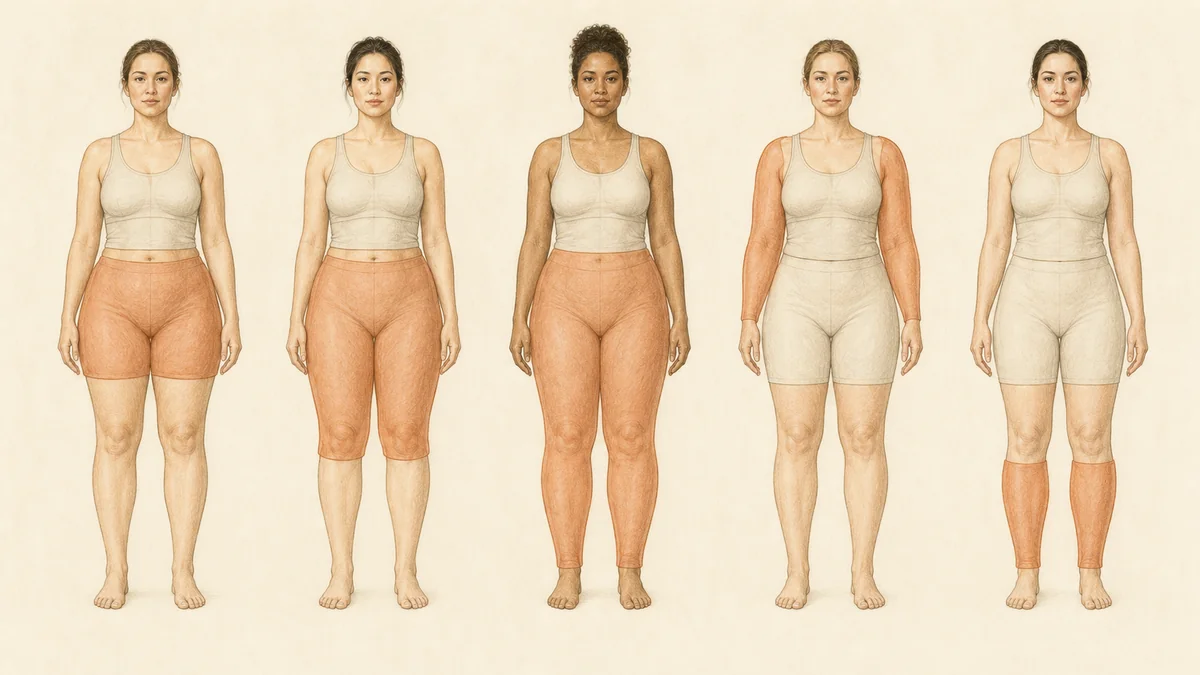
Lipedema doesn't look identical from one person to the next. The recognized types of lipedema describe different distribution patterns — some people have enlargement limited to the hips and thighs; others have their whole leg affected, or their arms, or a combination of areas that doesn't fit neatly into a single category. Understanding these distribution patterns — sometimes called "types" — helps explain why two people can both have lipedema and still look quite different, and it also helps make sense of less-discussed involvement at the knees, abdomen, and hands.
This guide covers the general framework clinicians use to describe distribution, followed by a closer look at areas that don't always fit the classic leg-and-arm picture. For the broader condition overview, see our understanding lipedema hub.
How Types of Lipedema Are Classified
Clinicians commonly describe lipedema using a system based on which body segments are involved, outlined in Herbst et al.'s 2021 US consensus guideline.1 Type I is limited to the hips and buttocks; Type II extends down to the knees; Type III reaches all the way to the ankles, covering the whole leg; Type IV describes arm involvement; and Type V is limited to the lower legs, from knee to ankle, sparing the thighs. These categories aren't mutually exclusive — many people have a combination, such as whole-leg involvement (Type III) together with the arms (Type IV).
| Type | Area typically involved |
|---|---|
| Type I | Hips and buttocks |
| Type II | Hips down to the knees |
| Type III | Hips down to the ankles (whole leg) |
| Type IV | Arms |
| Type V | Lower legs only, sparing the thighs |
Across the recognized types, the hands and feet are classically — but not universally — spared. This pattern can produce the well-known "cuff" sign at the wrists and ankles, described in more detail in our lipedema legs and lipedema arms guides. This type-based classification is used alongside — not instead of — the four-stage system that describes tissue changes within the affected areas, per a 2023 StatPearls overview of lipedema.3
The Knee Fat Pad
One of the more commonly reported — but less discussed — features of lipedema is a distinct pad of fat that forms around and just above the knee. This fat pad can make the knees look proportionally larger than the rest of the leg and can physically interfere with bending, kneeling, or fully straightening the leg as it enlarges.
Knee involvement often develops alongside broader thigh and calf involvement rather than in isolation, and it can meaningfully affect mobility over time, particularly for tasks like kneeling, using stairs, or getting up from low seating. If knee stiffness or discomfort has been part of your experience, it's worth describing specifically — "my knees feel tight and swollen" communicates something more useful than a general mention of leg heaviness.
Because the knee sits between two major segments — the thigh and the lower leg — a fat pad here can also shift how weight is distributed through the joint over years, which is part of why physical therapists and clinicians familiar with lipedema pay close attention to gait and joint alignment, not just tissue volume, during an assessment.
Continue: Lipedema legs — distribution, symptoms & patterns →Abdominal Involvement
The abdomen is not part of the classic Type I–V limb-distribution system. Abdominal fat can coexist with lipedema, but its presence, tenderness, or resistance to weight change does not by itself establish abdominal lipedema. Because abdominal fat has many possible explanations, it requires assessment in the context of the person's overall history and the more characteristic limb findings.
The absence of the clearer signs used for the legs and arms — symmetry compared to a spared joint, a visible cuff — makes abdominal involvement harder to identify confidently without a full clinical picture. It's generally considered alongside, not instead of, the more classic limb findings when a clinician is putting together an overall assessment.
If abdominal fullness is tender to pressure and bruises easily in the same way your legs or arms do, that combination is worth mentioning specifically, rather than assuming it's simply unrelated weight gain. On its own, without accompanying limb findings, abdominal fat is far more likely to reflect ordinary weight distribution than lipedema.
Hands: Usually Spared, But Not Always
As covered in our arms guide, the hands are typically spared even when the forearms above them are significantly enlarged — this is one of the more reliable and recognizable lipedema signs. That said, "usually" isn't "always," and a smaller number of people do have hand involvement, which is worth mentioning specifically to a clinician since it's a less typical presentation that can sometimes prompt a broader evaluation.
When hand involvement is present, it's generally assessed the same way as other lipedema-affected areas: looking at symmetry, texture, and tenderness rather than size alone, since hands naturally vary quite a bit in size between individuals regardless of lipedema. Grip strength and finger mobility are also worth noting if hand fullness is present, since these are practical, functional details a clinician can act on.
Why Distribution Varies
There isn't a well-established answer for why one person develops hips-and-thighs-only lipedema while another develops whole-leg and arm involvement, notes a 2025 PMC clinical review.2 This mirrors the broader uncertainty around what causes lipedema in the first place — genetic and hormonal factors are thought to influence both whether the condition develops and how extensively it spreads, but the specific mechanism determining distribution hasn't been mapped.
People can have mixed distribution patterns, but current evidence is not strong enough to predict whether a particular person's involved areas will remain fixed or expand over time. Distribution type should therefore describe the current clinical pattern, not be used as a forecast. Our lipedema stages guide separately explains what is known about tissue changes and progression.
Management Considerations by Area
Conservative care — compression, movement, and manual lymphatic drainage — remains the recommended starting point regardless of which type or combination of areas is involved, though the specifics differ by location. Knee involvement, for example, may call for compression that accommodates joint movement without restricting it, while abdominal involvement is generally addressed through broader garment fitting rather than a dedicated abdominal sleeve.
Our conservative care guide and compression garments guide cover fitting and technique in more depth, while our lipedema surgery guide explains how surgical planning accounts for which areas are involved when conservative measures aren't enough.
Why Type Matters for Treatment Planning
The specific type of lipedema someone has doesn't change the overall care ladder — conservative measures first, surgical options considered later if symptoms and function warrant it — but it does shape how each step is planned. Distribution determines which garments are prescribed, how manual lymphatic drainage sessions are sequenced, and which body regions a physical therapist prioritizes for gait, strength, and joint-alignment work.
When surgery enters the conversation, distribution helps the clinical team estimate the extent of treatment and discuss whether more than one procedure may be appropriate. The sequence, operating plan, tumescent volume, and recovery plan must be individualized; a Type III, IV, or V label alone does not determine a specific surgical approach.
Type also matters for setting realistic expectations. Someone with combined leg and arm involvement should expect a longer overall treatment arc than someone with hips-only involvement, regardless of which surgeon or clinic is chosen. Our treatment options overview and lipedema surgery guide explain how these planning decisions are typically sequenced.
Frequently Asked Questions
-
What are the different types of lipedema distribution?
Clinicians commonly describe lipedema by which segments are involved: Type I affects the hips and buttocks, Type II extends to the knees, Type III reaches the ankles, Type IV involves the arms, and Type V is limited to the lower legs. Someone can also have a combination — for example, whole-leg involvement alongside the arms. Our lipedema legs guide covers the most common leg-focused patterns in depth.
-
Does lipedema affect the knees?
Yes — a distinct fat pad around and above the knee is a common feature, and it can affect bending, kneeling, and general knee comfort as it enlarges. This knee involvement often occurs alongside broader thigh and calf involvement rather than as an isolated finding, and it's a detail worth mentioning specifically if knee stiffness or pain is part of your experience.
-
Can lipedema affect the stomach?
Abdominal involvement can occur, though it's less classic than leg or arm involvement and is more easily confused with general weight gain, since the abdomen isn't typically included in the symmetry and cuff-sign pattern that makes leg lipedema more recognizable. Our guide to lipedema vs just fat legs covers this kind of distinguishing confusion in more depth.
-
Do hands get involved in lipedema?
Usually not — hands are typically spared even when the arms above them are significantly enlarged, creating the wrist "cuff" described in our lipedema arms guide. Hand involvement does occur occasionally, and when it does, it's worth flagging specifically to a clinician since it's a less typical presentation.
-
Why does distribution vary so much between people?
This isn't fully understood, similar to broader open questions about what causes lipedema in the first place. Genetic and hormonal factors likely influence not just whether someone develops lipedema but which areas are affected and to what degree, though researchers haven't pinpointed exactly why distribution differs from person to person.
-
Does the type of distribution affect treatment?
It can influence specifics like which compression garments are needed and how surgical staging is planned, but the overall approach — conservative care first, surgery considered later if needed — applies across types. Our treatment options overview covers how care is generally sequenced regardless of which areas are involved.