If you've been researching what to expect for an upcoming procedure, you've likely seen "conscious sedation," "twilight sedation," and "MAC" used almost interchangeably — sometimes in the same paragraph, sometimes by the same clinic. That overlap isn't entirely wrong, but it isn't quite right either, and the gaps between these terms matter more than they seem when you're the one signing a consent form.
Conscious sedation for liposuction is often discussed alongside twilight sedation and MAC, even though the terms describe different parts of care. This guide untangles what each term actually refers to, how they relate to the broader spectrum of sedation depth, and why getting the terminology straight changes what you should ask before your procedure. For the full picture of how these options compare with local and general anesthesia, see our anesthesia options compared overview.
Conscious Sedation for Liposuction: The Short Answer
Conscious sedation, twilight sedation, and MAC describe overlapping but different pieces of the same picture. Conscious sedation is the everyday name for what modern clinical guidelines call moderate sedation — one specific point on a wider depth spectrum. Twilight is not a formal medical term at all; it's patient language that usually describes that same moderate-to-deep territory, chosen because it evokes a hazy, in-between state rather than full unconsciousness. MAC is different in kind, not just in degree: it describes a care and monitoring model — a qualified anesthesia provider watching your vital signs and ready to adjust — that can be layered onto almost any depth of sedation, from minimal to general.
None of the three is automatically "more" or "less" safe than the others in the abstract. What determines safety in practice is the depth actually reached, who is monitoring you, and how quickly they can respond if your body reacts differently than planned, according to a review of MAC in and outside the operating room.3
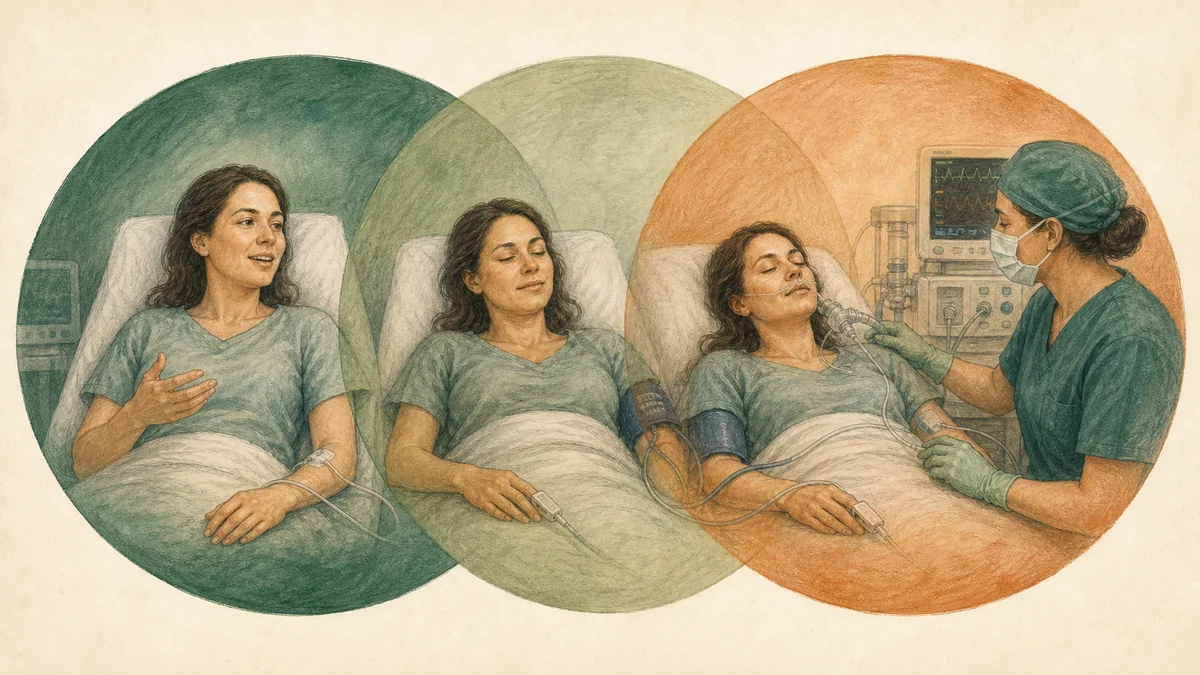
Sedation Depth Levels
Clinical guidelines describe sedation as a continuum rather than a set of separate boxes, because patients can drift between levels depending on the drugs used, the procedure, and their own physiology, according to a StatPearls overview of procedural sedation.1 The four commonly used reference points are:
- Minimal sedation (anxiolysis) — you respond normally to being spoken to; airway, breathing, and heart function are unaffected.
- Moderate sedation ("conscious sedation") — you respond purposefully to voice or light touch; your airway usually needs no help and breathing stays adequate on its own.
- Deep sedation — you're not easily roused and only respond to repeated or firmer stimulation; airway assistance may become necessary.
- General anesthesia — you're unarousable even to painful stimulation, and airway support is usually required.
Notice that "conscious sedation" sits specifically at the second level — it is not a synonym for "any sedation that isn't general anesthesia." A patient can also move between these levels during a single procedure, which is part of why the person monitoring you needs to be trained to recognize the shift and respond to it.
MAC Is a Care Model, Not a Depth
Monitored Anesthesia Care, or MAC, is frequently lumped in with "twilight" and "conscious sedation" as if it were another rung on the same ladder. It isn't. MAC describes an anesthesia provider's involvement — continuous monitoring of your breathing, heart rhythm, oxygen levels, and consciousness, plus the ability to titrate medication or convert to deeper sedation or general anesthesia if the situation calls for it, as described in Das & Ghosh's overview of Monitored Anesthesia Care.2
A MAC case can stay at minimal sedation the entire time, sit at moderate sedation, or deepen substantially — what makes it "MAC" is the dedicated monitoring and readiness to respond, not the depth reached, per a review of MAC in and outside the operating room.3 Our dedicated MAC guide covers how this model works in practice, including who's qualified to provide it.
"Twilight" Is Patient Language
You won't find "twilight sedation" defined in anesthesia textbooks or clinical guidelines the way moderate or deep sedation are. It's a term that grew out of how patients describe the experience — a hazy, dreamlike, in-between state rather than a technical classification. In practice, when a provider says "twilight," they usually mean moderate-to-deep sedation delivered under a MAC-style monitoring setup, but the exact depth can vary a great deal from one case, provider, and drug combination to the next.
Because "twilight" isn't standardized, it's a reasonable and useful word between you and your provider, but it's a poor substitute for asking about the actual planned depth, who will be monitoring you, and what you should expect to feel and remember. Our twilight sedation guide goes into what the experience typically involves.
Comparison Table
The table below lines up the terms side by side across the dimensions that actually affect your experience and safety.
| Term | Consciousness | Airway | Who Administers | Monitoring | Recovery |
|---|---|---|---|---|---|
| Minimal sedation | Normal response to voice | Unaffected | Trained provider, varies by setting | Standard vitals | Minutes |
| Conscious / moderate sedation | Purposeful response to voice or touch | Usually no support needed | Anesthesia provider or trained clinician | Continuous vitals + consciousness checks | 30–90 minutes typical |
| MAC (any depth) | Varies — minimal to near-general | Depends on depth reached | Anesthesiologist or CRNA | Full anesthesia-level monitoring | Varies with depth used |
| "Twilight" (patient term) | Usually moderate-to-deep | Depends on depth reached | Typically an anesthesia provider under MAC | Continuous, MAC-style | Often longer than moderate sedation alone |
| General anesthesia | Unarousable, even to pain | Support usually required | Anesthesiologist or CRNA | Full anesthesia-level monitoring | Longer, often hours |
Why the Terminology Confusion Matters
This isn't just a semantic quibble. Informed consent depends on you and your provider having a shared, accurate picture of what's about to happen. If you walk in assuming "twilight" guarantees you'll be fully unconscious with no memory afterward, and what's actually planned is moderate sedation where some awareness and recall are expected, that mismatch can turn an ordinary, well-managed experience into one that feels alarming or like something went wrong.
The safest approach is to ask specifically: what depth of sedation is planned, who will be monitoring you throughout, and what happens if more sedation is needed than expected. It's also worth being direct with yourself and your provider about which trade-off matters more to you — staying as alert as possible, or minimizing the chance you'll remember anything. Neither preference is wrong, but the plan should match it. And regardless of which term gets used, no depth of sedation should be treated as unconditionally "safer" than another — that depends on your individual health, the procedure, and the quality of monitoring in place, not on the label, per a review of MAC in and outside the operating room.3
It also helps to remember that the word conscious sedation carries a specific promise built into its name: you are meant to remain able to respond, follow simple instructions, and protect your own airway. That is different from being fully asleep, and it is different from the deeper, dreamlike state many people picture when they hear twilight. If the plan drifts toward heavier medication mid-procedure — because you are more anxious than expected, or the procedure takes longer — that shift should be explained rather than assumed. Ask ahead of time what triggers a change in depth, how it would be communicated, and how it affects your recovery window and driving-home plan.
Frequently Asked Questions
-
Is conscious sedation the same as twilight sedation?
They overlap heavily but aren't formally the same thing. Conscious sedation is an older name for what current guidelines call moderate sedation, a specific point on the sedation depth spectrum. Twilight isn't a clinical term at all — it's patient language that usually describes that same moderate-to-deep territory. See our full anesthesia options compared guide for how all these terms fit together.
-
Is MAC the same as general anesthesia?
No. MAC (Monitored Anesthesia Care) describes a care model — an anesthesia provider monitoring you and ready to adjust medication — not a fixed depth. A MAC case can stay at minimal or moderate sedation the entire time, or it can deepen toward general anesthesia if needed. Our MAC guide explains this distinction in more detail.
-
Which one will I actually get for my procedure?
It depends on the procedure's length and scope, your health history, your anxiety level, and the facility's setup, not on which word gets used in casual conversation. The clearest way to know is to ask your provider directly what depth of sedation is planned and who will be monitoring you — see our local vs general anesthesia guide for how that decision typically gets made.
-
Will I remember anything under conscious sedation?
Possibly, and that's expected, not a failure of the sedation. Moderate ("conscious") sedation is specifically designed to keep you responsive to voice or light touch, so partial memory or brief recall is common. Amnesia becomes more likely as sedation deepens. If full memory loss matters to you, say so before your procedure so the plan can reflect it.
-
Does "twilight" mean I'll be completely unconscious?
Not necessarily. Because twilight isn't a defined clinical depth, it can describe anything from a drowsy, cooperative state to something close to deep sedation. Some patients under twilight sedation can still answer questions; others recall very little afterward. Ask specifically what depth is being targeted rather than relying on the word twilight alone — our twilight sedation guide breaks this down further.
-
Is one of these sedation options always safer than the others?
No single depth is unconditionally safer — safety depends far more on patient health, monitoring quality, and the skill of the team than on the label attached to the sedation. Lighter sedation generally carries less cardiovascular and airway risk, but deeper sedation can still be appropriate and well managed for a longer procedure. Discuss your specific risk factors with your anesthesia provider rather than assuming a lighter option is automatically the safer choice.