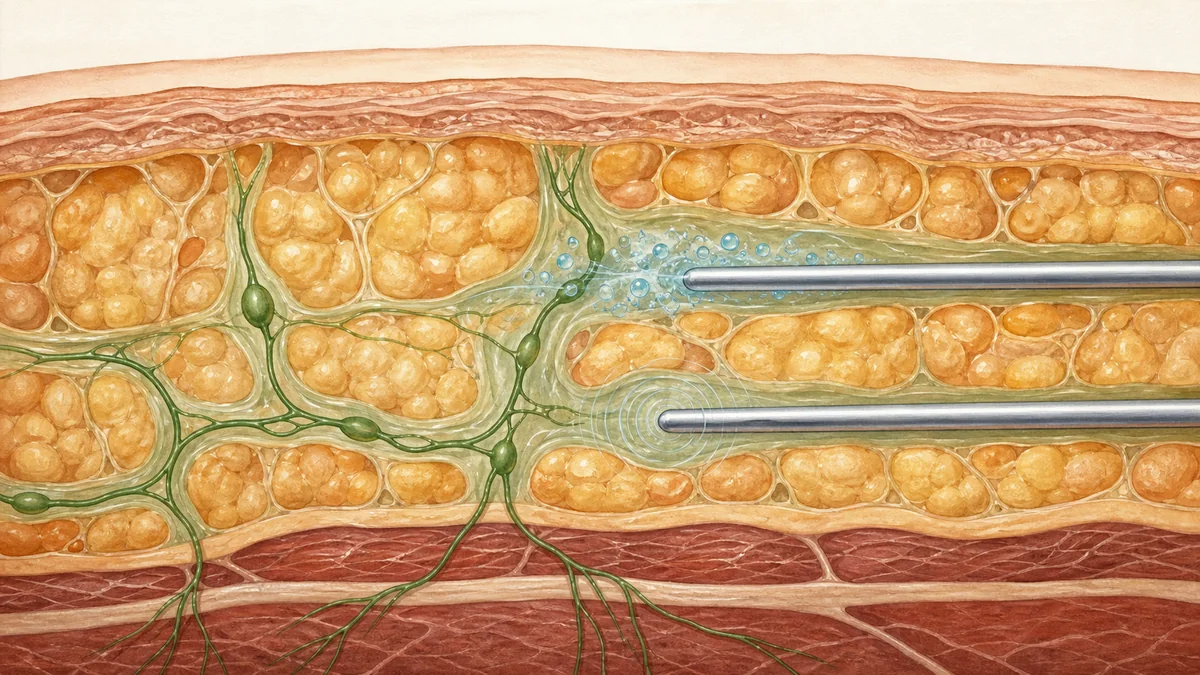
If you're researching lipedema surgery, you've likely come across the term lymph sparing liposuction — sometimes written "lymph-sparing," "water-assisted," or "gentle" liposuction technique — and wondered whether it's marketing language or something clinically meaningful. In lipedema surgery specifically, it's meaningful — and understanding the actual mechanical tools behind these terms, more than in ordinary cosmetic liposuction, is genuinely useful before you talk to a surgeon.
This guide covers what water-assisted and power-assisted approaches actually involve, how tumescent/awake technique fits into the picture, and an honest look at what "lymph-sparing" can't promise. For the broader surgical picture — candidacy, staging, and recovery — see our full lipedema surgery guide. For the separate question of why staying awake or lightly sedated is often preferred for lipedema specifically, see our why awake technique guide.
Why Technique Matters in Lipedema
In most cosmetic liposuction, the primary technical goal is contouring — removing fat evenly to achieve a desired shape. In lipedema surgery, there's an additional and arguably more important consideration: the lymphatic vessels and nodes that run through and near the affected tissue. Lipedema itself is a disease of fat tissue, but advanced disease can also carry a lymphatic component, and even without that overlap, aggressive tissue disruption during surgery can create new lymphatic problems where none existed before, a risk highlighted in a 2024 systematic review and meta-analysis.2
This is precisely the distinction that separates lipedema surgery from cosmetic liposuction technique conversations: the question isn't just "what gives the best contour," it's "what disturbs the surrounding lymphatic architecture the least while still achieving meaningful fat reduction." That priority shapes which mechanical tools are typically chosen for lipedema cases.
Water-Assisted Lymph Sparing Liposuction (WAL)
Water-assisted liposuction uses a thin, pressurized jet of tumescent fluid to gently loosen fat cells from surrounding connective and lymphatic tissue immediately ahead of the suction cannula, rather than relying on more forceful mechanical or ultrasonic disruption. This fan-shaped fluid stream is designed to separate fat with less direct trauma to the structures around it, which is why it's frequently discussed specifically in the context of lipedema care.
Research examining liposuction techniques used in lipedema management, including water-assisted approaches, has generally reported favorable safety profiles and low complication rates across case series and reviews, per a 2024 case series and narrative review.1 That's a meaningfully different evidence conversation than asking which technique gives the smoothest cosmetic result — the outcome being measured here is tolerability and tissue preservation, not aesthetic contouring.
Power-Assisted and Other Approaches
Power-assisted liposuction uses a cannula with a rapidly vibrating or oscillating tip to mechanically loosen fat, which can reduce the physical effort needed to move through denser, more fibrous lipedema tissue compared to fully manual suction. Ultrasound-assisted approaches are also sometimes used in lipedema surgery, applying energy to help break down fat before removal. A 2025 observational study of 191 patients with ultrasound-assisted liposuction specifically for lower-limb lipedema reported meaningful improvements in pain and limb circumference at twelve months, supporting its use as one reasonable option among several.3
None of these mechanical approaches is universally "the best" — a 2024 systematic review and meta-analysis comparing liposuction modalities used in lipedema management found generally favorable safety and effectiveness data across several techniques, without establishing one clear winner.2 The right choice depends on the surgeon's training, the treatment area, and the specific surgical plan for that patient.
| Approach | How it works |
|---|---|
| Water-assisted (WAL) | Pressurized fluid jet gently loosens fat ahead of suction |
| Power-assisted | Vibrating cannula tip mechanically loosens denser tissue |
| Ultrasound-assisted | Energy helps break down fat before removal |
| Tumescent infusion (used with all of the above) | Fluid separates fat from surrounding structures before mechanical removal |
How Tumescent/Awake Technique Fits In
Whichever mechanical tool is used, it's almost always paired with tumescent anesthesia — the large-volume fluid infusion covered in our tumescent technique guide. That fluid infusion does double duty here: it numbs the tissue thoroughly enough for the patient to remain awake, and it also physically separates fat from surrounding structures before mechanical disruption even begins, which is part of why tumescent-based approaches are considered gentler on lymphatic tissue than older "dry" liposuction methods.
The tool choice covered on this page and the anesthesia-approach choice are related but separate decisions. If you're wondering specifically why staying awake or lightly sedated — rather than general anesthesia — is so often the plan for lipedema surgery, our why awake technique is often preferred for lipedema guide covers that reasoning directly.
What "Lymph-Sparing" Does Not Guarantee
It's important to be direct about this: no liposuction technique, however gentle, eliminates all risk to lymphatic structures. "Lymph-sparing" describes an intention and a set of techniques chosen to reduce that risk — it is not a guarantee, a certification, or a promise of a specific outcome. Some degree of temporary swelling or lymphatic disruption is possible even with the most careful technique, and in rare cases, more lasting lymphatic changes can occur.
This honesty matters because patients researching lipedema surgery deserve a realistic picture, not marketing language dressed up as a safety claim. Surgery — even lymph-sparing surgery — reduces fat volume and can meaningfully improve symptoms; it does not cure lipedema, and conservative care such as compression and manual lymphatic drainage typically continues after surgery rather than stopping, per the 2021 Standard of Care for Lipedema in the United States guidelines.4 Our full lipedema surgery guide covers realistic risks, recovery, and results in detail.
Setting realistic expectations up front also helps patients evaluate surgeons more effectively. A surgeon who is candid about the limits of lymph sparing liposuction — rather than presenting it as a risk-free upgrade — is generally signaling a more trustworthy, evidence-based approach to lipedema care overall. Ask how a prospective surgeon monitors for lymphatic complications after surgery, what their revision or complication rate looks like, and how they coordinate with lymphedema therapists or conservative-care providers if swelling persists longer than expected during recovery.
Questions to Ask About Technique
If you're evaluating a surgeon or planning lipedema surgery, a few direct questions can help you understand their approach to lymphatic preservation:
- What specific mechanical technique or combination of techniques do you use for lipedema cases, and why?
- Do you use water-assisted, power-assisted, or ultrasound-assisted tools, and how did you choose?
- What is your experience specifically with lipedema surgery, as distinct from cosmetic liposuction?
- What does your post-operative plan for compression and lymphatic care look like?
- What realistic outcomes and risks — including to lymphatic function — should I expect?
A surgeon experienced in lipedema care should be able to answer these clearly and specifically, rather than giving a generic liposuction pitch. Our lipedema surgery guide covers a broader set of surgeon questions beyond technique alone.
Frequently Asked Questions
-
What is lymph-sparing liposuction?
Lymph-sparing liposuction is a general term for liposuction techniques — such as water-assisted or gentler power-assisted approaches — chosen specifically because they may disturb lymphatic vessels and structures less than more aggressive fat-removal methods. It's not one single named procedure but a technique philosophy applied especially often in lipedema surgery. Our tumescent technique guide covers the anesthesia side of how this is typically delivered.
-
Is water-assisted liposuction better than other techniques for lipedema?
It's a reasonable, evidence-supported option, but "better" depends on the individual case, the surgeon's experience, and the specific goals of treatment. Research comparing liposuction modalities for lipedema generally shows favorable safety and symptom outcomes across several gentler techniques, without establishing one as universally superior. Discussing technique choice directly with a lipedema-experienced surgeon matters more than picking a specific brand name.
-
Can liposuction damage lymphatics?
Yes, it's a real risk with any liposuction technique, which is exactly why lymph-sparing approaches were developed for lipedema surgery specifically. No technique fully eliminates this risk, and some degree of lymphatic disruption is possible even with the gentlest methods available. Our lipedema surgery risks and recovery coverage in the broader treatment guide addresses this directly.
-
How is this different from asking why awake technique is used for lipedema?
They're related but distinct questions. "Why awake technique" is mainly about anesthesia choice — staying awake or lightly sedated instead of under general anesthesia, especially across multiple staged sessions. This guide is about the mechanical tool used during suction itself — water-assisted, power-assisted, or ultrasound-assisted — which is a separate technique decision your surgeon makes largely independent of the anesthesia plan. Our guide on why awake technique is often preferred for lipedema covers the anesthesia side specifically.
-
Does lymph-sparing surgery mean no risk to the lymphatic system?
No — and this is an important honest caveat. "Lymph-sparing" describes an intention and a technique approach designed to reduce risk, not a guarantee that lymphatic tissue will be completely unaffected. Some swelling, temporary lymphatic disruption, or rarely more lasting changes remain possible. Our full lipedema surgery guide covers realistic risks and recovery expectations in detail.
-
Should everyone with lipedema who has surgery ask for lymph-sparing technique?
It's worth asking about and understanding, since lymphatic preservation is a legitimate and common priority in lipedema surgery specifically. That said, the right technique for any individual depends on the surgical plan, treatment areas, and the surgeon's expertise — it's a conversation to have directly with your surgical team rather than a checklist item to demand. See our questions to ask a surgeon section for a starting point.