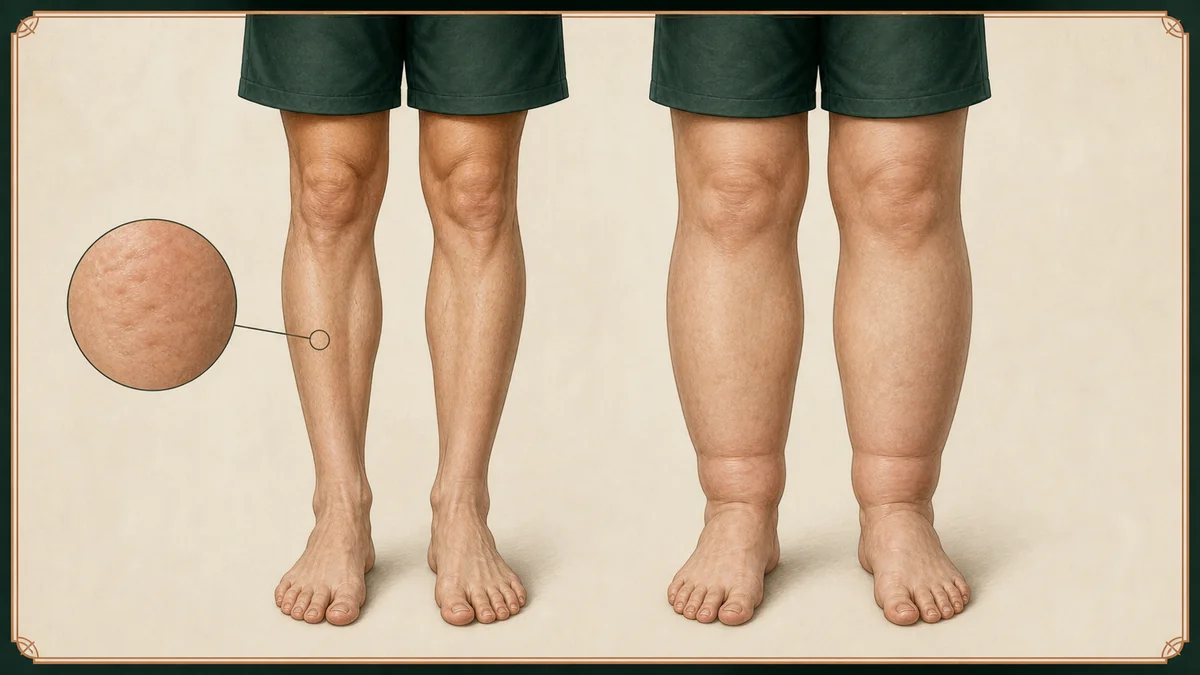
Lipedema vs cellulite is one of the most searched comparison questions when leg changes do not fit either explanation. Both terms get confused because they can appear on the thighs and lower legs, and because lipedema is often dismissed as "bad cellulite" or ordinary weight gain.
Getting the distinction right matters: the two are managed in completely different ways. This guide covers what each condition is, the signs that separate them, and what to do if your symptoms sound more like lipedema. Nothing here is a diagnosis — only an in-person clinician can confirm lipedema — but understanding the lipedema vs cellulite difference is the first step toward proper evaluation. See our is it lipedema? overview for the wider picture.
What Cellulite Is
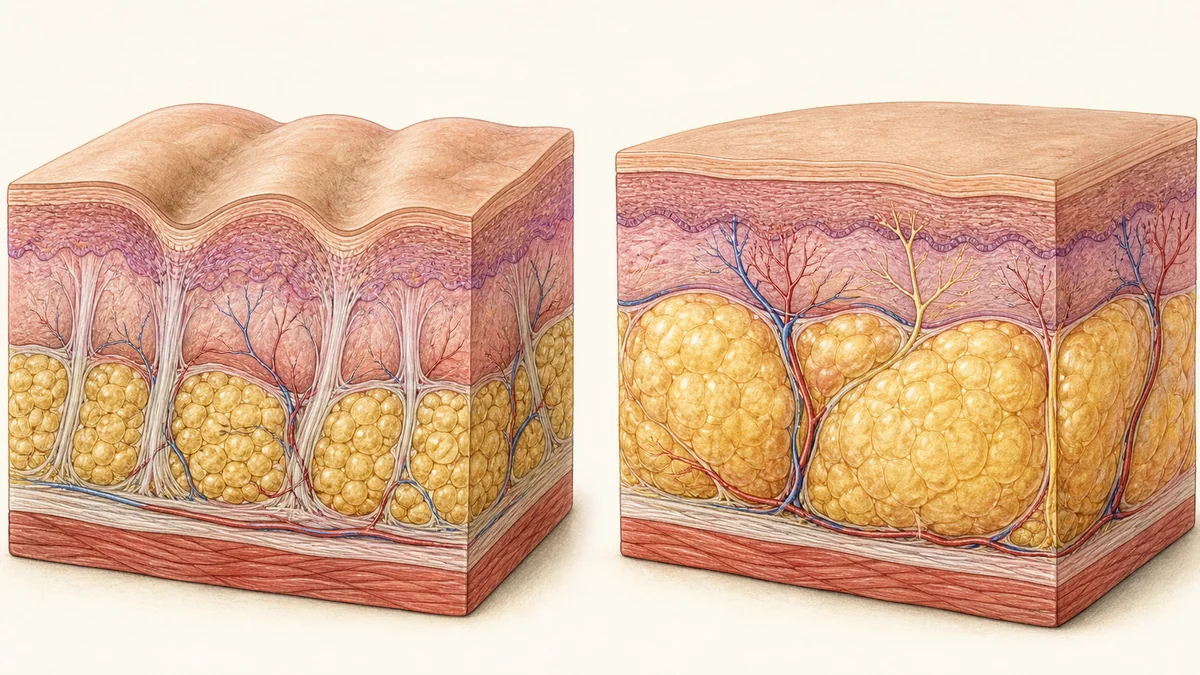
In a lipedema vs cellulite comparison, cellulite is the cosmetic side: dimpled, uneven skin texture — often compared to orange peel — that appears mainly on the thighs, hips, and buttocks. Fibrous bands under the skin pull down while fat pushes up, creating the puckered look, as described in a 2026 PMC dermatology review of fat-tissue disorders.4 It is extremely common in adult women regardless of body weight.
Cellulite is a cosmetic finding, not a medical condition. It does not hurt, cause swelling, or progress like a disease. No diagnosis is required, and no medical treatment is ever necessary.
What Lipedema Is
Lipedema is a chronic fat-tissue disorder causing disproportionate fat build-up in the legs and sometimes arms, while typically sparing the hands and feet, according to a 2021 US standard-of-care guideline led by Herbst and colleagues.2 The tissue is tender or painful, bruises easily, and develops symmetrically on both sides. It almost always affects women and often starts or worsens around puberty, pregnancy, or menopause — a pattern a StatPearls overview of lipedema links to hormonal and hereditary factors.3
Lipedema can progress over time: tissue may increase and become nodular, and advanced disease is associated with greater mobility problems, according to a 2025 clinical review.1 It is not caused by overeating, often responds differently to weight loss than ordinary fat, and has no cure — care focuses on symptom management. See our treatment options guide for details.
Continue: What is lipedema? A closer look at causes and stages →Lipedema vs Cellulite: Key Differences Side by Side
The table below summarizes the clearest lipedema vs cellulite differences. No single sign is diagnostic alone, but together they are far more useful than asking "does this look like cellulite?" by itself.
| Sign | Cellulite | Lipedema |
|---|---|---|
| Pain when pressed | Not painful | Tender or painful, especially under pressure |
| Symmetry | Often patchy, uneven | Symmetrical on both legs or both arms |
| Hands & feet | Not applicable | Usually spared — visible "cuff" at ankle or wrist |
| Bruising | Uncommon | Bruises easily, often without a clear cause |
| Texture | Smooth dimpling on the surface | Soft, nodular — often described as "peas" or "rice" under the skin |
| Diet & exercise | Appearance can improve somewhat | Often resistant — limb disproportion may persist despite weight loss |
Pain & Tenderness
Pain is a useful sign in a lipedema vs cellulite comparison, but it is not diagnostic by itself. Cellulite is typically painless to the touch, while lipedema tissue is often tender or painful when pressed — a 2026 dermatology review comparing the two conditions describes that distinction.4 If dimpled skin also hurts, mention that to a clinician by name.
Symmetry, Cuff Sign & Other Clues
Cellulite tends to appear unevenly — patchy, without a fixed pattern. Lipedema is strikingly symmetrical on both legs or arms, often with a slim upper body and larger lower half. Hands and feet are typically spared, creating a visible "cuff" at the ankle or wrist. People with lipedema also bruise easily, and the fat resists diet and exercise — Herbst et al.'s 2021 guideline documents that resistant pattern.2 Tissue may feel nodular, like small peas under the skin — a finding clinicians check during evaluation.
Continue: The pinch test explained — what it can and can't tell you →The Pinch Test — What It Adds
The "pinch test" involves gently pinching skin and tissue to feel for nodular, tender texture — and sometimes checking for pitting that may point toward lymphedema, covered in our lipedema vs lymphedema guide. It can add context to a lipedema vs cellulite self-check but is not diagnostic on its own. See our full pinch test guide for how it works and where it falls short.
During the same self-check, note whether tenderness or a cuff at the ankle appears on both sides — cellulite alone rarely produces symmetrical pain or spares the feet. If several signs overlap, write them down before an appointment rather than relying on memory; that detail helps a clinician separate cosmetic dimpling from a possible fat-tissue disorder.
Can You Have Both?
Yes — and it is common. Many adult women have some cellulite, so someone with lipedema can have both layered together. Lipedema has also historically been misclassified as severe or atypical cellulite because the conditions share some visible features, according to a 2026 dermatology review.4 If pain, symmetry, and a cuff sign are present alongside dimpling, raise lipedema by name. See lipedema or just fat legs? for a related confusion.
Why This Distinction Matters
Cellulite needs no medical treatment; lipedema can progress and may benefit from symptom-directed care. Herbst et al.'s 2021 US standard-of-care paper says treatment may reduce pain and edema, maintain mobility, and slow disease progression, making timely diagnosis important.2 A 2026 dermatology review also describes historical misclassification as cellulite and the resulting diagnostic ambiguity.4 Early recognition opens the door to conservative care before more involved options are considered — see our conservative care guide.
What to Do Next
If several signs above sound familiar, gather information a clinician can use: note when pain and swelling started, take photos over a couple of weeks, and ask about family history of similar leg shape. Ask specifically about lipedema by name rather than only describing "bad cellulite." Our how lipedema is diagnosed guide explains what that evaluation involves.
Frequently Asked Questions
-
Can lipedema look like cellulite?
Yes — early or mild lipedema can visually resemble cellulite, especially before the more distinctive signs (symmetry, tenderness, the ankle/wrist cuff) become obvious. This overlap is a major reason lipedema is frequently missed. If leg swelling or dimpling is also painful to pressure, it's worth asking a clinician about lipedema specifically rather than assuming it's ordinary cellulite.
-
Does cellulite hurt?
No. Cellulite is a cosmetic change in how skin looks on the surface, and it is not associated with pain, tenderness, or swelling. If the affected area is genuinely painful when pressed, that points away from ordinary cellulite and toward another cause — including lipedema — which is worth discussing with a clinician rather than treating as a purely cosmetic concern.
-
Can you have both lipedema and cellulite?
Yes, and it's common, since cellulite affects most adult women regardless of whether they also have lipedema. Having cellulite doesn't rule lipedema in or out, and having lipedema doesn't prevent ordinary cellulite from also being present. If you have both, each is evaluated and managed separately — see our treatment options guide for what lipedema management actually involves.
-
Does the pinch test diagnose lipedema?
No. The pinch test can pick up on the nodular, tender texture associated with lipedema, but it isn't a stand-alone diagnostic tool and it can miss subtle or early-stage cases. A proper assessment comes from a full clinical evaluation, not a self-check at home. Our pinch test guide explains exactly what it can and can't tell you.
-
Will losing weight get rid of lipedema legs?
Not on its own. Lipedema fat is resistant to diet and exercise, so a person can lose weight elsewhere in the body while lipedema-affected areas stay largely unchanged. Weight management can still support overall health, but it is not a treatment for lipedema itself — conservative care and, in some cases, surgery are what actually address the condition.
-
Is lipedema the same thing as being overweight?
No. Lipedema is a distinct medical condition, not a consequence of overeating or inactivity, even though it's frequently mistaken for ordinary weight gain or obesity. A person of any body weight can have lipedema, and the disproportionate, symmetrical, painful fat pattern it causes is different from generalized weight gain. This confusion is one of the most common reasons diagnosis gets delayed — see our guide on lipedema in slim people for more on this.