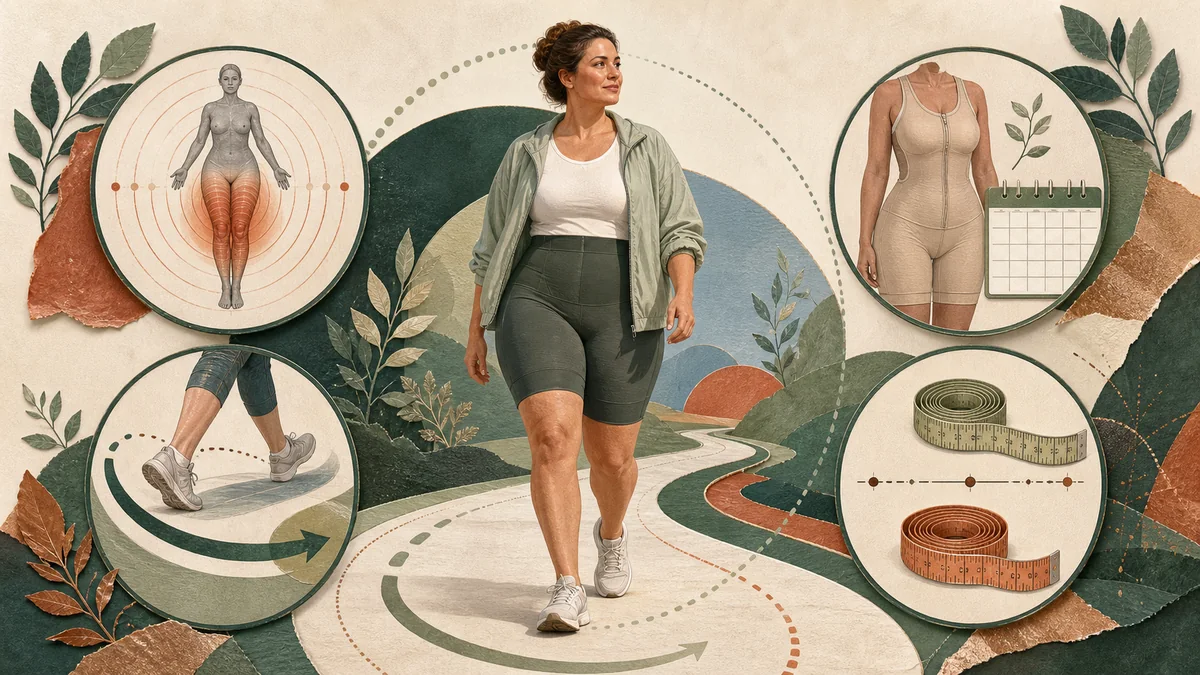
Searching "lipedema before and after surgery" or "lipedema before and after weight loss" usually means you're trying to picture what real change looks like — and that's a completely reasonable thing to want. This guide gives you that picture using published research rather than photographs, and explains directly why photos aren't part of how we present outcomes here.
For the fuller picture of the procedure itself — technique, candidacy, and recovery — see our lipedema surgery guide. If you're weighing whether surgery is oversold anywhere online, our guide to "cure" claims is a useful companion read.
What Studies Report
Published research on lipedema liposuction outcomes generally describes meaningful improvement across several measures: reduced pain, less tenderness to pressure, improved mobility, and better quality-of-life scores.1 A large observational study of 191 patients following ultrasound-assisted liposuction for lower-limb lipedema similarly reported sustained improvement in pain and limb circumference at twelve months.2 These are group-level findings from research, not a promise about what any one individual will experience — outcomes vary by disease stage, area treated, and how many sessions are completed.
It's worth noting what these studies generally measure and what they don't. Most outcome research focuses on pain scores, circumference or volume change, complication rates, and patient-reported quality of life — concrete, trackable measures rather than a subjective "before/after" impression. That's actually a more reliable way to understand results than a single photo comparison, since it accounts for a broader group of patients rather than one individual's best or worst day.
Why We Don't Publish Patient Photos
This site does not use real patient or body photography anywhere, on this page or any other, and that's a deliberate editorial policy rather than an oversight. There are three reasons. First, privacy — lipedema affects intimate, often already-stigmatized parts of a person's body and history, and publishing identifiable images carries real risk to patients regardless of consent framing. Second, body exposure — this is a medical information site, not a place designed around displaying bodies for evaluation, which we think matters for a condition already burdened by years of being looked at and judged. Third, and perhaps most practically, misleading comparison — before/after photography is uniquely easy to manipulate through lighting, posing, camera angle, and timing, in ways that distort what surgery actually did.
We'd rather describe outcomes accurately using cited research than show an image that looks more dramatic — or less — than what the data actually supports.
Continue: Lipedema surgery — techniques, candidacy, and recovery →Lipedema Before and After Surgery: Interpreting Images You See Elsewhere
You will encounter before/after photos on other sites and social media, and it's worth being a careful reader of them. Lighting can dramatically change how tissue and swelling appear. Pose and camera angle can exaggerate or minimize apparent size. The stage of swelling at the moment each photo was taken matters enormously — a "before" photo taken during a swollen flare and an "after" photo taken during a calm period can create a misleading impression that has little to do with the surgery itself. And a single comparison rarely tells you how many sessions, how much time, or what conservative care happened alongside the surgery.
None of this means every photo you see is dishonest — but it means a photo alone is a poor substitute for understanding what a staged, multi-session treatment plan actually involves. If you come across surgery outcome photos elsewhere, it's reasonable to ask what they're not showing you: how many sessions, how much time between them, and what conservative care was happening in parallel.
Weight Loss vs Lipedema Fat
A common and understandably confusing experience is losing a significant amount of weight and seeing little to no change in lipedema-affected legs or arms. This isn't a sign that something went wrong or that effort was wasted — lipedema fat is documented to be resistant to the calorie-deficit mechanism that drives ordinary weight loss, so it can remain largely unchanged even as other parts of the body change substantially, a feature documented in US standard-of-care guidance on lipedema.3 That's a matter of the tissue's physiology, not a reflection of how hard someone worked. Our lipedema diet guide explains this distinction in more depth.
Multiple Sessions Mean Gradual Change Before and After Surgery
Because lipedema surgery is almost always staged across several sessions rather than performed all at once, visible outcomes tend to build gradually, area by area, over months rather than appearing in one dramatic before/after moment. Someone reviewing their own progress midway through a staged plan is, by definition, looking at an incomplete picture — the full outcome only becomes clear once all planned sessions and recovery are complete. Our guide to sessions and staging covers what that timeline typically looks like.
Does Lipedema Progress After Surgery?
Honestly, it can. Surgery reduces existing diseased tissue in the areas treated, but it doesn't change the fact that lipedema is a chronic, progressive condition — tissue changes can still develop in untreated areas, or, less commonly, recur over time, particularly if conservative care lapses after surgery, a pattern also noted in the 2024 lipedema liposuction outcomes review.1 This is why our surgery guide emphasizes that compression and other conservative measures generally continue after the last session, not just before the first one.
This isn't meant to be discouraging — it's meant to set an accurate expectation from the start, since surprise about ongoing management tends to feel like failure, while an expected, planned-for reality doesn't. Framing surgery as one part of a longer-term management strategy, rather than a finish line, tends to produce both better long-term outcomes and less disappointment along the way.
What Multiple Rounds of Surgery Can Look Like Over Time
Because most patients treat lipedema in stages rather than a single operation, it helps to think in terms of rounds rather than one fixed "before" and "after" point. A first round typically targets the most symptomatic area — often the lower legs or thighs — with later rounds addressing arms or remaining regions once healing from the previous session is complete. Between rounds, swelling settles, tissue softens, and compression garments continue doing their part, so the true picture of change is really a series of overlapping recoveries rather than a single before/after snapshot.
Spacing between rounds commonly runs several months to allow adequate healing, and the total number of rounds depends on how many body areas are affected and how advanced the disease is at the outset. Someone with lipedema confined to the lower legs may need only one or two sessions, while more extensive involvement across legs and arms can reasonably call for three, four, or more, spread out over a year or longer. It's worth knowing this going in, since expecting a single procedure to resemble a dramatic one-time transformation sets up a comparison the actual treatment plan was never designed to match.
This staged reality is also why comparing your own results to any single photo — your own or someone else's — can be misleading partway through treatment. A limb photographed after round one, before round two has happened, isn't the finished outcome; it's a snapshot of a plan still in progress. Our lipedema surgery guide walks through how surgeons typically sequence rounds and what recovery looks like between them, and our guide to "cure" claims covers how to evaluate dramatic-sounding results you might encounter while researching your own options.
Frequently Asked Questions
-
How much improvement can I expect from lipedema surgery?
Research on lipedema liposuction outcomes generally reports meaningful reductions in pain and improvements in mobility and quality of life for many patients, though individual results vary by stage, area treated, and number of sessions. Our lipedema surgery guide covers the fuller range of factors that influence outcomes.
-
Will lipedema come back after surgery?
Surgically removed tissue is generally gone, but lipedema is a progressive condition, and new tissue changes can still develop in treated or untreated areas over time, especially without continued conservative care. This is a realistic long-term consideration covered further in our surgery guide.
-
Why don't you show before-and-after photos?
We don't publish patient or body photography anywhere on this site, out of respect for privacy, to avoid body exposure, and because before/after images are frequently staged or lit in ways that mislead. We rely on published research data and clear written explanation instead.
-
Why didn't losing weight change my lipedema-affected areas?
Because lipedema fat is physiologically resistant to weight loss in a way ordinary fat isn't — this is a documented feature of the condition, not a sign you didn't try hard enough. Our lipedema diet guide explains this distinction in more depth.
-
How many sessions does it take to see full results?
Because lipedema surgery is almost always staged across multiple sessions, visible change tends to build gradually area by area rather than appearing all at once. Our guide to sessions and staging explains typical timelines and spacing between sessions.
-
Does lipedema get worse again after surgery?
It can, particularly in areas that weren't treated or if conservative care lapses after surgery, since surgery reduces existing diseased tissue but doesn't change the underlying disease process. Continuing compression and other conservative measures after surgery is generally recommended to help protect results — see our surgery guide for more.