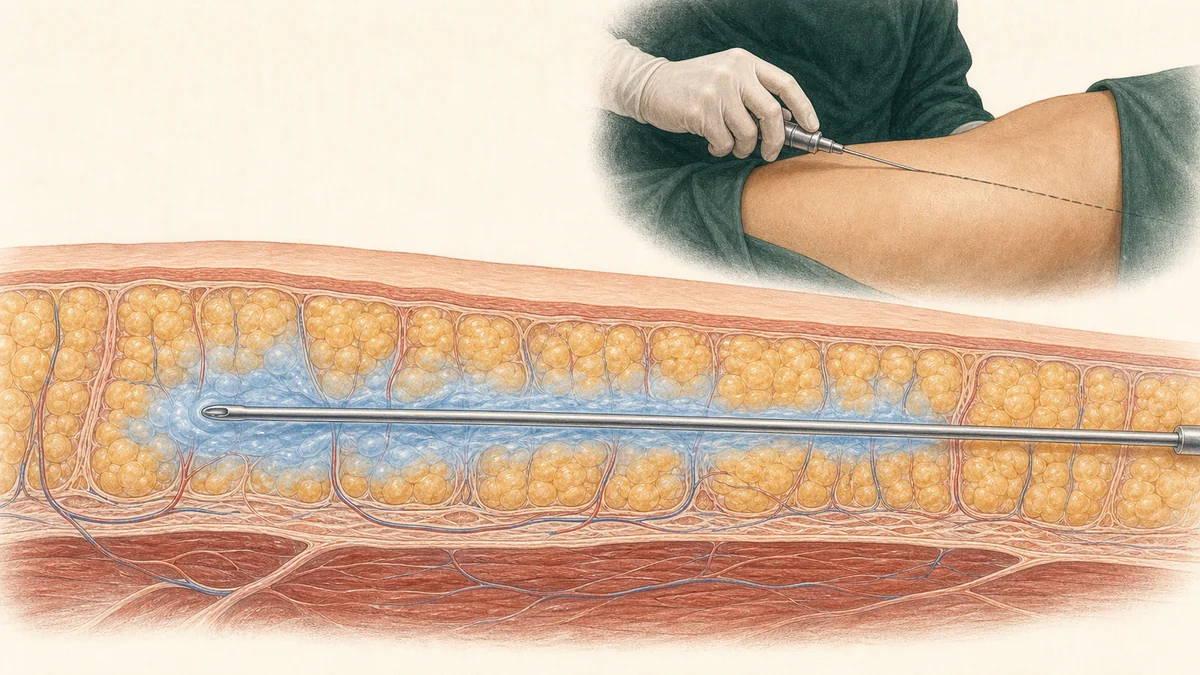
The word "tumescent" shows up constantly in liposuction content, but most explanations either oversimplify it into "the numbing shot" or overcomplicate it with clinical jargon. Tumescent liposuction is actually one specific, well-documented technique — and understanding it is the key to understanding how awake liposuction became possible at all.
This guide breaks down what the solution actually contains, how the technique numbs tissue thoroughly enough to allow a conscious patient to tolerate surgery, why it changed liposuction practice historically, and where its safety limits are. As with everything on this site, this is educational content for patients — it does not provide dosing instructions, which remain entirely the treating clinician's responsibility.
What "Tumescent Liposuction" Means
Tumescent simply means swollen, firm, or engorged with fluid. In this context, it describes what happens to fatty tissue once a large volume of anesthetic solution — far more than a typical local injection — has been infused into it. The tissue swells, becomes taut, and turns pale as blood vessels within it constrict. This physical change is deliberate: it's what allows the anesthetic to numb the area thoroughly and lets the surgeon remove fat more evenly and with less bleeding than older approaches allowed.
What's in the Tumescent Solution
A standard tumescent solution has three general components: a dilute local anesthetic (most commonly lidocaine), a vasoconstrictor such as epinephrine to narrow small blood vessels and reduce bleeding, and a large volume of sterile saline that acts as the carrier fluid. The anesthetic is deliberately diluted to a much lower concentration than you'd find in a typical dental or minor-procedure injection, precisely because such a large total volume is being infused.
This is general, educational background only — the exact formulation, concentration, and total volume used in any individual case are clinical decisions made by the treating surgical team based on the patient, the treatment area, and the planned extent of the procedure. Nothing on this page is intended as dosing guidance, and no patient should attempt to calculate or replicate a tumescent formulation themselves.
| Component | General purpose |
|---|---|
| Dilute local anesthetic (e.g., lidocaine) | Numbs the treatment area thoroughly |
| Vasoconstrictor (e.g., epinephrine) | Narrows small blood vessels, reduces bleeding |
| Sterile saline | Large-volume carrier fluid that swells the tissue |
How It Works
The mechanism has three overlapping effects. First, the sheer volume of fluid physically separates and loosens fat cells from surrounding connective tissue, making them easier to remove. Second, the diluted anesthetic diffuses evenly through the swollen tissue, providing numbing that's more thorough and longer-lasting than a smaller, more concentrated injection would achieve. Third, the vasoconstrictor narrows blood vessels in the treated area, which meaningfully reduces bleeding and bruising during and after the procedure.
Together, these effects are why a patient can remain conscious and reasonably comfortable through a procedure that, without this preparation, would be far too painful to tolerate while awake.
Why It Reduced the Need for General Anesthesia
Before the tumescent technique was described in the late 1980s, liposuction was typically performed under general anesthesia, because local numbing methods available at the time simply didn't provide enough depth or duration of anesthesia to make the procedure tolerable while conscious, according to Klein's 1990 tumescent technique paper.1 The original research demonstrated that highly dilute lidocaine, delivered in large volumes directly into the fat layer, could be used far more generously than standard local anesthetic dosing guidelines would otherwise allow — while still remaining within a safe range for the technique.
This changed liposuction practice meaningfully: instead of requiring an operating room, an anesthesiologist, and the recovery time associated with general anesthesia, many procedures could move to an outpatient setting with a much simpler anesthesia plan. That historical shift is the entire reason awake liposuction exists as a distinct category today.
Continue: What awake liposuction is and how it feels →Safety: Lidocaine Dosing and Why Limits Matter
The central safety question in tumescent liposuction is lidocaine dosing. Because tumescent technique allows for a much larger total lidocaine dose than a standard local injection, researchers have specifically studied how high that dose can safely go. Researchers later refined the original estimate, concluding that maximum safe doses can vary depending on whether liposuction is performed at the same time, since the procedure itself affects how quickly the drug is absorbed into the bloodstream, according to Klein & Jeske's 2016 dosing safety study.2
Surgical teams monitor for early signs of lidocaine toxicity — including ringing in the ears, a metallic taste, confusion, or heart rhythm changes — throughout and after the procedure, since absorption continues for hours as fluid is reabsorbed. Again, this article is not a substitute for a clinician's dosing decision; it exists so patients understand that real, researched limits exist and are taken seriously by qualified providers.
How Tumescent Liposuction Compares to Older Wet Techniques
Before the tumescent technique matured, "wet" liposuction used a modest amount of injected fluid to soften tissue, and "super-wet" liposuction pushed that volume higher — but neither approached the true-tumescent ratio, where infused fluid volume actually meets or exceeds the volume of fat being removed. That difference isn't cosmetic: the higher fluid load makes the treatment field firm enough to work through, dilutes lidocaine, and constricts small blood vessels to reduce intraoperative bleeding.
Older wet approaches, even when combined with sedation, typically still required general anesthesia for anything beyond a very small area because anesthetic coverage was more limited and blood loss was higher. Treating "wet," "super-wet," and "tumescent" as interchangeable misses why lipedema surgery today is often performed under tumescent conditions with the patient awake across staged sessions rather than in one prolonged operation. For how staged sessions work in practice, see our lipedema surgery guide.
Tumescent vs Other Approaches
Tumescent anesthesia is often combined with different mechanical methods of fat removal — including ultrasound-assisted or power-assisted devices — but those are separate questions from the anesthesia technique itself, and a deeper comparison of specific cosmetic liposuction methods is outside the scope of this site. What matters here is simply that tumescent fluid infusion is the anesthesia foundation underneath most awake liposuction, regardless of which mechanical technique is used on top of it.
Tumescent Technique in Lipedema Surgery
Tumescent technique is used especially often in lipedema surgery, and not just for anesthesia convenience. Lipedema fat sits close to lymphatic structures that surgeons want to disturb as little as possible, and the gentler, fluid-assisted separation that tumescent infusion provides is thought to support that goal better than more aggressive large-volume techniques, per a 2024 case series and narrative review.3 Because lipedema surgery is frequently staged across multiple sessions rather than one large operation, the awake, outpatient-friendly nature of tumescent technique also fits the way this specific surgery is typically planned.
These are really two related but separate questions worth untangling. For the mechanical-tool side — water-assisted and power-assisted variations, and an honest look at what "lymph-sparing" can and can't guarantee — see our lymph-sparing liposuction guide. For the anesthesia-choice side — why staying awake or lightly sedated fits lipedema's typical staged surgical plan — see our why awake technique is preferred for lipedema guide.
Frequently Asked Questions
-
What does tumescent mean?
Tumescent means swollen or firm, and it describes what happens to fatty tissue once a large volume of dilute anesthetic solution has been infused into it before liposuction. The tissue becomes taut and engorged with fluid, which numbs it thoroughly and makes it easier to remove fat evenly. Our awake liposuction overview explains how this fits into the broader procedure.
-
Is tumescent liposuction the same as awake liposuction?
They're closely related but not identical terms. Tumescent liposuction refers specifically to the anesthesia technique — the fluid infusion — while awake liposuction describes the broader experience of staying conscious during the procedure. Tumescent technique is what makes most awake liposuction possible; see our awake liposuction guide for the full picture.
-
What's actually in tumescent solution?
A typical tumescent solution combines a dilute local anesthetic (commonly lidocaine), a vasoconstrictor such as epinephrine to reduce bleeding, and a large volume of sterile saline as the carrier fluid. The exact formulation and dosing are determined by the treating clinician for each patient — this is general educational information, not a prescribing guide.
-
Is tumescent liposuction safe?
When performed within established dosing guidelines and monitored by a qualified surgical team, tumescent liposuction has a well-documented safety record dating back decades. The main risk to manage is lidocaine dosing, which has researched upper safety limits that clinicians follow. Our awake liposuction safety and limits guide covers what those limits are and how they're monitored.
-
Why is tumescent technique used for lipedema surgery specifically?
Tumescent technique is widely used in lipedema surgery because the gentler, fluid-assisted approach may help preserve fragile lymphatic structures better than more aggressive large-volume techniques — a mechanical-tool question covered in depth in our lymph-sparing liposuction guide. It also allows treatment to be staged across multiple sessions, which fits how lipedema surgery is typically planned, as our why awake technique is preferred for lipedema guide covers.
-
Does tumescent solution completely eliminate bleeding?
No, but it significantly reduces it. The vasoconstrictor in tumescent solution narrows small blood vessels in the treated area, which is one reason tumescent liposuction typically involves less blood loss than older liposuction approaches that didn't use this fluid-infusion method. Some bruising and fluid drainage after the procedure is still normal and expected.