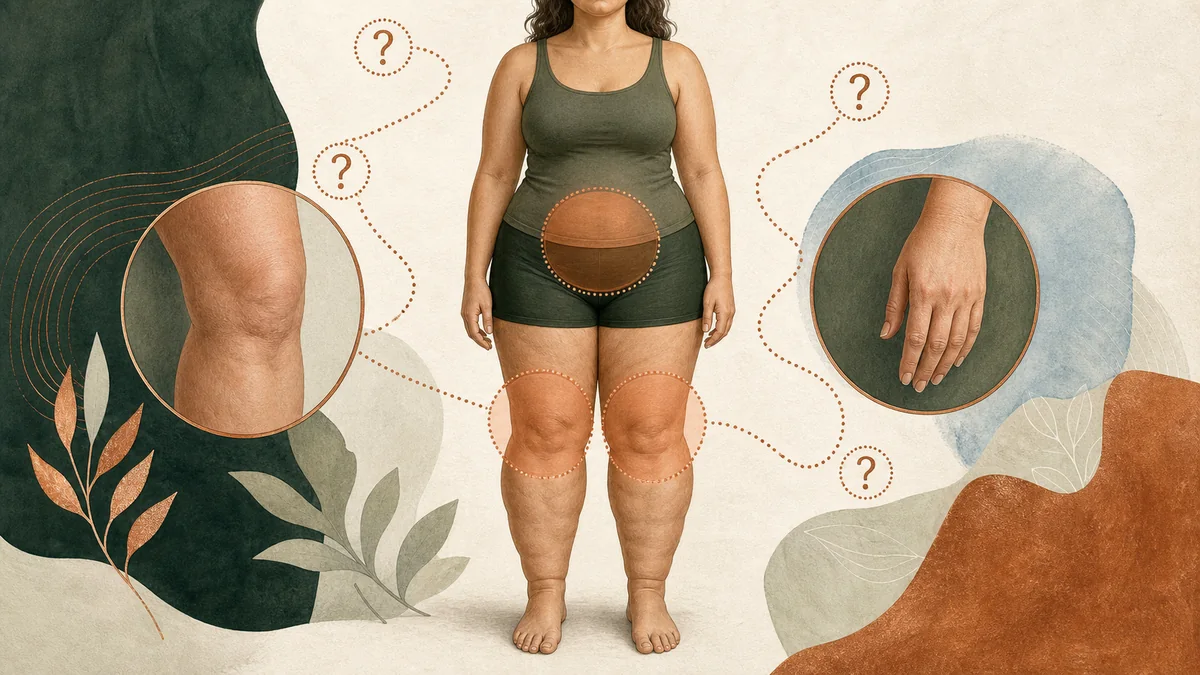
Most lipedema descriptions focus on symmetrical leg enlargement and, sometimes, the arms. That makes sense — those are the most common patterns — but it also leaves people wondering about areas that get less airtime: lipedema knees that look swollen or full, a tender abdomen, or hands that seem unaffected while the forearms above them are not. This guide addresses those specific questions. It does not replace the broader framework in our types and distribution patterns guide, which covers the full Type I–V classification.
Lipedema Knees: The Knee Fat Pad
Many people with leg lipedema describe a pad of tissue that builds up around and just above the knee, sometimes making the joint look disproportionately full compared with the rest of the leg. As it enlarges, it can interfere with bending, kneeling, climbing stairs, or sitting on low surfaces — not because the knee joint itself is diseased in every case, but because the surrounding soft tissue physically gets in the way.
Knee involvement usually appears alongside broader thigh or calf changes rather than as an isolated finding, according to descriptions in Herbst et al.'s 2021 US standard-of-care guideline.1 If knee stiffness is part of your experience, naming it specifically — "my knees feel tight when I bend" — gives a clinician more to work with than a general mention of heavy legs. Over time, extra tissue around the knee can also alter how load passes through the joint, which is one reason gait and mobility are assessed alongside tissue volume.
Abdominal Involvement
The abdomen is not part of the classic Type I–V limb-distribution system. Some people with lipedema also report tender or bruise-prone abdominal tissue, but those features are not specific enough to identify abdominal lipedema. Abdominal fat has many possible explanations and requires assessment in the context of the full clinical picture.
Abdominal fullness on its own, without symmetric leg or arm findings, is far more often general weight distribution than lipedema. When abdomen and limbs share the same tender, bruise-prone quality, that combination is worth noting together. StatPearls' lipedema overview emphasizes that diagnosis rests on the overall pattern — distribution, symmetry, tissue feel, and sparing of feet and hands — not a single body area in isolation.2
Hands: Usually Spared, But Not Always
One of the more recognizable lipedema signs is classic sparing of the hands and feet while the limbs above them enlarge, producing a "cuff" at the wrists or ankles. Sparing is common but not universal, so its absence can broaden the differential rather than rule lipedema in or out by itself. When the forearms are involved but the hands look normal-sized, that contrast can still be clinically useful.
Hand involvement does occur in a minority of cases and should be mentioned explicitly if you notice it, since it is a less typical presentation. When present, hands are assessed for symmetry, tenderness, and texture — not size alone — as described in our lipedema arms guide. Grip strength and finger mobility are practical details worth noting if hand fullness affects daily tasks.
Why Distribution Varies
Why one person develops knee-heavy leg lipedema while another has hips-only or whole-leg involvement is not fully understood, notes a 2025 clinical review of lipedema features and management.3 Genetic and hormonal influences likely play a role in both whether lipedema develops and which segments are affected, but the mechanism determining exact distribution has not been mapped.
Current evidence is not strong enough to predict whether a person's distribution will remain fixed or expand over time. Distribution type should describe the current clinical pattern, not be used as a forecast. For the Type I–V framework clinicians use alongside staging, see our distribution types guide.
Management Considerations by Area
Conservative care — compression, movement, and manual lymphatic drainage — remains the recommended foundation regardless of which areas are involved, per US standard-of-care guidance.1 Practical details differ by location: knee involvement may need garments that allow joint flexion without digging in; abdominal concerns are usually addressed through overall garment strategy rather than a dedicated abdominal sleeve alone.
Our compression garments guide and conservative care overview cover fitting in depth. If surgery is considered later, which segments are involved shapes planning — covered in our lipedema surgery guide.
Lipedema Knees: How Involvement Affects Mobility and Exercise
A knee fat pad does more than change appearance — it can shift how a joint moves through its full range. Extra tissue around and above the knee adds bulk that has to be pushed aside with every step, squat, or stair climb, which can make ordinary movements feel more effortful even when the joint itself is healthy. Over time, some people unconsciously compensate by shifting weight or shortening their stride, changes that can affect the hips and lower back as well as the knee.
This does not mean exercise should be avoided. Movement remains part of first-line conservative care, and low-impact options — walking, cycling, water-based exercise, and gentle resistance work — are generally easier on affected knees than high-impact activities like running or jumping. Water exercise in particular reduces joint loading while still supporting circulation and muscle tone, which is why many lipedema-focused physical therapy programs favor pool-based routines for people with significant knee involvement.
Footwear and bracing can also matter: supportive shoes and, in some cases, a well-fitted knee sleeve may reduce strain during activity, though any bracing decision should involve a clinician familiar with your specific presentation. Warming up gradually, avoiding deep knee flexion under load, and pacing activity to avoid next-day swelling are practical strategies many people find helpful. Our movement and exercise guide covers pacing, activity selection, and building a sustainable routine in more depth, including how to adapt common exercises when knee fullness limits range of motion.
If mobility has changed noticeably — new difficulty with stairs, a sense of instability, or pain rather than just tightness — that combination is worth raising with a clinician rather than working around indefinitely, since it may point to something beyond soft-tissue volume alone.
Distinguishing Lipedema Knee Fat From Baker's Cysts or Joint Swelling
Because lipedema knee fullness and true joint swelling can look similar from the outside, it helps to know roughly how they differ — while keeping in mind that only a clinical exam can reliably tell them apart. A lipedema-related knee fat pad is soft, subcutaneous tissue distributed fairly evenly around the knee, and it typically builds up gradually alongside similar changes in the thigh or calf. It is usually not painful to the touch in the way an inflamed joint is, though the tissue can feel tender or bruise easily.
A Baker's cyst, by contrast, is a fluid-filled swelling that forms behind the knee, often linked to an underlying joint problem such as cartilage irritation or arthritis. It tends to appear as a more localized, sometimes tense bulge in the back of the knee rather than an all-around fullness, and it can come with stiffness, a feeling of tightness when the knee is fully bent, or discomfort that worsens with activity. General joint swelling from arthritis or injury usually involves warmth, more focal pain, or a change that came on relatively quickly, unlike the slow, symmetric buildup typical of lipedema tissue.
None of these distinctions are meant to be used for self-diagnosis. Overlap is common — someone can have a lipedema knee fat pad and a Baker's cyst or early arthritis at the same time, and soft-tissue fullness can also make an underlying joint problem harder to notice. If a knee feels different from the rest of your leg pattern — more painful, warm, suddenly more swollen, or limiting in a new way — describing that specific change to a clinician is more useful than trying to categorize it yourself. Our how lipedema is diagnosed guide walks through what a clinical evaluation typically involves, including how it distinguishes soft-tissue findings from joint-related causes of swelling.
Frequently Asked Questions
-
Does lipedema affect the knees?
Yes — a distinct fat pad around and above the knee is a commonly reported feature. It can make bending, kneeling, and stair use more difficult as it enlarges, and it usually appears alongside broader thigh or calf involvement rather than in isolation. Mentioning knee-specific stiffness or tenderness helps a clinician build a fuller picture alongside leg distribution patterns.
-
Can lipedema be on the stomach?
The abdomen is not part of the classic Type I–V limb-distribution system. Abdominal fat can coexist with lipedema, but tenderness or resistance to weight change does not by itself establish abdominal lipedema. It should be assessed in the context of the full clinical pattern. See our guide on lipedema vs just fat legs for why one body area cannot answer the question alone.
-
Do hands get involved in lipedema?
Usually not — hands are typically spared even when the forearms are enlarged, producing the wrist cuff sign described in our lipedema arms guide. Occasional hand involvement does happen and is worth flagging specifically because it is a less typical presentation.
-
Is knee lipedema the same as knee osteoarthritis?
No. A lipedema-related knee fat pad is subcutaneous fat tissue change, while osteoarthritis is a joint-cartilage condition. The two can coexist and both may affect mobility, which is why describing whether the knee feels swollen from soft tissue versus painful inside the joint helps a clinician distinguish overlapping problems.
-
Why do some people have lipedema only at the knees or lower legs?
Distribution varies between individuals, and clinicians describe patterns using type frameworks — for example, lower-leg-only involvement is sometimes called Type V. Why one person develops one pattern and another develops a different one is not fully understood. Our types and distribution patterns guide explains the full classification system.