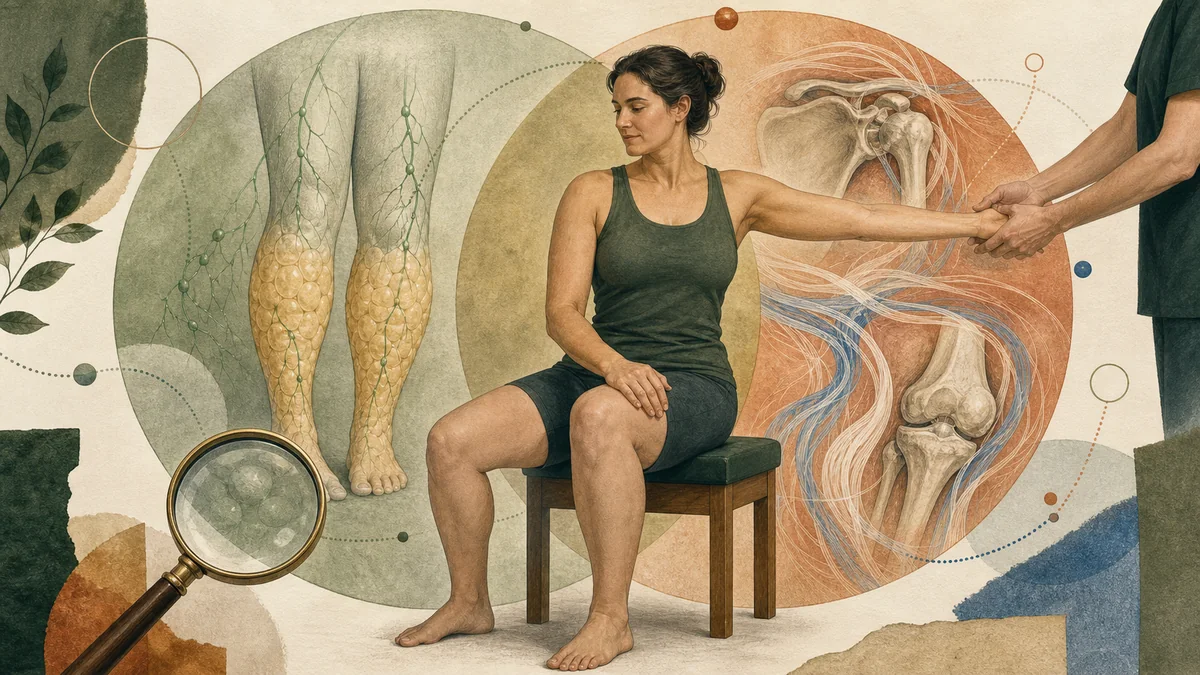
If you have lipedema and also notice unusually flexible joints, repeated sprains, or easy bruising, those features are worth discussing together during an evaluation rather than assuming they share one cause. Emerging research examines the relationship between lipedema and hypermobility spectrum disorders, including hypermobile Ehlers-Danlos syndrome. This guide focuses on what that research can and cannot establish. For lymphedema, venous disease, and obesity overlaps, see our broader related conditions guide.
What the Research Says About Lipedema and Ehlers-Danlos
Lipedema is a disorder of subcutaneous fat tissue; hypermobile Ehlers-Danlos syndrome is a connective tissue condition affecting multiple body systems. They are different diagnoses with different criteria. Existing studies report overlapping features in selected samples, but do not establish how often the diagnoses co-occur in the general population.
A 2025 cross-sectional study of people with lipedema reported substantial joint hypermobility alongside higher rates of musculoskeletal and systemic symptoms compared with a lymphedema comparison group, according to Fiengo and Sbarbati's observational research.1 Because both conditions involve differences in connective tissue — the structural scaffold supporting fat, skin, vessels, and joints — researchers have proposed that shared connective tissue biology may partly explain the overlap.
Precision matters: this is an observed pattern in a self-reported cross-sectional sample, not a proven cause-and-effect relationship. Lipedema does not cause Ehlers-Danlos syndrome, and hypermobility does not cause lipedema. The study was descriptive and cannot determine population prevalence, exclude selection bias, or establish a shared mechanism.
Overlapping Symptoms
When both conditions are present — or when hypermobility is suspected but not formally diagnosed — several symptoms can blur together:
- Chronic pain — lipedema tissue tenderness and hypermobility-related joint pain can both contribute
- Easy bruising — recognized in lipedema and common in connective tissue disorders
- Fatigue — reported frequently in both groups in research samples
- Joint instability or frequent sprains — more specific to hypermobility but sometimes dismissed when lipedema is the known diagnosis
These overlaps do not mean every symptom is "from hypermobility" or "from lipedema" — often both contribute, and sometimes neither fully explains a complaint on its own. That is why a whole-body clinical picture matters more than evaluating each symptom in isolation across separate appointments.
Continue: Why lipedema hurts — pain, tenderness & bruising →Why It Matters for Care
Knowing about a possible hypermobility overlap can change practical details without changing the overall lipedema management sequence, which still begins with conservative care per US standard-of-care guidance.2
Exercise: Hypermobile joints are more prone to strain. Low-impact, joint-stabilizing movement — swimming, recumbent cycling, supervised physical therapy — may be preferable to high-impact activity that repeatedly stresses unstable joints. Our movement guide covers general lipedema exercise principles; hypermobility may call for additional joint-protection strategies discussed with a clinician or physical therapist.
Compression: Some people with connective tissue differences find certain garment pressures or styles uncomfortable or less effective. A certified fitter familiar with both lipedema and hypermobility can adjust level, fabric, and coverage. See our compression garments guide.
Surgery: If lipedema surgery is considered after a genuine trial of conservative care, connective tissue differences may influence healing expectations and postoperative joint stability. This does not automatically rule surgery out — it means the full picture belongs in surgical planning conversations covered in our lipedema surgery guide.
What to Discuss With Your Clinician
If you have lipedema and also notice unusually flexible joints, frequent sprains, chronic joint pain beyond limb tissue tenderness, or a family history of "double-jointedness," mention these together rather than as separate, unrelated problems. Hypermobility screening is typically a straightforward physical assessment of joint range of motion during a routine evaluation — not a specialized lipedema test.
A written symptom list across body systems — joints, skin bruising, digestion, dizziness, fatigue — often gives a clearer picture than describing one complaint per visit. Our guide on how lipedema is diagnosed covers preparation for comprehensive evaluation. For what is and is not understood about lipedema origins more broadly, see what causes lipedema.
This page cannot diagnose hypermobility or lipedema. These are findings and questions to bring to a qualified clinician who can evaluate each condition on its own criteria.
Joint Symptoms Patients Commonly Report
Beyond the general overlap described above, many people living with lipedema who also have joint hypermobility describe a fairly consistent day-to-day pattern. Recognizing these patterns in your own experience is not a diagnosis — it is information worth bringing to a clinician.
Joints that "give way" without warning: Ankles that roll on flat ground, knees that feel unstable on stairs, or shoulders that seem to slip slightly out of place during ordinary movement are commonly described. These episodes are often brief and may not cause a visible injury each time, which can make them easy to dismiss until they happen repeatedly.
Pain that shifts location: Unlike a single injured joint, hypermobility-related discomfort often moves — a painful hip one week, sore wrists the next. When lipedema tissue tenderness is also present in the legs or arms, people sometimes struggle to describe which pain belongs to which condition, and clinicians benefit from hearing about both rather than just the most recent complaint.
Slower recovery from minor strains: A sprained ankle or a tweaked wrist that seems to take longer than expected to feel normal again is a pattern some patients report. This does not mean healing is impaired in a general sense — it is a specific, joint-level observation worth mentioning at an evaluation.
Fatigue tied to activity: Some people notice that a day of standing, walking, or light exercise leaves them more depleted than the activity level alone seems to explain. Because fatigue is common to both lipedema and connective tissue-related joint conditions, it is rarely diagnostic on its own, but it belongs in the symptom picture.
None of these patterns confirm hypermobile Ehlers-Danlos syndrome or any other diagnosis by themselves. They are simply the kinds of day-to-day details that help a clinician decide whether a closer joint evaluation is worthwhile. For background on what is and is not established about lipedema's origins, see what causes lipedema.
Should You Ask About Genetic Testing or Formal EDS Diagnosis
It is a reasonable question once you notice overlap between lipedema and joint symptoms: should you pursue genetic testing or a formal Ehlers-Danlos diagnosis? The honest answer depends on which type of EDS is suspected, and it is a conversation for a clinician rather than something to decide from a checklist.
Hypermobile EDS (hEDS), the subtype most often discussed alongside lipedema, currently has no identified genetic marker and is diagnosed clinically — through a structured assessment of joint mobility, skin findings, family history, and other physical criteria — not through a blood or genetic test. If a clinician suspects hEDS, genetic testing is unlikely to confirm or rule it out.
Other, rarer EDS subtypes — such as vascular or classical EDS — do have identified genetic markers, and testing can be appropriate when features suggestive of those subtypes are present, such as unusual skin fragility, distinctive scarring, or a family history of vascular complications. This is a decision made with a geneticist or physician familiar with connective tissue disorders, not a self-directed test.
If you are considering this conversation, it can help to first read about how lipedema itself is diagnosed, since a clear picture of your lipedema evaluation makes it easier to describe the full clinical context when a joint or connective tissue specialist is brought in. Bring a written history of joint symptoms, prior injuries, family history, and any patterns noticed day to day — this is more useful to a specialist than trying to self-diagnose a specific EDS subtype in advance.
This page does not diagnose Ehlers-Danlos syndrome or any hypermobility spectrum disorder. Formal diagnosis, when appropriate, belongs with a qualified clinician — often a geneticist, rheumatologist, or physician experienced in connective tissue conditions.
Frequently Asked Questions
-
Are lipedema and Ehlers-Danlos syndrome related?
Research has found a notable overlap between lipedema and hypermobility spectrum disorders, including hypermobile Ehlers-Danlos syndrome, but this is an observed association rather than a proven cause-and-effect relationship. Both involve connective tissue, which may explain why they co-occur. Having one does not mean you have or will develop the other. Our related conditions guide places this overlap in context with other common coexisting conditions.
-
Should I be screened for hypermobility?
There is no mandatory screening, but if you have lipedema alongside joint pain, frequent sprains, or unusually flexible joints, it is reasonable to raise hypermobility with a clinician. Screening is typically a simple physical assessment of joint range of motion, not a specialized test, and it can help tailor exercise and compression recommendations.
-
Does having both change my treatment plan?
It can influence specifics — joint-protective exercise, compression tolerance, surgical planning — but the core approach to lipedema, starting with conservative care, does not change. Individual adaptation matters more than a different disease pathway.
-
Can lipedema cause Ehlers-Danlos syndrome?
No. Current evidence describes co-occurrence and shared connective-tissue features, not one condition causing the other. Causality has not been established in either direction.
-
Why do pain and bruising show up in both conditions?
Both lipedema and hypermobility-related connective tissue disorders are associated with easy bruising, chronic pain, and fatigue in research samples, according to Fiengo and Sbarbati (2025). Shared symptoms can make it hard to know which condition is driving a particular complaint on a given day — another reason to describe the full picture at evaluation.