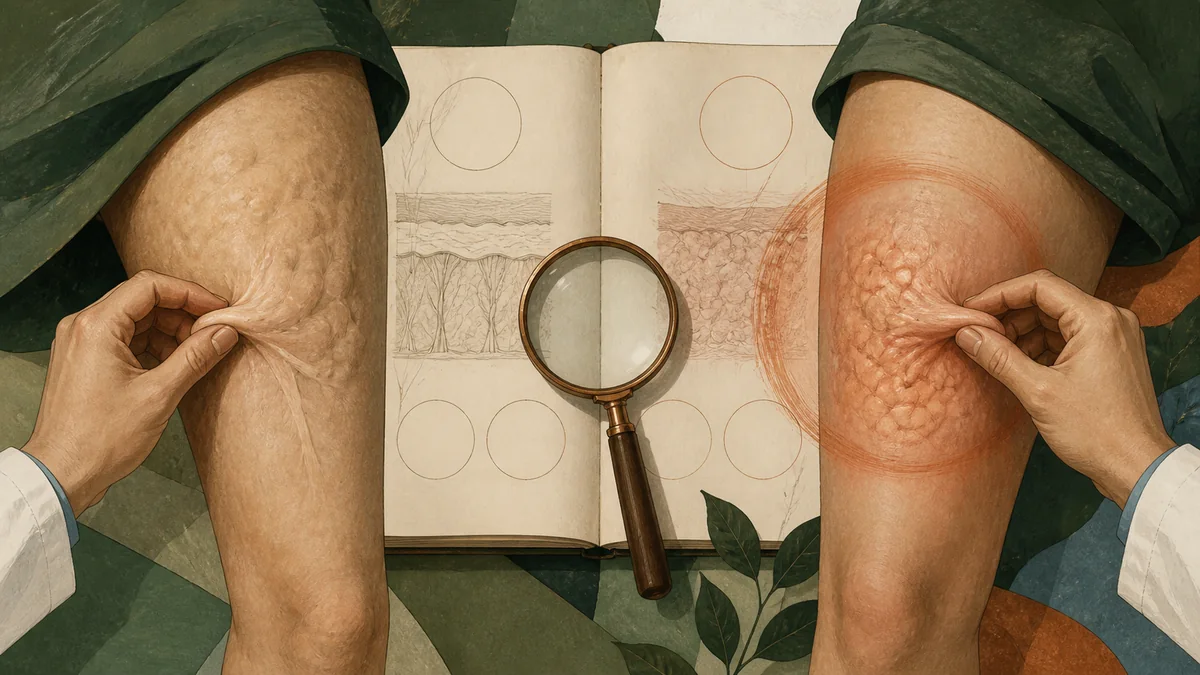
A lipedema vs cellulite pinch test comes up constantly in searches, and for good reason — it's simple, it costs nothing, and it can genuinely pick up on a real difference between the two. The catch is that it's often treated as more conclusive than it actually is.
This guide explains exactly what the pinch test checks for, what it typically feels like in cellulite versus lipedema, and — just as importantly — what it can't tell you. For the full comparison beyond this one test, see our guide to lipedema vs cellulite.
What the Pinch Test Is
The pinch test involves gently pinching a fold of skin and the tissue beneath it — commonly on the thigh, calf, or upper arm — using your thumb and fingers, then paying attention to two things: whether the area is tender or painful, and whether the tissue underneath feels smooth or has a soft, nodular quality. Some versions also check for pitting, which is more relevant to a related but distinct condition covered in our is it lipedema? overview.
It's a simple self-check, and that simplicity is exactly why it's popular — but simplicity also means it can't replace a trained clinician's hands-on assessment.
The test spread the way many self-checks do: patients shared it informally as a quick way to compare notes before an appointment, and it caught on because it doesn't require any equipment and takes seconds to try. That accessibility is genuinely useful, but it's also why the test gets overinterpreted online — a single pinch, done once, in one spot, is a small sample of a pattern that a full clinical exam looks at across multiple areas and alongside other findings.
What It Feels Like in Cellulite
When you pinch skin affected by ordinary cellulite, the surface typically dimples or puckers — the classic "orange peel" appearance — but the area is not painful or tender to the touch. The tissue underneath feels like ordinary fat: soft and even, without any nodular quality. Cellulite is a cosmetic, surface-level finding, and the pinch test reflects that: texture change on the surface, no pain underneath.
What It Feels Like in Lipedema
Lipedema tissue behaves differently under the same test. The area is often genuinely tender or painful when pinched — not just mildly sensitive — and many people describe the tissue underneath as having a soft, nodular feel, sometimes compared to small peas, rice, or marbles beneath the skin, a texture noted in US standard-of-care guidelines for lipedema.2 This texture and tenderness combination is one of the clinical signs that points toward lipedema rather than ordinary fat or cellulite.
Continue: The pinch test — a fuller explanation →What the Lipedema vs Cellulite Pinch Test Cannot Do
This is the part that gets skipped over most often: the pinch test cannot diagnose lipedema, and it cannot definitively rule it out either — a limitation acknowledged in clinical literature on lipedema features, diagnosis, and management.1 Pain sensitivity varies from person to person, early-stage lipedema tissue can feel relatively subtle, and a single self-check misses the broader pattern — symmetry, distribution, the ankle cuff sign — that a full evaluation considers together.
A "positive" result (tender, nodular) is worth taking seriously and bringing up with a clinician. A "negative" result (no tenderness, smooth) doesn't mean you can rule lipedema out on your own, especially if other signs, like disproportion or easy bruising, are also present. This page can't diagnose you either way — only a clinical evaluation can.
It also helps to know that pain thresholds genuinely vary between individuals, and stress, fatigue, or where you are in a hormonal cycle can all shift how tender an area feels on a given day. A single try that comes back mild or unclear isn't a reason to stop paying attention — trying again on a different day, and comparing notes across both legs or arms, gives a more complete picture than one quick pinch.
Other Signs Clinicians Combine It With
A clinician doesn't rely on tenderness and texture alone. During a full evaluation, the pinch test finding is considered alongside symmetry between both legs or arms, whether the hands and feet are spared (the "cuff" sign), how easily the area bruises, and whether close family members have a similar pattern, according to a StatPearls overview of lipedema.3 Together, these give a far more reliable picture than any single check, including the pinch test by itself.
Timing also matters. A clinician will typically ask when the tenderness or nodular feel started, whether it lined up with puberty, pregnancy, or menopause, and whether it has stayed roughly the same or changed over time. None of this can be captured by a single pinch, which is one more reason the test works best as one input into a larger conversation rather than a stand-alone answer.
How to Document What You Find
If you try the pinch test at home, writing down a few specifics makes the information more useful when you do see a clinician:
- Exactly where you tested (which part of the thigh, calf, or arm) and whether both sides matched.
- Whether it was tender, painful, or felt normal.
- Whether the tissue underneath felt smooth or nodular.
- Any other signs you've noticed — bruising, swelling, or a sense of disproportion.
Bring these notes to an appointment and ask about lipedema by name. Our guide on how lipedema is diagnosed explains what a full clinical evaluation adds beyond a home self-check.
Why the Pinch Test Alone Is Not Reliable in Slim People
The pinch test assumes there's enough tissue thickness to properly assess texture and tenderness, and that assumption gets shakier the leaner someone is. In people with a low overall body fat percentage, lipedema tissue can still be present, but there may be less bulk to pinch, which makes the nodular "pea" or "rice" texture harder to feel clearly through the skin. A thin pinch that comes back smooth isn't necessarily a smooth result — it might just be a thin one.
This matters because lipedema is often assumed to affect only people who are overweight, when in fact it can appear in slim individuals with a disproportionate lower body compared to their upper body. Our guide on lipedema in slim people goes into more detail on why this presentation gets missed so often, both by patients doing a home self-check and, at times, by clinicians unfamiliar with the condition.
Tenderness can also be harder to judge in slim people, since there's less padding between the skin and underlying muscle, and ordinary pinching of any thin area can feel slightly uncomfortable regardless of tissue type. If you're lean and a pinch test feels inconclusive either way — not clearly painless, not clearly nodular — that ambiguity itself is worth mentioning to a clinician rather than treated as a "negative" result. Disproportion, symmetry, and family history often carry more weight than the pinch test in these borderline cases.
Frequently Asked Questions
-
Does a painful pinch test mean lipedema?
A painful pinch test is a meaningful clue, but it doesn't mean lipedema on its own. Pain on pinching is one of several signs clinicians look at, alongside symmetry, the ankle cuff sign, and tissue texture. If the pinch test hurts, it's worth mentioning specifically to a clinician rather than treating it as a confirmed answer — see our diagnosis guide for what comes next.
-
How do I do the pinch test?
Gently pinch a fold of skin and the tissue underneath — often on the thigh or calf — using your thumb and fingers, and notice two things: whether it's tender or painful, and whether the tissue underneath feels smooth or has a soft, nodular texture. This is a self-check for information only, not a substitute for a clinical evaluation.
-
Is the pinch test reliable?
It's a useful piece of information but not a reliable stand-alone diagnostic tool. The pinch test can miss subtle or early-stage lipedema, and pain sensitivity varies between people, so a normal-feeling pinch test doesn't rule lipedema out. A full clinical evaluation, not a home self-check, is what actually confirms a diagnosis.
-
Can cellulite ever feel tender when pinched?
Ordinary cellulite is not typically tender when pinched — its defining feature is a surface texture change without pain. If pinching an area with dimpled skin also produces real tenderness or soreness, that combination points away from simple cellulite and toward another cause worth discussing with a clinician, as explained in our lipedema vs cellulite guide.
-
What should I do after a positive pinch test result?
Write down what you noticed — where it was tender, what the texture felt like, and whether it was symmetrical — and bring those details to a clinical evaluation. Our guide on how lipedema is diagnosed explains what a full assessment involves beyond a home pinch test.
-
Can the pinch test tell lipedema apart from lymphedema too?
Not reliably on its own. The pinch test mainly picks up tissue tenderness and nodularity, which are more specific to lipedema, while lymphedema is better distinguished by pitting swelling and whether the feet are involved. A clinician typically checks for both patterns together during a full evaluation.