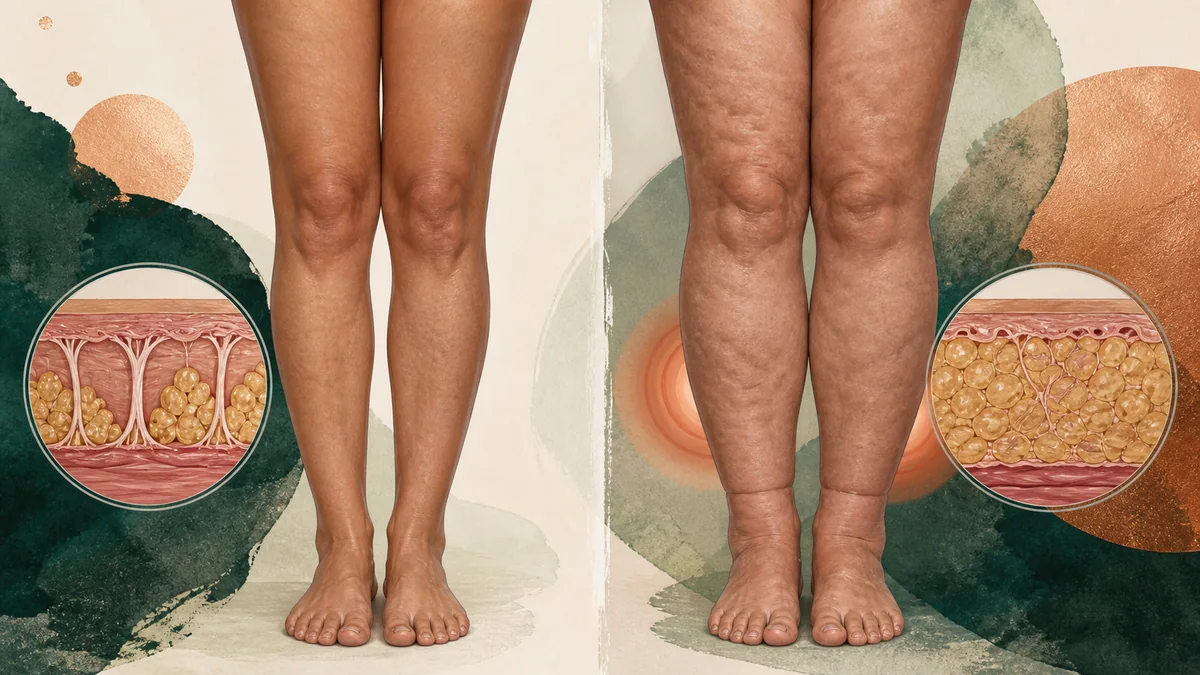
Your legs can tell more than one story at once, and cellulite and lipedema are two of the most commonly confused. Both can involve dimpled or uneven-looking skin on the thighs and calves, which is exactly why so many people searching "cellulite vs lipedema" end up unsure which one actually describes what they're seeing. Sorting out lipedema legs vs cellulite comes down to a handful of concrete, checkable signs rather than a single glance in the mirror.
This guide focuses specifically on reading the signs on your legs — a quick comparison, the single most useful test, and what actually does (and doesn't) separate the two. For the fuller picture beyond the legs, see our guide to lipedema vs cellulite.
Lipedema Legs vs Cellulite: Quick Comparison Table
| Sign | Cellulite | Lipedema |
|---|---|---|
| Pain when pressed | Not painful | Often tender or painful |
| Where it appears | Skin surface | Deeper fat tissue |
| Symmetry | Often patchy | Bilateral, both legs alike |
| Ankles & feet | No sparing pattern | Often spared — visible "cuff" |
| Diet & exercise | Can improve somewhat | Resistant to change |
Surface Appearance vs Deep Tissue
Cellulite is, by definition, a surface phenomenon — fibrous bands under the skin pull down on the surface while fat pushes up between them, creating a dimpled look that sits right at skin level, as described in a 2025 update on lipedema pathophysiology and therapeutic strategies.2 Lipedema is a deeper story: the fat tissue itself is structurally different, and the visible effect is less about surface texture and more about overall shape, volume, and disproportion between body regions. A leg can have cellulite's surface dimpling, lipedema's deeper disproportion, or both layered on top of each other.
This is a useful mental model when you're trying to sort out what you're looking at: ask whether the change you're noticing is mainly about the surface of the skin, or about the underlying shape and volume of the limb itself. Surface dimpling that comes and goes with hydration or muscle tone points toward cellulite. A shape change that has been building gradually, especially if it doesn't match the rest of your body's proportions, points toward something happening at a deeper tissue level.
Continue: The pinch test for lipedema vs cellulite →The Pain Test
If you only check one thing, check for pain. Pressing on cellulite-affected skin — no matter how visually pronounced the dimpling is — should not hurt. Lipedema tissue, by contrast, is frequently tender or genuinely painful under the same kind of pressure, often described as a dull ache that's worse by the end of the day, consistent with clinical literature on lipedema features, diagnosis, and management.1 This single distinction resolves more confusion than almost any other sign on this list.
Symmetry and Where It Stops
Cellulite tends to be uneven — more noticeable on one thigh than the other, in patches, without a consistent pattern. Lipedema is strikingly symmetrical, affecting both legs to a similar degree, and it has a clear stopping point: the ankles and feet are typically spared even as the calves and thighs above them enlarge, creating a visible "cuff." Cellulite has no equivalent boundary — it can occur anywhere fat is present, feet included, with no sparing effect.
What Doesn't Distinguish Them
A few common assumptions don't actually separate cellulite from lipedema, and relying on them can lead to the wrong conclusion:
- Weight — both conditions occur across the full range of body weights; being slim doesn't rule lipedema out, and being at a higher weight doesn't confirm it.
- Age — cellulite becomes more common with skin aging, but it isn't exclusive to any age group, and lipedema's hormonal triggers (puberty, pregnancy, menopause) span a wide age range too.
- Exercise habits — regular exercise can reduce overall body fat and soften cellulite's appearance somewhat, but it does not shrink lipedema-affected tissue, so being fit doesn't rule lipedema out, per US standard-of-care guidelines for lipedema.3
Leaning on any of these alone tends to produce the wrong read. Pain, symmetry, and the cuff sign are far more reliable than weight, age, or fitness level.
It's worth being explicit about this because so much of the confusion around cellulite and lipedema traces back to exactly these assumptions. A slim, active person can still have lipedema; a person carrying more overall weight can still have ordinary cellulite without any underlying condition at all. Sorting the two out means looking at the specific signs covered in this guide, not making inferences from body size or lifestyle.
Next Steps
If the pain test and symmetry check both point toward lipedema, the next step is a clinical evaluation, not a firm conclusion drawn from this guide. Note when you first noticed the pattern, whether relatives have a similar leg shape, and whether the tenderness is consistent — then bring those details to a clinician and ask about lipedema by name. Our guide on how lipedema is diagnosed explains exactly what that evaluation involves.
If your legs mostly show surface dimpling without pain, symmetry, or the cuff sign, that combination is far more consistent with ordinary cellulite, and there's no medical need to pursue further evaluation on that basis alone — cellulite is a cosmetic finding, not a health concern. Either way, checking the signs methodically, rather than guessing from a single glance, is what actually moves you toward a useful answer.
What About Cellulite on Other Body Areas Besides Legs
Legs get most of the attention in this comparison, but cellulite is not a leg-only phenomenon, and neither is lipedema confined to the calves and thighs. Cellulite's surface dimpling most commonly shows up wherever there is subcutaneous fat close to skin that is anchored down by fibrous bands — the buttocks, hips, lower abdomen, and upper arms are all common sites, and the same painless, patchy, texture-only pattern applies there as it does on the legs. If dimpling on your arms or abdomen behaves the same way — no tenderness, no swelling, no disproportion relative to the rest of your frame — that's consistent with ordinary cellulite rather than a sign of something more.
Lipedema, by contrast, typically follows a more specific regional pattern. It most often affects the legs from the hips to the ankles, and in many people it also involves the arms from the shoulders to the wrists, again with the hands spared in a "cuff" much like the ankle sign described earlier in this guide. It generally does not affect the abdomen, chest, face, or feet, which is one reason clinicians pay close attention to exactly which body regions are enlarged and which are spared when working through an evaluation. A person can have lipedema in the legs and arms while having ordinary cellulite, independently, on the abdomen or buttocks — the two are simply not related to each other by location.
This distinction matters because self-checking a single area in isolation can be misleading. If you're working through the pain, symmetry, and cuff-sign checks described above for your legs, it can help to also note whether your arms show a similar pattern, since bilateral arm involvement alongside leg involvement strengthens the case for asking a clinician about lipedema specifically. Our lipedema vs cellulite guide covers how these patterns extend beyond the legs in more detail, including how clinicians think about regional distribution during an evaluation.
Frequently Asked Questions
-
Can cellulite be painful?
No, not as a general rule. Cellulite is a cosmetic, surface-level skin change, and it isn't associated with pain, tenderness, or swelling. If your legs have dimpled skin that is also genuinely painful to press, that combination points away from ordinary cellulite and toward another cause worth asking a clinician about — see our lipedema vs cellulite guide.
-
Does lipedema look lumpy?
It can. Lipedema tissue is often described as feeling nodular or lumpy underneath the skin — sometimes compared to peas or rice — even when the skin surface itself looks relatively smooth, especially in earlier stages. This is different from cellulite's surface dimpling, which is visible on top of the skin rather than felt underneath it. Our pinch test guide explains how to check for this texture.
-
Can both cellulite and lipedema be present on the same legs?
Yes, and it's common. Cellulite affects most adult women regardless of whether they also have lipedema, so the two frequently overlap on the same legs. Having cellulite doesn't rule lipedema in or out, and each is evaluated and managed separately by a clinician.
-
Does weight loss help tell them apart?
It can offer a clue but isn't definitive on its own. Cellulite's appearance can improve somewhat with body-fat reduction, while lipedema fat is well documented to resist diet and exercise. If your legs stay disproportionately large despite weight loss elsewhere, that pattern is worth mentioning specifically at a clinical evaluation.
-
Is age a reliable way to tell cellulite and lipedema apart?
No. Cellulite can appear at almost any adult age and becomes more common with skin aging, while lipedema tends to start or worsen around specific hormonal windows like puberty, pregnancy, or menopause — but neither pattern is exclusive to one age group. Pain, symmetry, and the cuff sign are more reliable indicators than age alone.
-
What's the single best sign to check first?
Pain on pressure is generally considered the most useful single sign. Cellulite, however visually pronounced, is not painful to the touch, while lipedema tissue is often tender or genuinely painful — a detail worth checking before looking at symmetry or the ankle cuff sign, which are covered in our lipedema vs cellulite guide.